Key Takeaways & Executive Findings
- •• A mild and safe organic acid etching method using acetic acid/acetate solution was developed for synthesizing Mo2CTx MXene, replacing hazardous HF-based etching. • The resulting Mo2CTx nanosheets exhibit acetate termination and high specific surface areas of 18.1 m²/g (NaAc+HAc) and 14.1 m²/g (KAc+HAc), far exceeding conventional methods. • As an anode material for lithium-ion batteries, it delivers a specific capacity of 108 mA·h/g at 100 mA/g after 100 cycles, outperforming HF-etched Mo2CTx. • This work provides a scalable, environmentally friendly route to high-performance MXenes with enhanced energy-storage potential.
Abstract
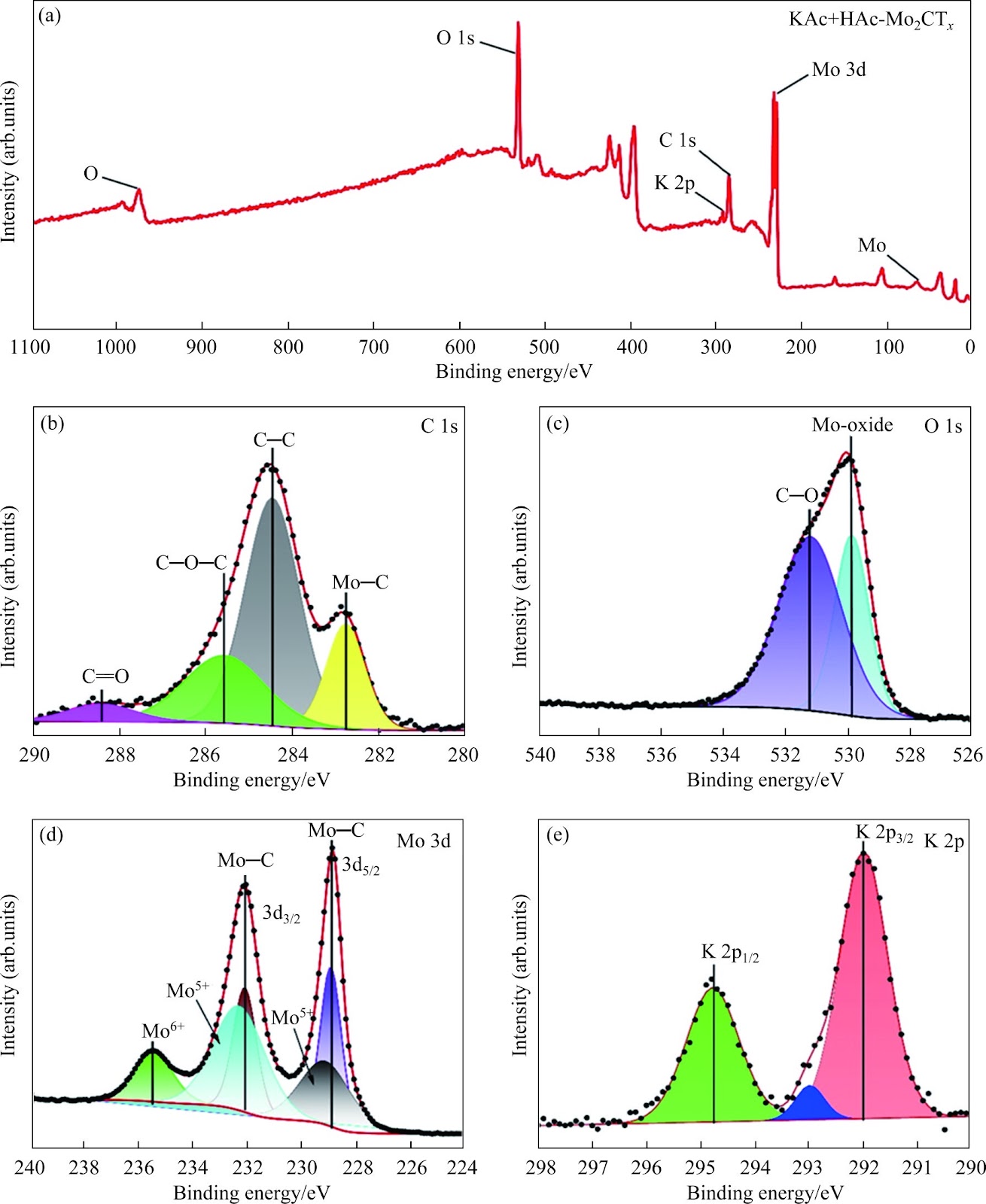
Mo2CTx MXene is a novel two-dimensional material, which is generally made by the etching of inorganic acid solutions, such as hydrofluoric acid (HF) or hydrochloric acid (HCl). Those solutions are always corrosive and hazardous. In this paper, a mild organic acid, acetic acid (CH3COOH), was selected to synthesize Mo2CTx MXene. 30 mL acetic acid (HAc) with the concentration of 13 mol/L was mixed with 2 g acetate (CH3COONa or CH3COOK) and 10 mL water to make etching solution (NaAc+HAc or KAc+HAc). In the solution, the concentration of CH3COO− was 10 mol/L, the concentration of Na+/K+ is 0.6/0.5 mol/L. The pH value is 2.8. Mo2CTx was obtained by hydrothermal etching at 240 ℃ for 1 d. Compared with the general method of HF etching, the etchant is milder and the etching process is safer. On the surface of Mo2CTx nanosheet made by this method, acetate group (CH3COO−) was adsorbed as termination, which is larger than the F/O/OH termination of that made by general HF etching. The lattice parameter c (LPc) of Mo2CTx etched with NaAc+HAc/KAc+HAc is 21.09 Å/20.89 Å. Moreover, the specific surface areas of the samples etched by NaAc+HAc and KAc+HAc were 18.1 m2/g and 14.1 m2/g, respectively, which were much larger than those etched by conventional methods. As the anode of lithium-ion battery, the specific capacity under current density of 100 mA/g at 100th cycle was 108 mA·h/g, which is higher than the capacity of samples made by general HF etching. This work reports a novel method to make Mo2CTx MXene by the solution of mild acetic acid. The samples made by this method had very high specific surface area and relatively high lithium-storage performance.
1. Introduction
The synthesis of two-dimensional (2D) materials is remarkable significant for the research these materials [1−3]. The applications are also very broad, including energy storage, catalysis [4, 5], electrochemical [6, 7], etc [8−11].
MXene is a 2D material obtained by selectively etching the A layer in the MAX phase [12−14]. MAX phases are carbides/nitrides/carbonitrides with the formula of Mn+1AXn, where “M” is early transition element, “A” is A group element, “X” is for C and/or N [15−17]. The Ti3C2Tx MXene was the first and most studied MXene to be created, which is made by removing Al layer from Ti3AlC2 by etching of hydrofluoric acid (HF) [12, 18, 19]. Subsequently more and more scholars have attempted to prepare MXene using safer methods [20−22]. The surface of MXene made by HF etching always terminated by F/OH/O or with inorganic elemental end groups when using other etching methods [23]. MXenes exhibits excellent lithium-storage performance as anode of lithium-ion-batteries (LIB) [24, 25]. Mo2CTx is another member of MXene [26−31], which is made from Mo2Ga2C [32, 33]. Compared with other MXenes, Mo2CTx MXene has better thermal stability [34, 35], higher thermoelectric performance [36, 37], and higher catalytic performance [38−41]. The first method to make Mo2CTx is the etching by HF [42]. Thereafter, other etching solutions were also used for the synthesis of Mo2CTx, such as fluorides+HCl [29], HCl [43], HBr [44], NH4HF2 [28]. All those etchants are inorganic acid solutions. The acid group ions (F/Cl/Br…) are small and the acids are highly corrosive and hazardous. Different with those inorganic acid, organic acids have rarely been used for the synthesis of MXene. Compared with those inorganic acid, organic acids are generally milder and safer [45]. The organic acid group ions are larger, which can terminate on the surface of MXene. Due to the larger termination, the specific surface area (SSA) of the MXene is increased and, in turn, the performance is changed.
In this paper, acetic acid (CH3COOH, HAc) was selected as etchant to synthesize Mo2CTx MXene. This is a very mild and safe acid, which can be used as additive of food. In previous research [44], it is found that Mo2CTx is not easily made by the etching of mild acid (for example, HBr). However, the mixture of the acid with …
Loading authentic research manuscript (Pages 1–5)...
Zhang Guang-lei, Du Ya-qiong, Guo Yi-tong, Liu Han, Wang Li-bo, Jiang Ji-zhou, Zhou Ai-guo (2025). Preparation of Mo2CTx MXene with high specific surface area by etching of acetic acid/acetate solution. Journal of Central South University. https://doi.org/10.1007/s11771-025-5940-4
Research & Educational Purpose Only:The translations, structured abstracts, analytical annotations, and data reports provided by SinoTechIntel are intended exclusively for academic research, internal corporate R&D, and educational benchmarking. They do not constitute formal engineering, chemical safety, legal, or professional advice.
Copyright & Intellectual Property Notice: Original copyright of the underlying source articles and experimental data remains with the respective authors, institutions, and original publishing journals. SinoTechIntel claims intellectual property only over its proprietary translations, analytical syntheses, and AEO structured enhancements in accordance with international fair use and academic citation principles.
Frequently Asked Questions
What is Mo2CTx MXene?
Mo2CTx is a two-dimensional MXene material derived from Mo2Ga2C by selective etching of the Ga layer. It exhibits high thermal stability, thermoelectric performance, and catalytic activity.
How is Mo2CTx synthesized in this study?
The paper reports a mild etching method using an acetic acid/acetate solution. A mixture of 30 mL acetic acid (13 mol/L), 2 g acetate (CH3COONa or CH3COOK), and 10 mL water is used for hydrothermal etching at 240 °C for 1 day.
What are the advantages of using acetic acid over conventional HF etching?
Acetic acid is a mild, safe organic acid (food additive) compared to corrosive and hazardous HF. The resulting acetate termination is larger, leading to higher specific surface area.
What specific surface area was achieved?
The specific surface areas were 18.1 m²/g with NaAc+HAc and 14.1 m²/g with KAc+HAc, much higher than those achieved by conventional etching methods.
How does Mo2CTx perform as an anode in lithium-ion batteries?
It delivered a specific capacity of 108 mA·h/g at a current density of 100 mA/g after 100 cycles, which is higher than that of samples made by general HF etching.
Related Technical Papers & Translations
Design and optimization of a high-efficiency distillation process for cellulosic fuel ethanol integrated with thermal coupling and molecular sieve adsorption
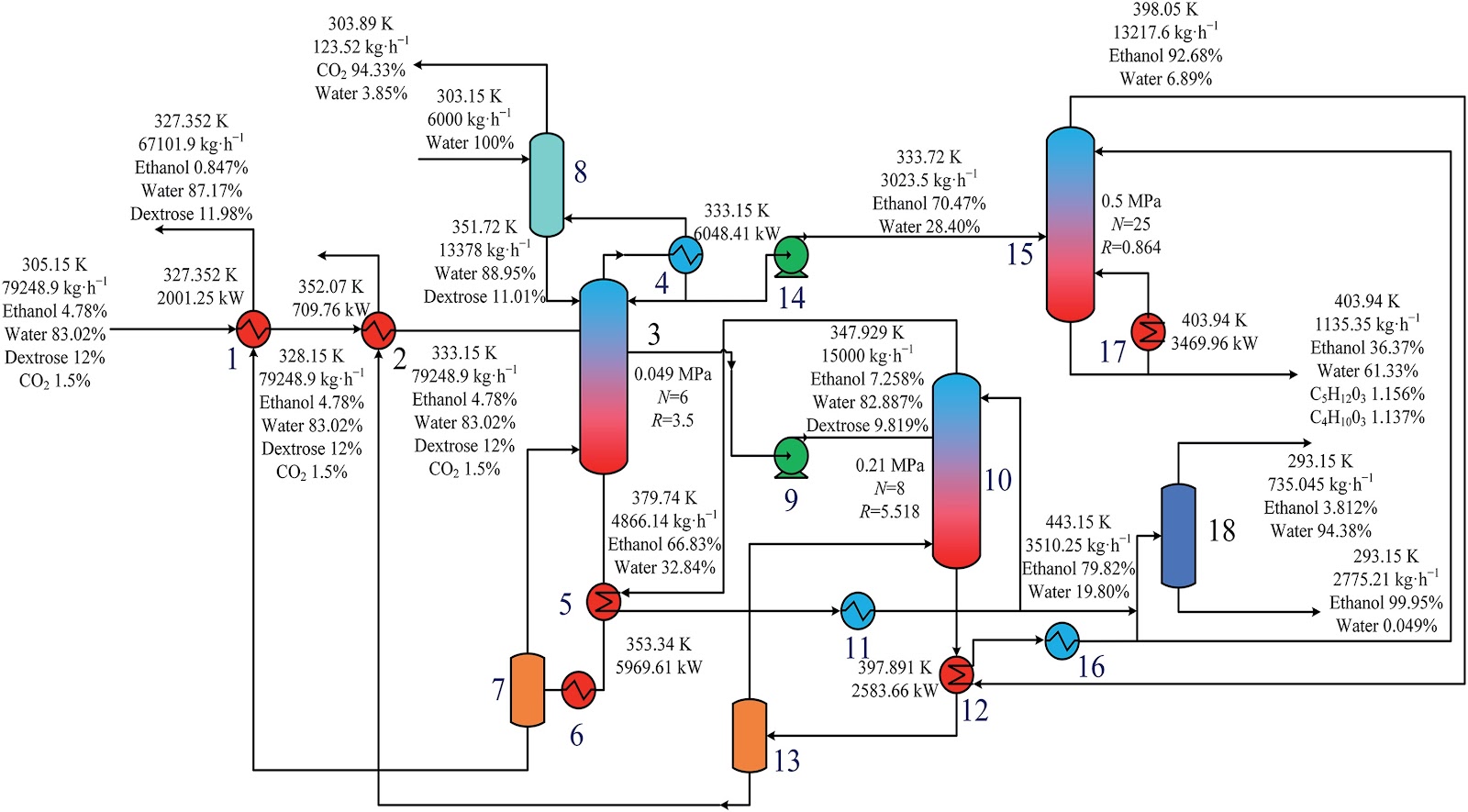
To address the challenges of high energy consumption and prominent costs in the traditional three-columns distillation process for cellulosic fuel ethanol, a distillation—molecular sieve coupling separation process is proposed. This process integrates a three-column (crude distillation column, first distillation column, second distillation column) system with a 3A molecular sieve adsorption deep dehydration unit. A thermal coupling network is constructed via differential pressure design (steam from medium/high-pressure columns as mutual heat sources, reboiler liquid waste heat for feed preheating), and molecular sieve adsorption conditions are optimized. The study first performs a thermodynamic consistency test on the ethanol—water system, determines optimal non-random two-liquid (NRTL) model binary interaction parameters via experimental data regression for Aspen Plus simulation. Aiming at minimum total annual cost (TAC), Aspen Plus is used to optimize process parameters (theoretical tray number, feed location, reflux ratio, side-draw position, etc.). Economic analysis shows this process reduces CO2 emission costs by 27.56%, TAC by 15.58% (to 5.123 × 10⁶ USD·a-1), and increases ethanol purity to >99.6%, providing an effective solution for green, efficient separation.
A cohesion loss model for determining residual strength of deep bedded sandstone
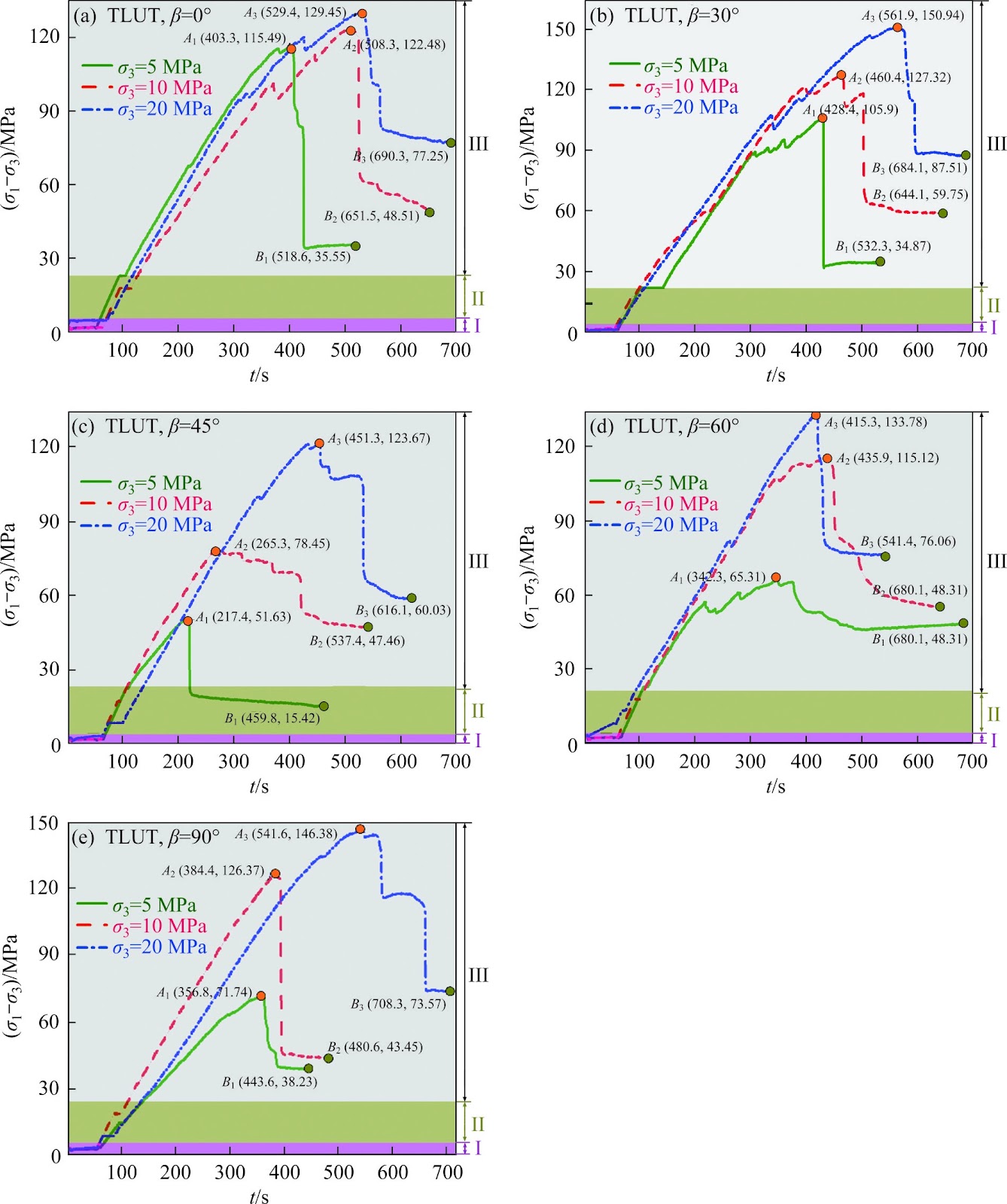
Rock residual strength, as an important input parameter, plays an indispensable role in proposing the reasonable and scientific scheme about stope design, underground tunnel excavation and stability evaluation of deep chambers. Therefore, previous residual strength models of rocks established were reviewed. And corresponding related problems were stated. Subsequently, starting from the effects of bedding and whole life-cycle evolution process, series of triaxial mechanical tests of deep bedded s
Federated model with contrastive learning and adaptive control variates for human activity recognition
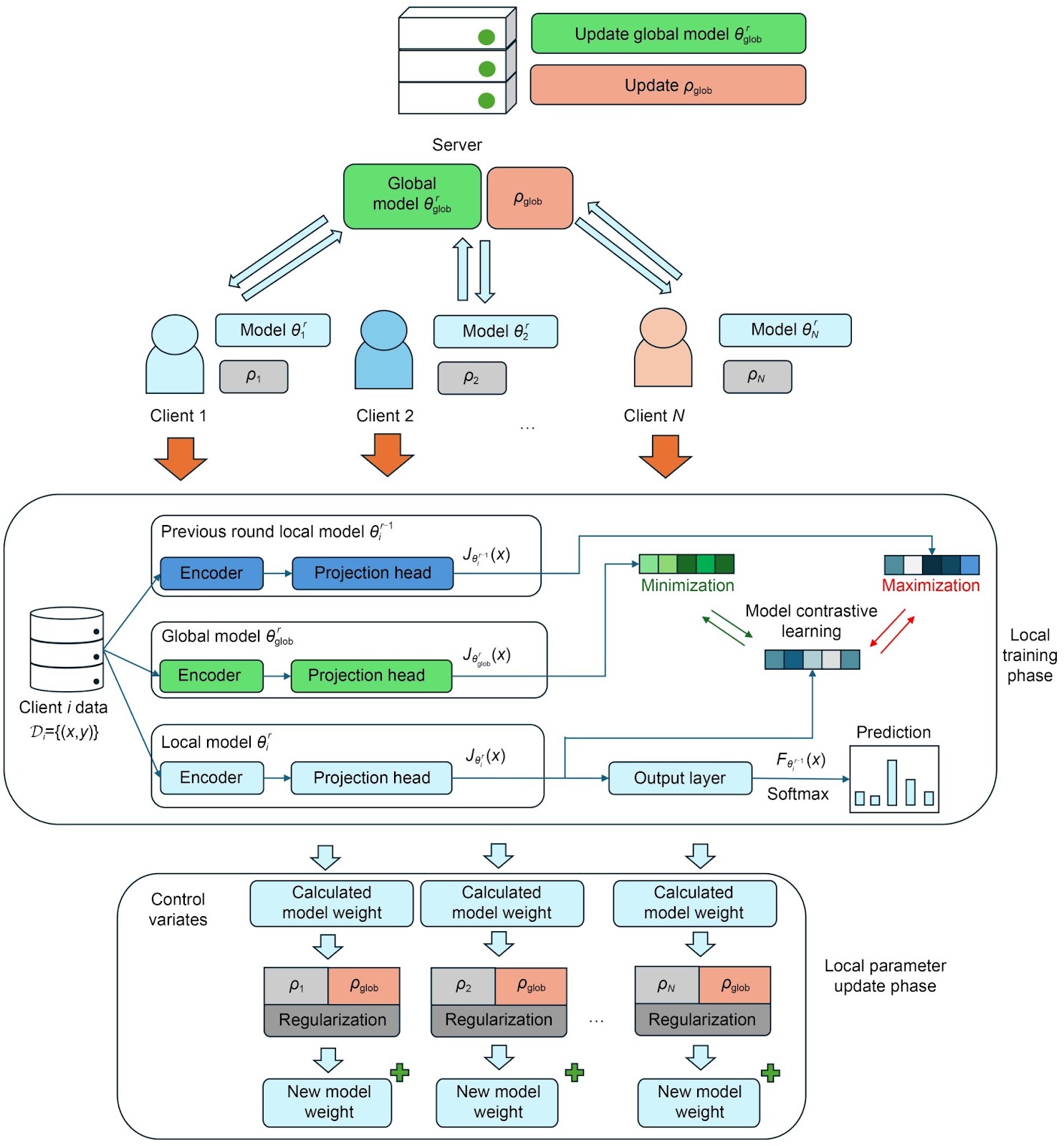
Recent attention to privacy issues demands a communication-safe method for training human activity recognition (HAR) models on client activity data. Federated learning (FL) has become a compelling technique to facilitate model training between the server and clients while preserving data privacy. However, classical FL methods often assume independent and identically distributed (IID) data among clients. This assumption does not hold true in practical scenarios. Human activity in real-world scena