Key Takeaways & Executive Findings
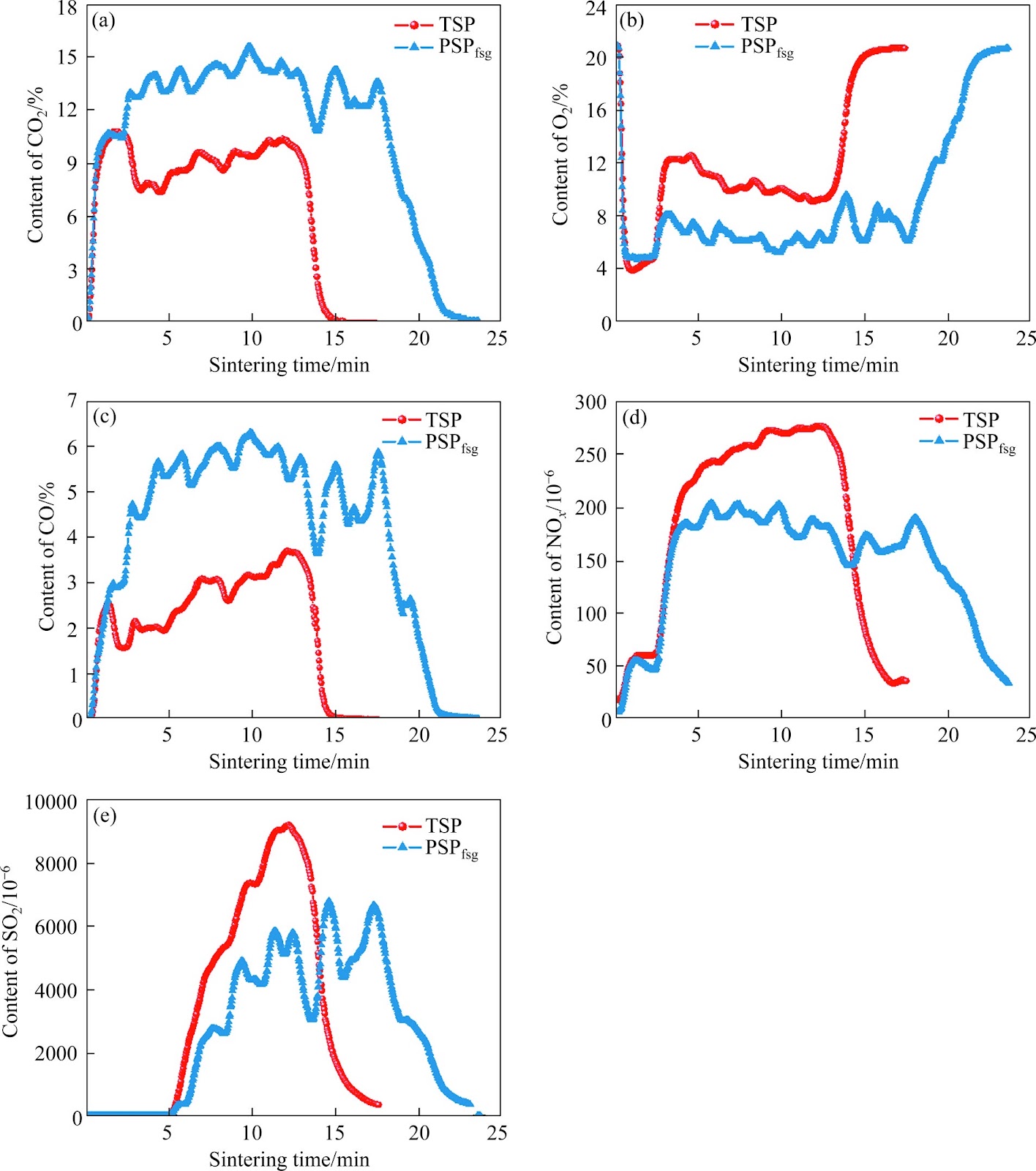
- •• Pre-reduction sintering removes 58.02% of K and 30.68% of Na from raw mixtures while improving yield to 74.40% and tumbler index to 68.69%. • Flue gas recirculation further boosts alkali removal to 74.11% for K and 32.92% for Na while recycling CO. • The process reduces NOx and SO2 emissions and increases CO content in flue gas, contributing to lower overall emissions. • Pre-reduced sinter consists mainly of magnetite, wustite, and small amounts of metallic iron, with minimal silicate glass phase, enabling simultaneous alkali removal and emission reduction.
Abstract
A pre-reduction sintering process with flue gas recirculation (PSPfsg-FGR) was developed to mitigate alkalis harm to the blast furnace and reduce the flue gas emission in the whole ironmaking process. The results indicated that the pre-reduction sintering process (PSP) can effectively remove 58.02% of K and 30.68% of Na from raw mixtures and improve yield and tumbler index to 74.40% and 68.69%, respectively. Moreover, PSP was conducive to reducing NOx and SO2 emissions and simultaneously increasing CO content in flue gas. Circulating CO-containing flue gas to sintering bed effectively recycled CO and further improved K and Na removal ratio to 74.11% and 32.92%, respectively. Microstructural analysis revealed that the pre-reduced sinter mainly consisted of magnetite, wustite and a small quantity of metallic iron, and very few silicate glass phase was also formed. This process can simultaneously realize alkali metal elements removal as well as flue gas emission reduction from the integrated ironmaking process.
1. Introduction
As is well known, the steel industry is an energy consumption sector and a huge emission source of greenhouse gas and various toxic pollutants, including SO2, NOx, etc [1−3]. Statistical data showed that the CO2 emitted from steelworks exceeded 15% of total CO2 emission from Chinese industry and even accounts for about 30% of that from major cities [1, 4]. Consequently, it is of great importance to abate the CO2 emissions in the steelmaking sector to meet the domestic low carbon development policy in the coming decades.
Iron ore sintering is an essential process with its purpose to prepare the lumpy feeding materials for ironmaking in the blast furnace. The CO2 emitted in sintering and blast furnace contributed about 15% and 70% of the total CO2 emission from the whole steelmaking flow, respectively [5]. To reduce the CO2 emitted by the entire iron and steelmaking, a new process, i.e. using pre-reduced iron ore as raw materials in ironmaking was proposed in Japan [6]. JFE Iron and Steel Corporation of Japan has carried out some research on the use of pre-reduced iron ore which was generated by a fluidized bed reduction as raw materials for ironmaking [6]. The result showed that the energy consumption of blast furnace was significantly decreased through the use of pre-reduced iron ores as burden materials. YABE et al [7] pre-reduced two brands of iron ores by fluidized bed reduction with blast furnace gas and then used them in a sinter pot test. Their results confirmed that using pre-reduced iron ore as a sinter raw material enabled CO2 abatement not only in the ironmaking process but also in the whole steelworks. SATOSHI [8] developed a pre-reduction sintering process (PSP), which achieved the agglomeration and partial reduction of fine iron ores simultaneously in the sintering process. They used the pre-reduced agglomerates in blast furnace and found that the total CO2 emission from the entire iron-making process also showed a downward trend, and the utilization efficiency of coke breeze was significantly improved [8]. ZHOU et al [9] indicated that raw materials of pre-reduction sintering with higher iron grades might achieve a better metallization ratio of pre-reduced sinter. Simultaneously, with the increase of the content of solid carbon added in PSP, the reducibility of pre-reduced sinter was improved.
With the development of steel production in China, apart from the serious environmental issue caused by CO2 emission, another outstanding question is the increasingly aggravated exhaustion of high-grade iron ore resources. In order to meet the sustainable development of iron and steel industry, abundant iron ores were imported. However, the gradual decrease of iron grade and increase of harmful elements, such as alkali metal elements, in imported iron ore have been observed. The increasing contents of alkali metals will aggravate the pulverization of sinter products and cause the abnormal expansion of pellet ore, adversely affecting the blast furnace smelting [10−107].
Loading authentic research manuscript (Pages 1–5)...
ZHONG Qiang, JIANG Wen-zheng, GAO Wei, LI Qian, YANG Yong-bin, JIANG Tao (2025). Pre-reduction sintering process with flue gas recirculation for reduction alkalis harm and flue gas emission. Journal of Central South University. https://doi.org/10.1007/s11771-024-5770-9
Research & Educational Purpose Only:The translations, structured abstracts, analytical annotations, and data reports provided by SinoTechIntel are intended exclusively for academic research, internal corporate R&D, and educational benchmarking. They do not constitute formal engineering, chemical safety, legal, or professional advice.
Copyright & Intellectual Property Notice: Original copyright of the underlying source articles and experimental data remains with the respective authors, institutions, and original publishing journals. SinoTechIntel claims intellectual property only over its proprietary translations, analytical syntheses, and AEO structured enhancements in accordance with international fair use and academic citation principles.
Frequently Asked Questions
What is pre-reduction sintering with flue gas recirculation?
It is a novel iron ore sintering process that combines pre-reduction and flue gas recirculation to simultaneously remove alkali metals from raw mixtures and reduce flue gas emissions, thereby mitigating alkali harm to blast furnaces and lowering environmental impact.
How effective is this process in removing alkali metals?
The process removes approximately 58.02% of potassium and 30.68% of sodium from raw mixtures; with flue gas recirculation, potassium removal increases to 74.11% and sodium to 32.92%.
What are the environmental benefits of this process?
The process reduces NOx and SO2 emissions while increasing CO concentration in flue gas, and circulating CO-containing flue gas recycles CO, contributing to reduced overall flue gas emission in integrated ironmaking.
What is the microstructure of pre-reduced sinter?
Microstructural analysis shows the pre-reduced sinter mainly consists of magnetite, wustite, and a small quantity of metallic iron, with very little silicate glass phase formed.
How does this process impact blast furnace operation?
By removing alkali metals during sintering, the process helps prevent pulverization and abnormal expansion of sinter and pellet ore, improving blast furnace stability and reducing harmful emissions.
Related Technical Papers & Translations

Design and optimization of a high-efficiency distillation process for cellulosic fuel ethanol integrated with thermal coupling and molecular sieve adsorption
To address the challenges of high energy consumption and prominent costs in the traditional three-columns distillation process for cellulosic fuel ethanol, a distillation—molecular sieve coupling separation process is proposed. This process integrates a three-column (crude distillation column, first distillation column, second distillation column) system with a 3A molecular sieve adsorption deep dehydration unit. A thermal coupling network is constructed via differential pressure design (steam from medium/high-pressure columns as mutual heat sources, reboiler liquid waste heat for feed preheating), and molecular sieve adsorption conditions are optimized. The study first performs a thermodynamic consistency test on the ethanol—water system, determines optimal non-random two-liquid (NRTL) model binary interaction parameters via experimental data regression for Aspen Plus simulation. Aiming at minimum total annual cost (TAC), Aspen Plus is used to optimize process parameters (theoretical tray number, feed location, reflux ratio, side-draw position, etc.). Economic analysis shows this process reduces CO2 emission costs by 27.56%, TAC by 15.58% (to 5.123 × 10⁶ USD·a-1), and increases ethanol purity to >99.6%, providing an effective solution for green, efficient separation.

A cohesion loss model for determining residual strength of deep bedded sandstone
Rock residual strength, as an important input parameter, plays an indispensable role in proposing the reasonable and scientific scheme about stope design, underground tunnel excavation and stability evaluation of deep chambers. Therefore, previous residual strength models of rocks established were reviewed. And corresponding related problems were stated. Subsequently, starting from the effects of bedding and whole life-cycle evolution process, series of triaxial mechanical tests of deep bedded s

Federated model with contrastive learning and adaptive control variates for human activity recognition
Recent attention to privacy issues demands a communication-safe method for training human activity recognition (HAR) models on client activity data. Federated learning (FL) has become a compelling technique to facilitate model training between the server and clients while preserving data privacy. However, classical FL methods often assume independent and identically distributed (IID) data among clients. This assumption does not hold true in practical scenarios. Human activity in real-world scena