Key Takeaways & Executive Findings
- •• A deep-learning-assisted optimization method combining ANN and PSO enables simultaneous port and radiation pattern decoupling in a metasurface-loaded 1×2 patch array. • Measured isolation improved from 7.6 dB to 24.3 dB with an envelope correlation coefficient below 0.0005 at 0.35λ0 spacing. • The prototype achieves 8% fractional bandwidth (4.8–5.2 GHz) with a compact footprint of 0.88λ0 × 0.47λ0 × 0.21λ0. • Consistent and symmetric H-plane radiation patterns in the broadside direction make the antenna well suited for closely spaced MIMO systems.
Abstract
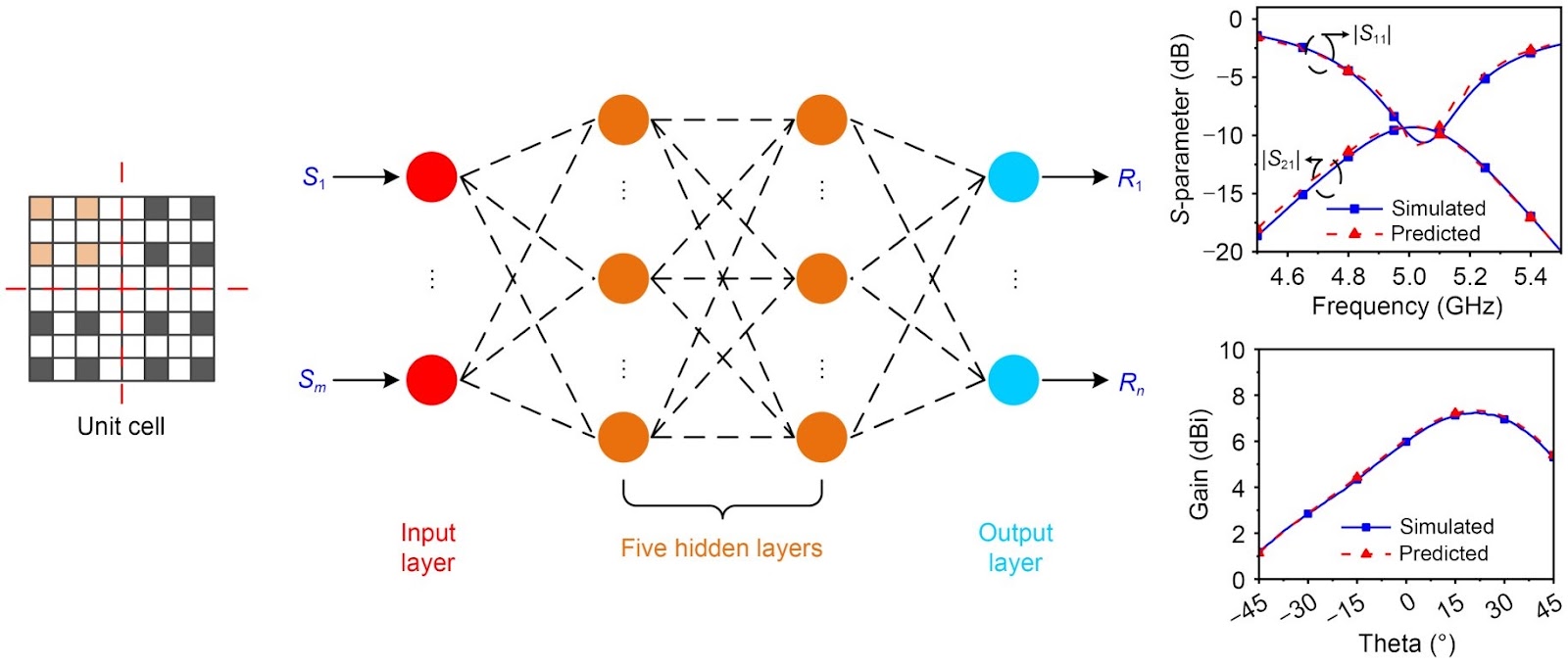
A metasurface-loaded 1×2 patch array antenna assisted by a deep-learning optimization method is proposed to realize port and radiation pattern decoupling simultaneously to enhance the isolation among elements in multi-input multi-output (MIMO) systems. The deep-learning-assisted optimization method uses an artificial neural network (ANN) and a particle swarm optimization (PSO) algorithm to seek the optimal structure of the antenna to achieve port decoupling with undistorted radiation patterns. The ANN is trained to describe the nonlinear relationship between the geometric parameters and the responses of the antenna. The PSO algorithm, guided by the cost function and number of iterations, is used to optimize the structure of the antenna according to the cost function combined with the trained ANN. Finally, by constraining the cost function, we obtain a 1×2 patch array antenna with a metasurface fixed above by studs, which achieves port and radiation pattern decoupling simultaneously. To validate the principle and design method, we designed, fabricated, and measured an antenna prototype with dimensions of 0.88λ0×0.47λ0×0.21λ0 (λ0 is the wavelength in free space at the center frequency). The measured fractional bandwidth is 8% (4.8–5.2 GHz). The isolation of the two-element patch antenna increases from 7.6 dB to 24.3 dB with an envelope correlation coefficient (ECC) of <0.0005 at 0.35λ0. Moreover, the H-plane radiation pattern of each element is consistent and symmetric in the broadside direction. These characteristics make the proposed antenna suitable for MIMO antenna systems with close spacing.
1. Introduction
Multi-input multi-output (MIMO) array antennas have been widely employed in wireless communication devices such as base stations, benefiting from large channel capacity and wide beam coverage. However, when antenna spacing is reduced, mutual coupling between elements increases, leading to deterioration of port isolation and distortion of radiation patterns, which degrades beamforming performance. Therefore, it is of great practical value to design a MIMO array antenna that realizes port and radiation pattern decoupling simultaneously.
Many reported decoupling designs have achieved significant improvements. One approach introduces decoupling structures between antenna elements, such as neutralization lines, defected ground structures (DGS), electromagnetic band gaps (EBG), and metal decoupling structures, to create an additional coupling path that counteracts the original coupling. However, these extra structures often destroy the radiation pattern. A second approach, self-decoupling, exploits the inherent characteristics of the antenna to obtain a weak electric field in the coupled element through field cancellation, significantly reducing coupling without extra structures, yet it usually requires specific element shapes or spacing.
In recent years, metasurfaces composed of planar subwavelength scattering units have been increasingly applied to antenna decoupling owing to their flexible design and minimal restrictions on radiation pattern. This work combines a deep-learning-based optimization strategy with a metasurface-loaded patch array to achieve simultaneous port and radiation pattern decoupling, addressing the limitations of conventional techniques.
Loading authentic research manuscript (Pages 1–5)...
Gu LIU, Jiajiang SHEN, Lei MA, Wei QIN, Wenwen YANG, Lei GUO, Jianxin CHEN (2025). Port and radiation pattern decoupled metasurface-loaded patch antenna using deep-learning-assisted optimization for MIMO applications. Frontiers of Information Technology & Electronic Engineering. https://doi.org/10.1631/FITEE_2500119
Research & Educational Purpose Only:The translations, structured abstracts, analytical annotations, and data reports provided by SinoTechIntel are intended exclusively for academic research, internal corporate R&D, and educational benchmarking. They do not constitute formal engineering, chemical safety, legal, or professional advice.
Copyright & Intellectual Property Notice: Original copyright of the underlying source articles and experimental data remains with the respective authors, institutions, and original publishing journals. SinoTechIntel claims intellectual property only over its proprietary translations, analytical syntheses, and AEO structured enhancements in accordance with international fair use and academic citation principles.
Frequently Asked Questions
What is the focus of this article?
This article proposes a metasurface-loaded 1×2 patch array antenna optimized by a deep-learning-assisted method that simultaneously achieves port and radiation pattern decoupling for MIMO applications. The design aims to enhance isolation between closely spaced antenna elements while preserving undistorted radiation patterns.
How does the deep-learning-assisted optimization method work?
The method combines an artificial neural network (ANN) with particle swarm optimization (PSO). The ANN is trained to model the nonlinear relationship between the antenna's geometric parameters and its responses. The PSO algorithm then optimizes the structural parameters using a cost function integrated with the trained ANN to achieve the desired decoupling performance with undistorted radiation patterns.
What are the key measured performance results?
The prototype, with dimensions 0.88λ0×0.47λ0×0.21λ0, achieves a measured fractional bandwidth of 8% (4.8–5.2 GHz). The isolation between two patch elements increases from 7.6 dB to 24.3 dB, with an envelope correlation coefficient below 0.0005 at 0.35λ0 spacing. The H-plane radiation pattern remains consistent and symmetric in the broadside direction.
Why are metasurfaces advantageous for antenna decoupling?
Metasurfaces, composed of planar subwavelength scattering units, offer flexible design and impose fewer restrictions on the radiation pattern compared with conventional decoupling structures. In this work, the metasurface is placed above the patch array to help achieve both port decoupling and radiation pattern restoration simultaneously.
How does this design overcome limitations of conventional decoupling methods?
Conventional decoupling methods, such as neutralization lines or defected ground structures, often degrade the radiation pattern because the added structures are located close to the elements. Self-decoupling methods require very specific element shapes or spacings. The proposed deep-learning-optimized metasurface-loaded array avoids these drawbacks, achieving high isolation and consistent radiation patterns in a compact design suitable for closely spaced MIMO systems.
Related Technical Papers & Translations
Design and optimization of a high-efficiency distillation process for cellulosic fuel ethanol integrated with thermal coupling and molecular sieve adsorption
To address the challenges of high energy consumption and prominent costs in the traditional three-columns distillation process for cellulosic fuel ethanol, a distillation—molecular sieve coupling separation process is proposed. This process integrates a three-column (crude distillation column, first distillation column, second distillation column) system with a 3A molecular sieve adsorption deep dehydration unit. A thermal coupling network is constructed via differential pressure design (steam from medium/high-pressure columns as mutual heat sources, reboiler liquid waste heat for feed preheating), and molecular sieve adsorption conditions are optimized. The study first performs a thermodynamic consistency test on the ethanol—water system, determines optimal non-random two-liquid (NRTL) model binary interaction parameters via experimental data regression for Aspen Plus simulation. Aiming at minimum total annual cost (TAC), Aspen Plus is used to optimize process parameters (theoretical tray number, feed location, reflux ratio, side-draw position, etc.). Economic analysis shows this process reduces CO2 emission costs by 27.56%, TAC by 15.58% (to 5.123 × 10⁶ USD·a-1), and increases ethanol purity to >99.6%, providing an effective solution for green, efficient separation.
A cohesion loss model for determining residual strength of deep bedded sandstone
Rock residual strength, as an important input parameter, plays an indispensable role in proposing the reasonable and scientific scheme about stope design, underground tunnel excavation and stability evaluation of deep chambers. Therefore, previous residual strength models of rocks established were reviewed. And corresponding related problems were stated. Subsequently, starting from the effects of bedding and whole life-cycle evolution process, series of triaxial mechanical tests of deep bedded s
Federated model with contrastive learning and adaptive control variates for human activity recognition
Recent attention to privacy issues demands a communication-safe method for training human activity recognition (HAR) models on client activity data. Federated learning (FL) has become a compelling technique to facilitate model training between the server and clients while preserving data privacy. However, classical FL methods often assume independent and identically distributed (IID) data among clients. This assumption does not hold true in practical scenarios. Human activity in real-world scena