Key Takeaways & Executive Findings
- •• PtPd bimetallic nanoparticles supported on porous silica nano-flowers (KCC-1) exhibit superior catalytic activity for guaiacol synthesis via dehydrogenation of 2-methoxycyclohexanol. • The optimal catalyst (2.5%Pt-2.5%Pd/KCC-1) achieves 97.2% conversion and 76.8% selectivity, outperforming monometallic counterparts due to synergistic effects. • The catalyst demonstrates high stability and a turnover frequency of 4.36 s−1, indicating excellent efficiency for continuous fixed-bed reactor applications. • The study proposes reaction pathways for dehydro-aromatization, providing insights for green and sustainable guaiacol production.
Abstract
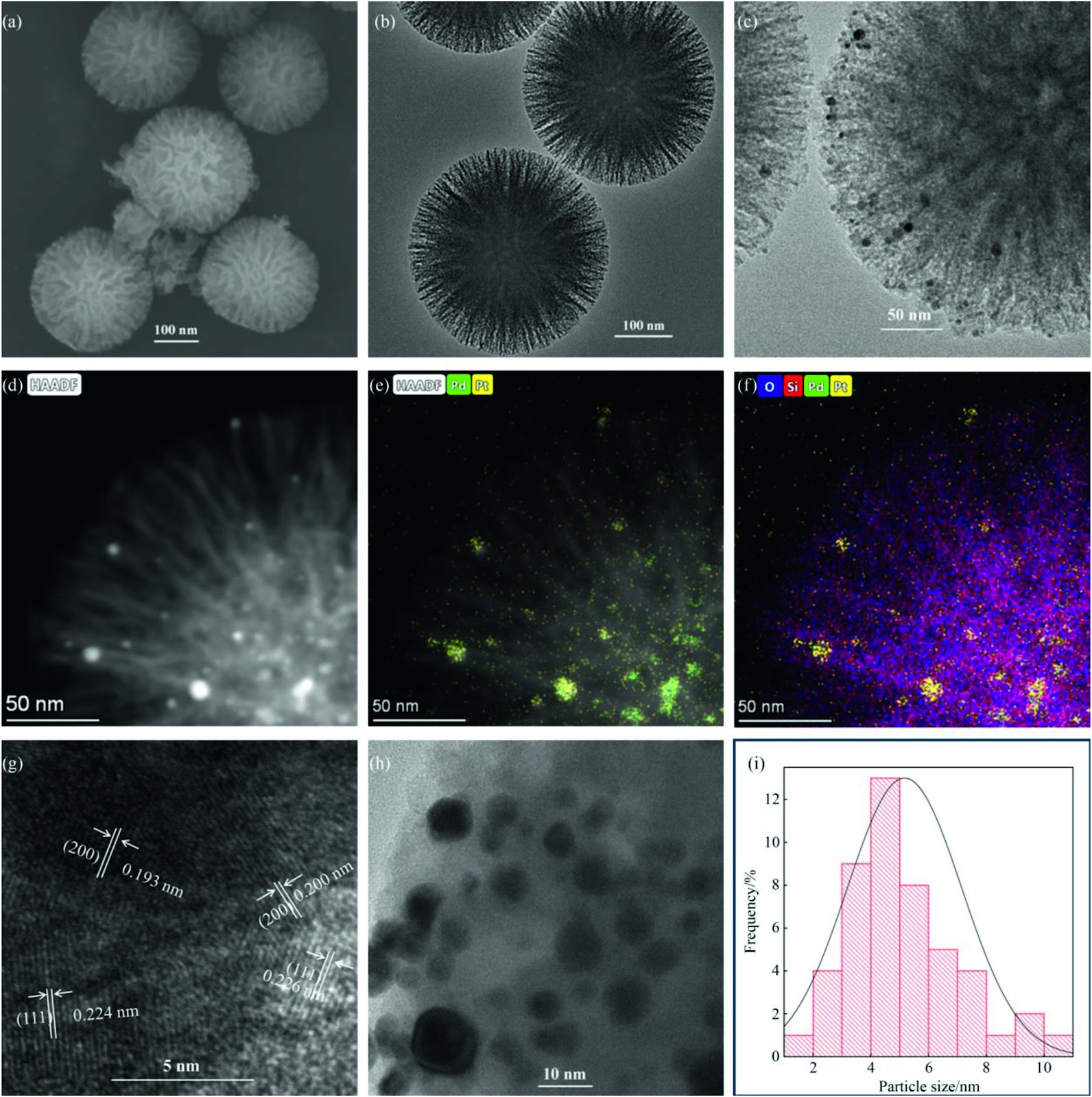
Porous silica nano-flowers (KCC-1) immobilized PtPd alloy NPs (PtPd/KCC-1) with different mass ratios of Pd and Pt were successfully prepared by a facile in situ one-step reduction, using hydrazinium hydroxide as a reducing agent. The as-synthesized silica nanospheres possess radial fibers with a distance of 15 nm, exhibiting a high specific surface area (443.56 m2·g−1). Meanwhile, the obtained PtPd alloy NPs are uniformly dispersed on the silica surface with a metallic particle size of 4–6 nm, which exist as metallic Pd and Pt on the surface of monodisperse KCC-1, showing the transfer of electrons from Pd to Pt. The as-synthesized 2.5%Pt-2.5%Pd/KCC-1 exhibited excellent catalytic activity and stability for the continuous dehydrogenation of 2-methoxycyclohexanol to prepare guaiacol. Compared with Pt or Pd single metal supported catalysts, the obtained 2.5%Pt-2.5%Pd/KCC-1 shows 97.2% conversion rate of 2-methoxycyclohexanol and 76.8% selectivity for guaiacol, which attributed to the significant synergistic effect of bimetallic PtPd alloy NPs. Furthermore, turn over frequency value of the obtained 2.5%Pt-2.5%Pd/KCC-1 NPs achieved 4.36 s−1, showing higher catalytic efficiency than other two monometallic catalysts. Reaction pathways of dehydro-aromatization of 2-methoxycyclohexanol over the obtained catalyst are proposed. Consequently, the obtained 2.5%Pt-2.5%Pd/KCC-1 NPs prove their potential in the dehydrogenation of 2-methoxycyclohexanol, while the kinetics and mechanistic study of the dehydrogenation reaction over the catalyst in a continuous fixed-bed reactor may provide valuable information for the development of green, outstanding and powerful synthetic pathway of guaiacol.
1. Introduction
Guaiacol as an important intermediate that has been extensively used in the synthesis of synthetic spices, drug and plant growth regulator, such as sulfogaiacol, vanillin [1], guaifenesin [2,3], isoprenaline [4] and 5-nitroguaiacol sodium salt. To date, various study for the synthetic pathways of guaiacol have been reported in the Refs. [5e14]. These synthesis methods could be divided into two types. One is the conventional synthesis of guaiacol in homogeneous phase and batch process, which suffers from some shortcomings like corrosive and poisonous reagents, nonreusable issues of these catalysts, complex operation, low production efficiency. Such negative issues restrict their industrial applications in a wider field. The other type is the vapor-phase selective alkylation of catechol to prefabricate guaiacol with an alkylating agent [12e17] over these heterogeneous catalytic systems, which manifest many different merits, such as high production efficiency, simple separation, environmental friendliness, etc. However, there is a common and severe problem over the tested catalysts, it tends to rapidly deactivate on the long-running experiment, greatly hindering their practical application on a large scale. Comparatively, dehydro-aromatization of 2-methoxycyclohexanol can avoid these above drawbacks over metal catalysts in a continuous fixed-bed reactor.
Therefore, more attentions have been paid to dehydrogenation of 2-methoxycyclohexanol over the supported metal catalysts because of several benefits including its excellent catalytic performance, high efficiency, simple separation procedure, and eco-friendly route. Recently, the promising strategy to the direct synthesis of guaiacol by dehydrogenation of 2-methoxycyclohexanol over the supported metal catalysts was reported in the Refs. [18e20]. Although the catalysts with only containing Pd display perfect catalytic activity in the dehydrogenation of 2-methoxycyclohexanol, their durabilities are disappointing due to carbon or coke formation. Nickel (Ni) is a cheap and widely available core metal. Nevertheless, the supported Ni monometallic catalysts show low catalytic activity, and many by-products are formed. The above-mentioned imperfections of these catalysts with containing Pd or Ni restraint their applications in the industry. Hence, to meet the growing demand of guaiacol, it is vital important and highly desirable to develop an efficient, low cost and green catalyst.
Loading authentic research manuscript (Pages 1–5)...
Junbo Feng, Junyan Wu, Dongdong Yan, Yadong Zhang (2024). Porous silica nano-flowers stabilized PtPd bimetallic nanoparticles as heterogeneous catalyst for efficiently synthesizing guaiacol from 2-methoxycyclohexanol. Chinese Journal of Chemical Engineering. https://doi.org/10.1016/j_cjche_1448
Research & Educational Purpose Only:The translations, structured abstracts, analytical annotations, and data reports provided by SinoTechIntel are intended exclusively for academic research, internal corporate R&D, and educational benchmarking. They do not constitute formal engineering, chemical safety, legal, or professional advice.
Copyright & Intellectual Property Notice: Original copyright of the underlying source articles and experimental data remains with the respective authors, institutions, and original publishing journals. SinoTechIntel claims intellectual property only over its proprietary translations, analytical syntheses, and AEO structured enhancements in accordance with international fair use and academic citation principles.
Frequently Asked Questions
What is the main contribution of this paper?
The paper presents a novel PtPd bimetallic catalyst supported on porous silica nano-flowers (KCC-1) that efficiently catalyzes the dehydrogenation of 2-methoxycyclohexanol to guaiacol, achieving high conversion and selectivity with excellent stability.
What are the key advantages of the PtPd/KCC-1 catalyst?
The catalyst exhibits high surface area, uniform dispersion of alloy nanoparticles, and a synergistic effect between Pt and Pd, leading to superior catalytic activity, stability, and a turnover frequency of 4.36 s−1.
How does this catalyst compare to monometallic catalysts?
Compared to Pt or Pd single-metal catalysts, the bimetallic PtPd/KCC-1 shows significantly higher conversion (97.2%) and selectivity (76.8%) for guaiacol, attributed to the synergistic effect of the alloy.
What is the significance of the reaction pathway study?
The proposed reaction pathways for dehydro-aromatization provide mechanistic insights that can guide the design of more efficient and greener catalysts for guaiacol production.
What are the potential industrial applications?
The catalyst is suitable for continuous fixed-bed reactors, offering a green and efficient route for large-scale guaiacol synthesis, which is important for pharmaceuticals, flavors, and agrochemicals.
Related Technical Papers & Translations

Design and optimization of a high-efficiency distillation process for cellulosic fuel ethanol integrated with thermal coupling and molecular sieve adsorption
To address the challenges of high energy consumption and prominent costs in the traditional three-columns distillation process for cellulosic fuel ethanol, a distillation—molecular sieve coupling separation process is proposed. This process integrates a three-column (crude distillation column, first distillation column, second distillation column) system with a 3A molecular sieve adsorption deep dehydration unit. A thermal coupling network is constructed via differential pressure design (steam from medium/high-pressure columns as mutual heat sources, reboiler liquid waste heat for feed preheating), and molecular sieve adsorption conditions are optimized. The study first performs a thermodynamic consistency test on the ethanol—water system, determines optimal non-random two-liquid (NRTL) model binary interaction parameters via experimental data regression for Aspen Plus simulation. Aiming at minimum total annual cost (TAC), Aspen Plus is used to optimize process parameters (theoretical tray number, feed location, reflux ratio, side-draw position, etc.). Economic analysis shows this process reduces CO2 emission costs by 27.56%, TAC by 15.58% (to 5.123 × 10⁶ USD·a-1), and increases ethanol purity to >99.6%, providing an effective solution for green, efficient separation.

A cohesion loss model for determining residual strength of deep bedded sandstone
Rock residual strength, as an important input parameter, plays an indispensable role in proposing the reasonable and scientific scheme about stope design, underground tunnel excavation and stability evaluation of deep chambers. Therefore, previous residual strength models of rocks established were reviewed. And corresponding related problems were stated. Subsequently, starting from the effects of bedding and whole life-cycle evolution process, series of triaxial mechanical tests of deep bedded s

Federated model with contrastive learning and adaptive control variates for human activity recognition
Recent attention to privacy issues demands a communication-safe method for training human activity recognition (HAR) models on client activity data. Federated learning (FL) has become a compelling technique to facilitate model training between the server and clients while preserving data privacy. However, classical FL methods often assume independent and identically distributed (IID) data among clients. This assumption does not hold true in practical scenarios. Human activity in real-world scena