Key Takeaways & Executive Findings
- •• A novel photoinduced transposed Paternò–Büchi reaction enables efficient synthesis of high-energy-density jet fuels from biomass-derived cyclic ketones and alkenes. • The reaction mechanism, including photosensitizer excitation, triplet-triplet energy transfer, and cyclization, was elucidated via quenching studies and DFT calculations. • Optimized conditions achieved a target product yield of 65.5%, with norbornene conversion up to 85.7% and oxetane selectivity of 76.4%. • The resulting fuels exhibit high density (0.864–0.938 g·mL⁻¹) and excellent cryogenic performance (freezing point < −55 °C), offering a sustainable route for advanced aerospace applications.
Abstract
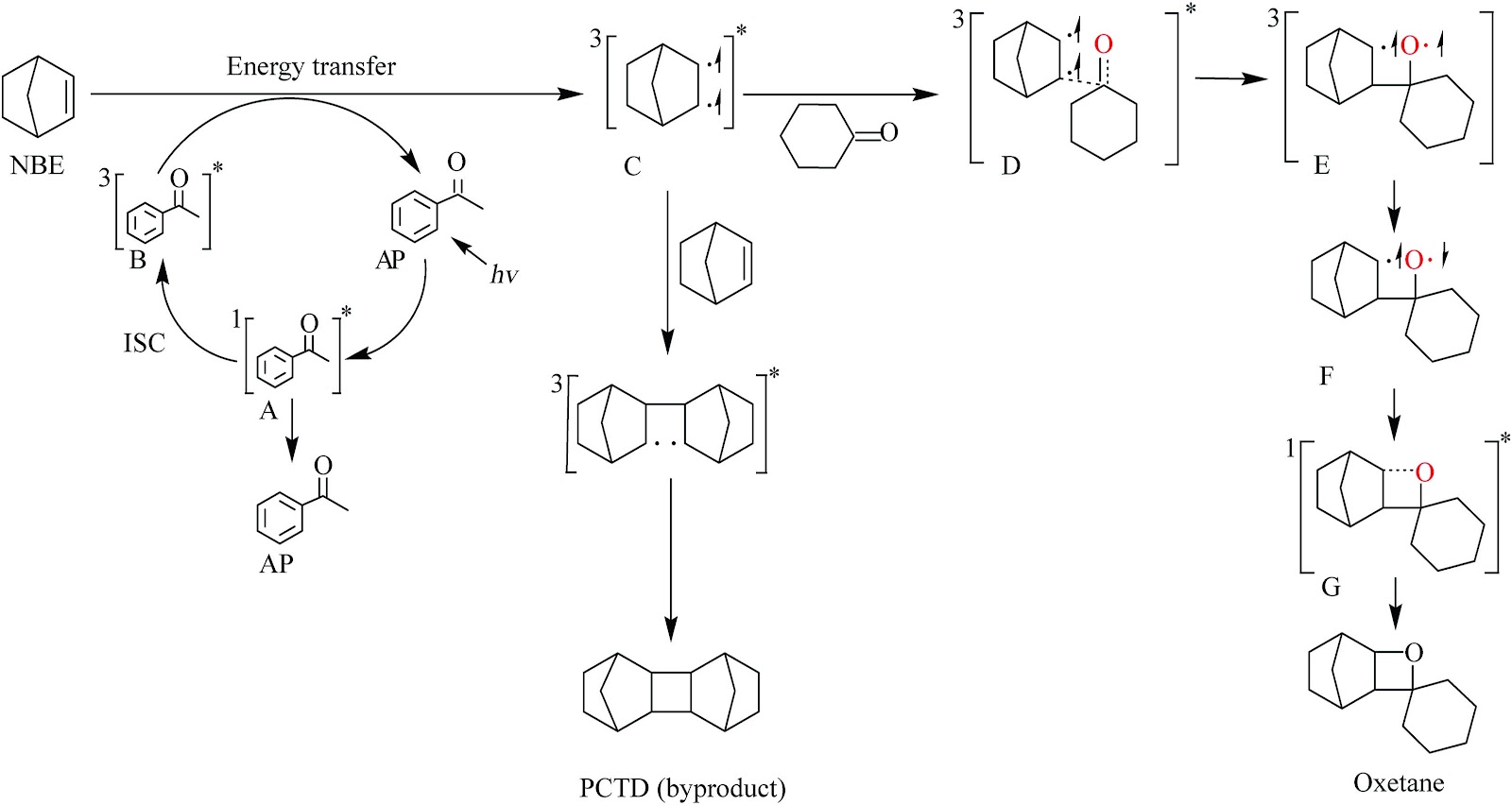
High-energy-density fuels are important for volume-limited aerospace vehicles, but the increase in fuel energy density always leads to poor cryogenic performance. Herein, we investigated the transposed Paternò–Büchi reaction of biomass cyclic ketone and cyclic alkene to synthesize a new kind of alkyl-substituted polycyclic hydrocarbon fuel with high energy density and good cryogenic performance. The triplet-energy-quenching results and phosphorescent emission spectra reveal the sensitization mechanism of the reaction, including photosensitizer excitation, triplet-triplet energy transfer, cyclization, and relaxation, and the possible reaction path was revealed by the density functional theory (DFT) calculations. The reaction conditions of photosensitizer type and addition, molar ratio of substrates, reaction temperature, and incident light intensity were optimized, with the target product yield achieving 65.5%. Moreover, the reaction dynamics of the reaction rate versus the light intensity are established. After the hydrogenation-deoxygenation reaction, three fuels with a high density of 0.864–0.938 g·ml⁻¹ and a low freezing point of < −55 °C are obtained. This work provides a benign and effective approach to synthesize high-performance fuels.
1. Introduction
High-energy-density (HED) fuels, with their high density and high volumetric net heat of combustion (NHOC), are very important for volume-limited aerospace vehicles to extend their flight range [1]. Cycloaddition of cyclic alkene is the most commonly used method to synthesize HED fuels, but higher carbon content leads to poor cryogenic performance (high freezing point and low-temperature viscosity) [2]. Actually, the construction of bicyclic and alkyl-branched structures can realize high density and well-cryogenic properties simultaneously [3–5]. This kind of molecule structure could be obtained by thermal catalytic alkylation, but it seems difficult to synthesize the target products with high yields for the abundant byproducts [6–9].
Alternatively, photoinduced reactions have attracted much attention for their advantages of mild reaction conditions, high product selectivity, and low process energy consumption [10]. Specifically, an efficient C–C coupling process between the ketone and cyclic alkene can produce oxetane products using the [2+2] cycloaddition reaction (Paternò–Büchi reaction) triggered by UV light [11–13], whose hydrodeoxygenation can result in the HED fuels with bicyclic and alkyl-branched structures. As for the substrates of HED fuels, the biomass resources attract more attention than the traditional petroleum-derived compounds for their green and sustainable properties [14]. It is worth noting that the cyclic ketones, like cyclohexanone, cyclopentanone, isophorone, etc., can be easily obtained from the degradation and isomerization of lignocellulose [15], which is very promising to be used as the substrate to produce HED fuels.
Loading authentic research manuscript (Pages 1–5)...
Jinxiu Hu, Xianlong Liu, Yi Liu, Kang Xue, Chengxiang Shi, Xiangwen Zhang, Li Wang, Ji-Jun Zou, Lun Pan (2023). Photoinduced transposed Paternò–Büchi reaction for effective synthesis of high-performance jet fuel. Chinese Journal of Chemical Engineering. https://doi.org/10.1016/j_cjche_144878602
Research & Educational Purpose Only:The translations, structured abstracts, analytical annotations, and data reports provided by SinoTechIntel are intended exclusively for academic research, internal corporate R&D, and educational benchmarking. They do not constitute formal engineering, chemical safety, legal, or professional advice.
Copyright & Intellectual Property Notice: Original copyright of the underlying source articles and experimental data remains with the respective authors, institutions, and original publishing journals. SinoTechIntel claims intellectual property only over its proprietary translations, analytical syntheses, and AEO structured enhancements in accordance with international fair use and academic citation principles.
Frequently Asked Questions
What is the transposed Paternò–Büchi reaction?
The transposed Paternò–Büchi reaction is a photochemical [2+2] cycloaddition between a ketone and an alkene, leading to the formation of oxetane rings. In this study, it is used to synthesize high-energy-density fuels from biomass-derived cyclic ketones and alkenes.
How does the reaction achieve high energy density and good cryogenic performance?
The reaction produces alkyl-substituted polycyclic hydrocarbons with bicyclic and branched structures, which provide high density and low freezing points, overcoming the trade-off typically seen in HED fuels.
What are the key optimized reaction conditions?
The study optimized photosensitizer type and addition, molar ratio of substrates, reaction temperature, and incident light intensity, achieving a target product yield of 65.5%.
What is the significance of using biomass-derived substrates?
Using biomass-derived cyclic ketones (e.g., cyclohexanone) and alkenes (e.g., norbornene) provides a sustainable and green route to produce high-performance jet fuels, reducing reliance on petroleum-derived compounds.
What are the properties of the synthesized fuels?
The synthesized fuels exhibit high density (0.864–0.938 g·mL⁻¹) and low freezing points (< −55 °C), making them suitable for volume-limited aerospace applications.
Related Technical Papers & Translations

Design and optimization of a high-efficiency distillation process for cellulosic fuel ethanol integrated with thermal coupling and molecular sieve adsorption
To address the challenges of high energy consumption and prominent costs in the traditional three-columns distillation process for cellulosic fuel ethanol, a distillation—molecular sieve coupling separation process is proposed. This process integrates a three-column (crude distillation column, first distillation column, second distillation column) system with a 3A molecular sieve adsorption deep dehydration unit. A thermal coupling network is constructed via differential pressure design (steam from medium/high-pressure columns as mutual heat sources, reboiler liquid waste heat for feed preheating), and molecular sieve adsorption conditions are optimized. The study first performs a thermodynamic consistency test on the ethanol—water system, determines optimal non-random two-liquid (NRTL) model binary interaction parameters via experimental data regression for Aspen Plus simulation. Aiming at minimum total annual cost (TAC), Aspen Plus is used to optimize process parameters (theoretical tray number, feed location, reflux ratio, side-draw position, etc.). Economic analysis shows this process reduces CO2 emission costs by 27.56%, TAC by 15.58% (to 5.123 × 10⁶ USD·a-1), and increases ethanol purity to >99.6%, providing an effective solution for green, efficient separation.

A cohesion loss model for determining residual strength of deep bedded sandstone
Rock residual strength, as an important input parameter, plays an indispensable role in proposing the reasonable and scientific scheme about stope design, underground tunnel excavation and stability evaluation of deep chambers. Therefore, previous residual strength models of rocks established were reviewed. And corresponding related problems were stated. Subsequently, starting from the effects of bedding and whole life-cycle evolution process, series of triaxial mechanical tests of deep bedded s

Federated model with contrastive learning and adaptive control variates for human activity recognition
Recent attention to privacy issues demands a communication-safe method for training human activity recognition (HAR) models on client activity data. Federated learning (FL) has become a compelling technique to facilitate model training between the server and clients while preserving data privacy. However, classical FL methods often assume independent and identically distributed (IID) data among clients. This assumption does not hold true in practical scenarios. Human activity in real-world scena