Key Takeaways & Executive Findings
- •• Suspension roasting achieves rapid bastnaesite decomposition with simultaneous cerium oxidation, yielding CO2, Ce7O12, La2O3, CeF3, and LaF3 as products. • Prolonged roasting initially increases surface cracks, porosity, and BET specific surface area, but later particle fusion and pore consolidation reduce specific surface area. • Both bastnaesite pyrolysis and cerium oxidation follow Avrami–Erofeev kinetic models; reaction order decreases with temperature, and activation energy is higher at lower temperatures. • The study provides mechanistic insights and kinetic parameters essential for optimizing suspension roasting technology in bastnaesite smelting and rare earth extraction.
Abstract
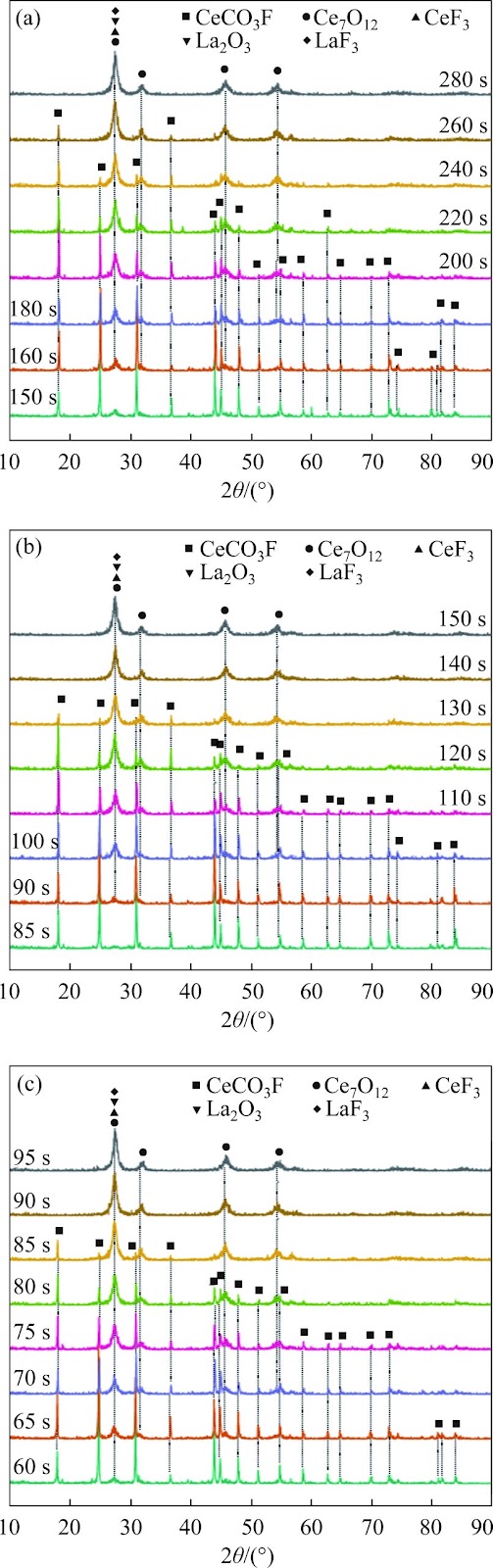
Roasting bastnaesite concentrates is a crucial process in extracting rare earths. This study explored an efficient suspension roasting technology and investigated the bastnaesite pyrolysis and cerium (Ce) oxidation. Relevant analytical tests were applied to evaluate the phase and surface property variations of bastnaesite, and isothermal kinetic analysis of bastnaesite pyrolysis and Ce oxidation was performed. The results revealed that bastnaesite decomposed rapidly and accompanied by Ce oxidation, and the gas-solid products were identified as CO2, Ce7O12, La2O3, CeF3 and LaF3, with Ce oxidation restricted by bastnaesite pyrolysis. As roasting time prolonged, cracks and pores appeared on bastnaesite surface; the BET specific surface and pore diameter increased. In later roasting period, the pore diameter continued to increase but the specific surface decreased, assigned to particle fusion agglomeration and pore consolidation. Additionally, the surface C content reduced and Ce(Ⅳ) content increased gradually as roasting progressed. The reaction kinetics all followed Avrami-Erofeev equations, the reaction orders of bastnaesite pyrolysis and Ce oxidation decreased with decreasing reaction temperature. The calculated activation energies at lower temperatures were higher than those calculated at higher temperatures. This study analyzed the bastnaesite reaction mechanism to supply a reference for the application of suspension roasting technology in bastnaesite smelting.
1. Introduction
Rare earth elements (REEs) are widely applied in high-tech industries, national defense and new energy fields because of their unique physical features (e.g., magnetism, optics, and electricity) and superior chemical properties, and are known as the “all-purpose earth”. Rare earth (RE) ores are the key resources for the production of new materials and for cutting-edge national defense technology. The world’s proven RE reserves are about 125 million tons, of which China has the largest reserves, accounting for approximately 35%. At present, among the more than 250 RE-containing minerals identified, only about 10 have industrial value. Bastnaesite is the most widespread raw material employed to produce rare earths, and well-known RE deposits include Bayan Obo and Maoniuping in China, and Mountain Pass in America.
The bastnaesite beneficiation technology is mainly based on the combination of gravity separation, magnetic separation and froth flotation to produce high-grade bastnaesite concentrates with REO content over 50%. In subsequent smelting process, oxidation roasting–HCl leaching–caustic conversion are the mainstream technology for extracting REEs from bastnaesite concentrates. The bastnaesite is commonly oxidized in a rotary kiln at temperatures ranging from 500 to 700 °C, and its pyrolysis products are leached in hydrochloric acid to obtain rare earth chloride (RECl3) solution. Then the leaching residue containing CeO2 and rare earth fluorides (REF3) was transformed by caustic soda and depleted of fluorine to produce Ce-rich RECl3 solution.
Roasting is the critical process for improving the leaching efficiency by modifying the crystal structure of bastnaesite, increasing the porosity of the particles, and facilitating the transfer of substances. To reduce the environmental pollution in REEs extraction, more efficient and cleaner roasting technologies are being developed. This study explores an efficient suspension roasting technology and investigates the bastnaesite pyrolysis and cerium oxidation, aiming to supply a reference for the application of suspension roasting in bastnaesite smelting.
Loading authentic research manuscript (Pages 1–5)...
CHENG Shao-kai, HAN Yue-xin, LI Wen-bo, ZHANG Ling-hui, GAO Peng, SUN Yong-sheng (2025). Phase transitions and surface property variations of bastnaesite in suspension roasting: A study of bastnaesite pyrolysis and cerium oxidation. Journal of Central South University. https://doi.org/10.1007/s11771-025-6026-z
Research & Educational Purpose Only:The translations, structured abstracts, analytical annotations, and data reports provided by SinoTechIntel are intended exclusively for academic research, internal corporate R&D, and educational benchmarking. They do not constitute formal engineering, chemical safety, legal, or professional advice.
Copyright & Intellectual Property Notice: Original copyright of the underlying source articles and experimental data remains with the respective authors, institutions, and original publishing journals. SinoTechIntel claims intellectual property only over its proprietary translations, analytical syntheses, and AEO structured enhancements in accordance with international fair use and academic citation principles.
Frequently Asked Questions
What is suspension roasting of bastnaesite?
Suspension roasting is an efficient technology that rapidly decomposes bastnaesite and oxidizes cerium, improving the extraction of rare earths. It involves heating fine bastnaesite particles in a gas-solid suspension to facilitate phase transitions and surface modifications.
What are the main products of bastnaesite pyrolysis?
The gas-solid products of bastnaesite pyrolysis include CO2, Ce7O12, La2O3, CeF3, and LaF3. Cerium oxidation is coupled with the pyrolysis process, yielding these compounds.
How does roasting time affect the surface properties of bastnaesite?
Prolonged roasting initially increases surface cracks, pores, BET specific surface area, and pore diameter. However, in later stages, particle fusion agglomeration and pore consolidation lead to a decrease in specific surface area while pore diameter continues to increase.
What kinetic models describe bastnaesite pyrolysis and cerium oxidation?
Both bastnaesite pyrolysis and cerium oxidation follow Avrami-Erofeev equations. The reaction order decreases with decreasing reaction temperature, and the calculated activation energies are higher at lower temperatures than at higher temperatures.
Why is roasting important for rare earth extraction?
Roasting modifies the crystal structure of bastnaesite, increases particle porosity, and facilitates mass transfer. This enhances the efficiency of subsequent hydrochloric acid leaching, making roasting a critical step in the extraction of rare earths from bastnaesite concentrates.
Related Technical Papers & Translations

Design and optimization of a high-efficiency distillation process for cellulosic fuel ethanol integrated with thermal coupling and molecular sieve adsorption
To address the challenges of high energy consumption and prominent costs in the traditional three-columns distillation process for cellulosic fuel ethanol, a distillation—molecular sieve coupling separation process is proposed. This process integrates a three-column (crude distillation column, first distillation column, second distillation column) system with a 3A molecular sieve adsorption deep dehydration unit. A thermal coupling network is constructed via differential pressure design (steam from medium/high-pressure columns as mutual heat sources, reboiler liquid waste heat for feed preheating), and molecular sieve adsorption conditions are optimized. The study first performs a thermodynamic consistency test on the ethanol—water system, determines optimal non-random two-liquid (NRTL) model binary interaction parameters via experimental data regression for Aspen Plus simulation. Aiming at minimum total annual cost (TAC), Aspen Plus is used to optimize process parameters (theoretical tray number, feed location, reflux ratio, side-draw position, etc.). Economic analysis shows this process reduces CO2 emission costs by 27.56%, TAC by 15.58% (to 5.123 × 10⁶ USD·a-1), and increases ethanol purity to >99.6%, providing an effective solution for green, efficient separation.

A cohesion loss model for determining residual strength of deep bedded sandstone
Rock residual strength, as an important input parameter, plays an indispensable role in proposing the reasonable and scientific scheme about stope design, underground tunnel excavation and stability evaluation of deep chambers. Therefore, previous residual strength models of rocks established were reviewed. And corresponding related problems were stated. Subsequently, starting from the effects of bedding and whole life-cycle evolution process, series of triaxial mechanical tests of deep bedded s

Federated model with contrastive learning and adaptive control variates for human activity recognition
Recent attention to privacy issues demands a communication-safe method for training human activity recognition (HAR) models on client activity data. Federated learning (FL) has become a compelling technique to facilitate model training between the server and clients while preserving data privacy. However, classical FL methods often assume independent and identically distributed (IID) data among clients. This assumption does not hold true in practical scenarios. Human activity in real-world scena