Key Takeaways & Executive Findings
- •• Proposes OTL-GM, an online transfer learning framework with an MLP-assisted GCN that transfers source-domain features to edge devices and bridges domain gaps via online learning. • Reduces convergence time by 24.77%–95.32% compared with non-OTL models across four traffic flow datasets. • Addresses critical practical constraints of intelligent edge devices, including limited computing resources, data sparsity, and external environmental influences. • Enhances timeliness and reliability of traffic flow prediction, supporting real-time route planning and intelligent transportation management.
Abstract
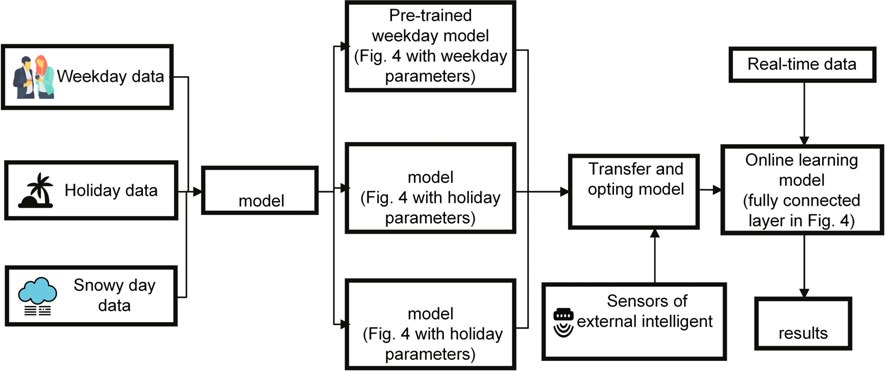
Traffic flow prediction is crucial for intelligent transportation and aids in route planning and navigation. However, existing studies often focus on prediction accuracy improvement, while neglecting external influences and practical issues like resource constraints and data sparsity on edge devices. We propose an online transfer learning (OTL) framework with a multi-layer perceptron (MLP)-assisted graph convolutional network (GCN), termed OTL-GM, which consists of two parts: transferring source-domain features to edge devices and using online learning to bridge domain gaps. Experiments on four data sets demonstrate OTL's effectiveness; in a comparison with models not using OTL, the reduction in the convergence time of the OTL models ranges from 24.77% to 95.32%.
1. Introduction
The integration of the Internet of Things (IoT) and intelligent transportation systems (ITSs) signifies a transformative era with unprecedented possibilities (Bojan et al., 2014). A widespread sensor network in urban traffic nodes enables real-time monitoring of variables like traffic flow and congestion, and swiftly transmits data for dynamic traffic management (Zhang H and Lu, 2020). The significance of IoT lies in processing data with advanced techniques such as deep learning, providing a scientific foundation for optimized transportation systems with heightened efficiency and reduced congestion. Accurate traffic flow prediction is crucial for intelligent transportation, empowering advanced management and optimizing resources for efficiency. However, prediction delay is a more important aspect for traffic managers and traveling vehicles (Hashemi and Abdelghany, 2015). Excessively long delays can lead to wrong decisions by traffic managers and mislead vehicles in planning their driving routes. The synergy of traffic flow prediction and IoT establishes an intelligent foundation for resilient, efficient, and secure urban transportation systems (Derawi et al., 2020).
However, some contradictions have arisen during the integration of IoT and ITSs. On one hand, IoT devices have evolved from simple magnetic and infrared sensors to the current generation of intelligent edge devices (Qadri et al., 2020). Initially, basic motion detection relied on magnetic and infrared technologies. Later, cameras were introduced to improve monitoring precision. However, integration among different sensors is still limited. Intelligent edge devices now have integrated sensors, computing abilities, and connectivity to provide advanced real-time processing and feedback functions. This integration is driving IoT towards greater intelligence and efficiency. However, such multi-functional devices are often limited by resources, especially computing resources (Asim et al., 2020). They not only perform computation, but also transmit wireless data (Cong et al., 2021) and information on road condition detection (Singh et al., 2021). Therefore, how to reduce the computing resource consumption and provide as many computing resources as possible for other aspects has become an urgent problem. In addition, collecting traffic flow data can be challenging in extreme weather conditions (Datla and Sharma, 2008).
On the other hand, as the core of traffic flow prediction problems, prediction accuracy has always been a hot topic in academic research. In the 1990s, traffic flow prediction based on micro-simulation and macro-models began to attract attention (Bando et al., 1995). During the 2010s, there was growing recognition of the significance of data-driven approaches and real-time technology (Nellore and Hancke, 2016). Currently, deep learning has emerged as an essential technology for predicting traffic flow, highlighting the superiority of neural network models in handling complex spatiotemporal relationships (Kashyap et al., 2022). Various models have emerged for spatiotemporal prediction, such as the spatial–temporal graph convolutional network (STGCN) (Yu et al., 2017), diffusion convolutional recurrent neural network (DCRNN) (Li YG et al., 2018), and graph attention method (Tang et al., 2020), all of which achieve excellent accuracy. This pursuit of higher accuracy often comes with an increase in algorithmic complexity and prediction time.
Loading authentic research manuscript (Pages 1–5)...
Jingru SUN, Chendingying LU, Yichuang SUN, Hongbo JIANG, Zhu XIAO (2025). Online transfer learning with an MLP-assisted graph convolutional network for traffic flow prediction: a solution for edge intelligent devices. Frontiers of Information Technology & Electronic Engineering. https://doi.org/10.1631/FITEE_2401059
Research & Educational Purpose Only:The translations, structured abstracts, analytical annotations, and data reports provided by SinoTechIntel are intended exclusively for academic research, internal corporate R&D, and educational benchmarking. They do not constitute formal engineering, chemical safety, legal, or professional advice.
Copyright & Intellectual Property Notice: Original copyright of the underlying source articles and experimental data remains with the respective authors, institutions, and original publishing journals. SinoTechIntel claims intellectual property only over its proprietary translations, analytical syntheses, and AEO structured enhancements in accordance with international fair use and academic citation principles.
Frequently Asked Questions
What is OTL-GM?
OTL-GM is an online transfer learning framework that combines a multi-layer perceptron (MLP)-assisted graph convolutional network (GCN). It has two main parts: transferring source-domain features to edge devices and using online learning to bridge domain gaps.
How does OTL-GM improve traffic flow prediction on edge devices?
By integrating transfer learning and online learning, OTL-GM effectively handles resource constraints and data sparsity on edge devices, achieving faster convergence and robust prediction without heavily increasing algorithmic complexity.
What were the main experimental findings?
Experiments on four datasets showed that OTL models reduced convergence time by 24.77% to 95.32% compared with models not using OTL, while maintaining prediction accuracy.
Why is prediction delay important in intelligent transportation?
Excessively long prediction delays can lead to wrong decisions by traffic managers and mislead vehicles in route planning. Timely traffic flow prediction is essential for dynamic traffic management and safe, efficient navigation.
What are the practical applications of this research?
The proposed approach supports intelligent edge devices in Internet of Things and intelligent transportation systems, enabling real-time traffic flow prediction for route planning, congestion management, and smart city infrastructure.
Related Technical Papers & Translations

Design and optimization of a high-efficiency distillation process for cellulosic fuel ethanol integrated with thermal coupling and molecular sieve adsorption
To address the challenges of high energy consumption and prominent costs in the traditional three-columns distillation process for cellulosic fuel ethanol, a distillation—molecular sieve coupling separation process is proposed. This process integrates a three-column (crude distillation column, first distillation column, second distillation column) system with a 3A molecular sieve adsorption deep dehydration unit. A thermal coupling network is constructed via differential pressure design (steam from medium/high-pressure columns as mutual heat sources, reboiler liquid waste heat for feed preheating), and molecular sieve adsorption conditions are optimized. The study first performs a thermodynamic consistency test on the ethanol—water system, determines optimal non-random two-liquid (NRTL) model binary interaction parameters via experimental data regression for Aspen Plus simulation. Aiming at minimum total annual cost (TAC), Aspen Plus is used to optimize process parameters (theoretical tray number, feed location, reflux ratio, side-draw position, etc.). Economic analysis shows this process reduces CO2 emission costs by 27.56%, TAC by 15.58% (to 5.123 × 10⁶ USD·a-1), and increases ethanol purity to >99.6%, providing an effective solution for green, efficient separation.

A cohesion loss model for determining residual strength of deep bedded sandstone
Rock residual strength, as an important input parameter, plays an indispensable role in proposing the reasonable and scientific scheme about stope design, underground tunnel excavation and stability evaluation of deep chambers. Therefore, previous residual strength models of rocks established were reviewed. And corresponding related problems were stated. Subsequently, starting from the effects of bedding and whole life-cycle evolution process, series of triaxial mechanical tests of deep bedded s

Federated model with contrastive learning and adaptive control variates for human activity recognition
Recent attention to privacy issues demands a communication-safe method for training human activity recognition (HAR) models on client activity data. Federated learning (FL) has become a compelling technique to facilitate model training between the server and clients while preserving data privacy. However, classical FL methods often assume independent and identically distributed (IID) data among clients. This assumption does not hold true in practical scenarios. Human activity in real-world scena