Key Takeaways & Executive Findings
- •• Nitric acid oxidation dramatically enhances the microwave absorption of carbonized melamine foam, achieving a minimum reflection loss of −21.51 dB at 13.20 GHz. • The surface treatment yields a broad effective absorption bandwidth of 7.04 GHz, covering a wide frequency range useful for electromagnetic interference shielding. • The improved performance arises from strengthened dielectric loss, better impedance matching, and increased polarization losses induced by oxidized surface functional groups. • The work presents a lightweight, low-density surface-modification strategy for designing high-performance carbon-based microwave absorbers for aviation, civilian, and military applications.
Abstract
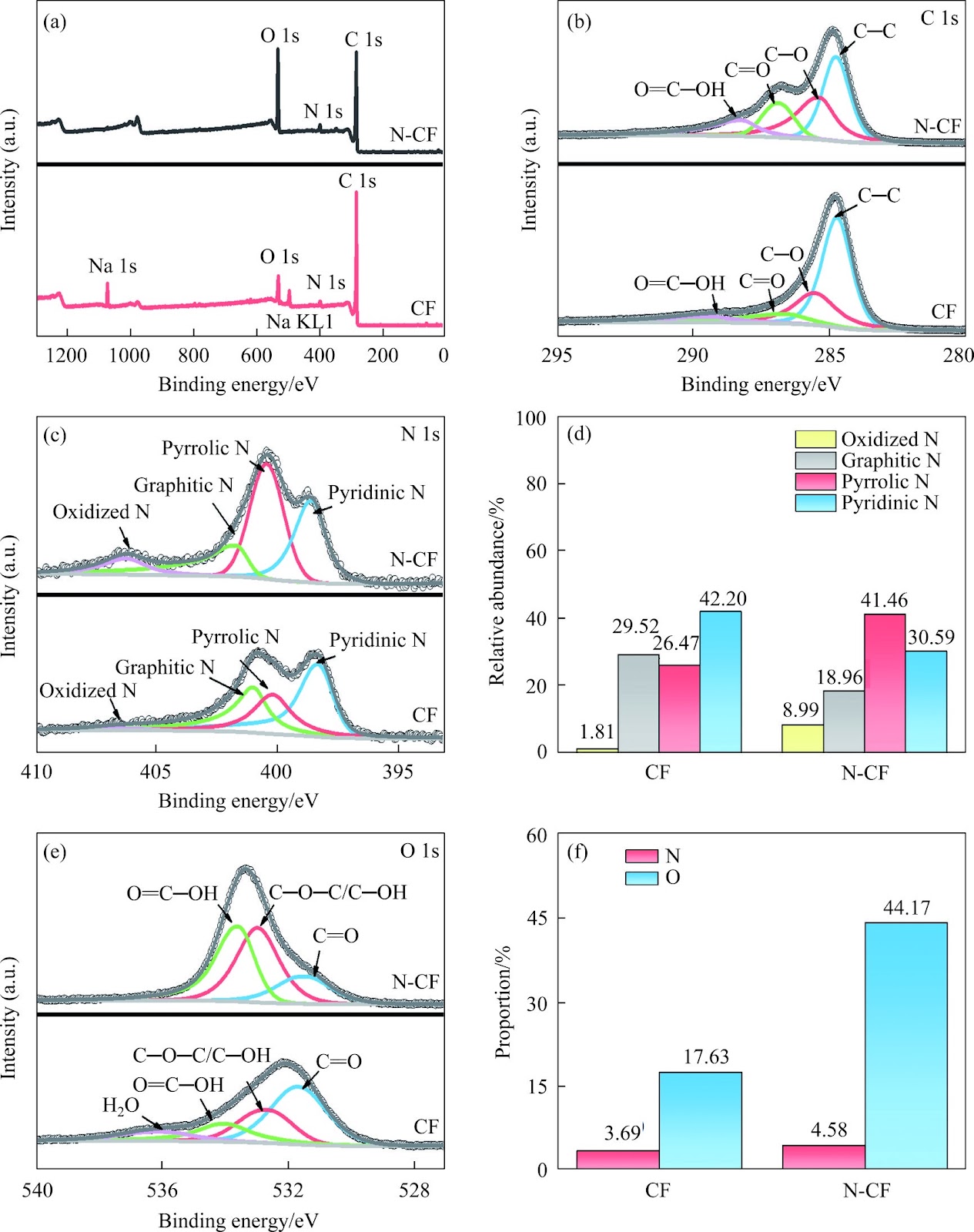
Carbonized melamine foam has been recognized as a promising material for microwave absorption due to its exceptional thermal stability, lightweight, and remarkable dielectric properties. In this study, we investigated the impact of nitric acid oxidation on the surface of carbonized melamine foam and its microwave absorption properties. The treated foam exhibits optimal reflection loss of −21.51 dB at 13.20 GHz, with an effective absorption bandwidth of 7.04 GHz. The enhanced absorption properties are primarily attributed to the strengthened dielectric loss, improved impedance matching, and increased polarization losses resulting from the oxidized surfaces. This research demonstrates a promising new approach for research into surface treatments to improve the performances of microwave absorbers.
1. Introduction
Microwave absorbing materials have attracted growing research interest for electromagnetic interference (EMI) shielding applications in aviation, civilian, and military fields [1−3]. To mitigate harmful electromagnetic radiation, materials with strong microwave absorption properties are required [4, 5]. Over the past decades, various microwave absorbers have been developed with excellent absorption performances, including carbon materials [6], ferrites [7] and ceramics [8]. Carbon-based absorbers, including carbon nanotubes [9, 10], nanofibers [11, 12] and graphene [13, 14], have emerged as promising candidates owing to their high thermal stability, low density, and tunable electromagnetic properties. Among them, carbon foam, possessing open-cell structure with ultrahigh surface area, has gained much interest as lightweight and highly effective microwave absorbers. For example, the multifunctional Ni/MXene-MF with the microcapacitor structure and 3D porous structure was reported to enable good impedance matching and strong attenuation efficiency, showing minimum reflection loss (RLmin) of −62.7 dB and effective absorption bandwidth (EAB) of 6.24 GHz at thickness of 2 mm [15]. 3D graphene-coated foam structure with embedded Co3O4 particles was developed to achieve RLmin of −31.88 dB at 11.54 GHz and EAB of 3.4 GHz [16]. The enhanced performance was attributed to the synergistic effects of impedance matching, interfacial polarization, and polarization relaxation. In addition, porous carbonated melamine foam (CMF) with layers of FeNi alloy and SiO2 (CMF/FeNi15-SiO2) exhibited RLmin of −53 dB at 3.38 GHz and EAB of 0.93 GHz at thickness of 4.1 mm [17]. It is worthy to be mentioned that the 3D foam structure, carbon skeleton, FeNi alloy, and SiO2 coating shell synergistically contributed to the excellent microwave absorption in the 2−6 GHz frequency band. However, pure carbon-based materials alone as microwave absorbers remain a major challenge caused by high reflectivity and poor impedance mismatch [18−20].
As we know, microwave absorption ability relies on converting incident electromagnetic waves into thermal energy through dielectric and magnetic loss. Generally, modifying the surface, interface and inner chemical structure of carbon materials can optimize dielectric properties and the impedance match, promoting the electromagnetic waves absorption performance [21−24]. For example, HU et al [24] studied the microwave absorption properties of pristine multi-walled carbon nanotube (MWCNT)-P, MWCNT-OH and MWCNT-COOH, and proposed to tune the microwave absorption properties of multi-walled carbon nanotubes by surface functional groups. The absorption efficiencies of MWCNT-P, MWCNT-OH and MWCNT-COOH at 8−18 GHz are >33%, >50% and >45%, respectively. Compared with MWCNT-P, 17% absorption efficiency of MWCNT-OH is significantly enhanced. DAI et al [25] designed 2D structure of Ti3C2Tx MXenes/nano-carbon-sphere hybrids, which exhibited superior microwave absorption performance due to formation of heterogeneous interface structure. The optimal reflection loss (RL) was −54.67 dB at 3.97 GHz with an absorber thickness of 4.8 mm. SONG et al [26] incorporated the dielectric polarization effect induced by atomic-scale structural defects to improve the electromagnetic absorption performances of materials.
Loading authentic research manuscript (Pages 1–5)...
Mao Ming-zhen, Xia Peng-kun, Ma Lei, Huang Sheng-xiang, Gao Xiao-hui, Deng Lian-wen (2025). Nitric acid oxidation treatment promoting microwave absorption performance of carbonized melamine foam. Journal of Central South University. https://doi.org/10.1007/s11771-025-5972-9
Research & Educational Purpose Only:The translations, structured abstracts, analytical annotations, and data reports provided by SinoTechIntel are intended exclusively for academic research, internal corporate R&D, and educational benchmarking. They do not constitute formal engineering, chemical safety, legal, or professional advice.
Copyright & Intellectual Property Notice: Original copyright of the underlying source articles and experimental data remains with the respective authors, institutions, and original publishing journals. SinoTechIntel claims intellectual property only over its proprietary translations, analytical syntheses, and AEO structured enhancements in accordance with international fair use and academic citation principles.
Frequently Asked Questions
What is the optimal microwave absorption performance achieved after nitric acid oxidation?
The treated carbonized melamine foam exhibits a minimum reflection loss of −21.51 dB at 13.20 GHz, with an effective absorption bandwidth of 7.04 GHz.
How does nitric acid oxidation improve microwave absorption?
Nitric acid oxidation introduces oxygen-containing functional groups and surface defects, which strengthen dielectric loss, improve impedance matching, and increase polarization losses.
Is the enhancement mainly due to magnetic or dielectric loss?
The enhancement is mainly attributed to dielectric loss mechanisms, including strengthened dielectric loss and increased polarization losses, rather than magnetic loss.
Why is carbonized melamine foam considered a promising microwave absorber?
It offers exceptional thermal stability, lightweight structure, remarkable dielectric properties, and a 3D porous architecture that facilitates impedance matching and attenuation.
What are the key application fields for this material?
The lightweight carbonized melamine foam absorber is suitable for electromagnetic interference shielding in aviation, civilian, and military applications.
Related Technical Papers & Translations
Design and optimization of a high-efficiency distillation process for cellulosic fuel ethanol integrated with thermal coupling and molecular sieve adsorption
To address the challenges of high energy consumption and prominent costs in the traditional three-columns distillation process for cellulosic fuel ethanol, a distillation—molecular sieve coupling separation process is proposed. This process integrates a three-column (crude distillation column, first distillation column, second distillation column) system with a 3A molecular sieve adsorption deep dehydration unit. A thermal coupling network is constructed via differential pressure design (steam from medium/high-pressure columns as mutual heat sources, reboiler liquid waste heat for feed preheating), and molecular sieve adsorption conditions are optimized. The study first performs a thermodynamic consistency test on the ethanol—water system, determines optimal non-random two-liquid (NRTL) model binary interaction parameters via experimental data regression for Aspen Plus simulation. Aiming at minimum total annual cost (TAC), Aspen Plus is used to optimize process parameters (theoretical tray number, feed location, reflux ratio, side-draw position, etc.). Economic analysis shows this process reduces CO2 emission costs by 27.56%, TAC by 15.58% (to 5.123 × 10⁶ USD·a-1), and increases ethanol purity to >99.6%, providing an effective solution for green, efficient separation.
A cohesion loss model for determining residual strength of deep bedded sandstone
Rock residual strength, as an important input parameter, plays an indispensable role in proposing the reasonable and scientific scheme about stope design, underground tunnel excavation and stability evaluation of deep chambers. Therefore, previous residual strength models of rocks established were reviewed. And corresponding related problems were stated. Subsequently, starting from the effects of bedding and whole life-cycle evolution process, series of triaxial mechanical tests of deep bedded s
Federated model with contrastive learning and adaptive control variates for human activity recognition
Recent attention to privacy issues demands a communication-safe method for training human activity recognition (HAR) models on client activity data. Federated learning (FL) has become a compelling technique to facilitate model training between the server and clients while preserving data privacy. However, classical FL methods often assume independent and identically distributed (IID) data among clients. This assumption does not hold true in practical scenarios. Human activity in real-world scena