Key Takeaways & Executive Findings
- •• NiS2–MXene hybrid composite synthesized via one-step hydrothermal method reduces MgH2 dehydrogenation temperature by 118°C (from 310°C to 192°C). • The composite releases 5.87 wt% H2 within 12 minutes at 300°C and absorbs ~2.96 wt% H2 from room temperature to 50°C, demonstrating excellent kinetics. • Activation energies for hydrogenation and dehydrogenation are reduced by 33.7 and 40.6 kJ·mol−1, respectively, compared to pure MgH2. • Synergistic mechanisms include multivalent Ti in MXene for electron transport, in situ formed Mg2Ni/Mg2NiH4 and MgS phase interfaces providing active sites, and MXene's high surface area preventing catalyst agglomeration.
Abstract
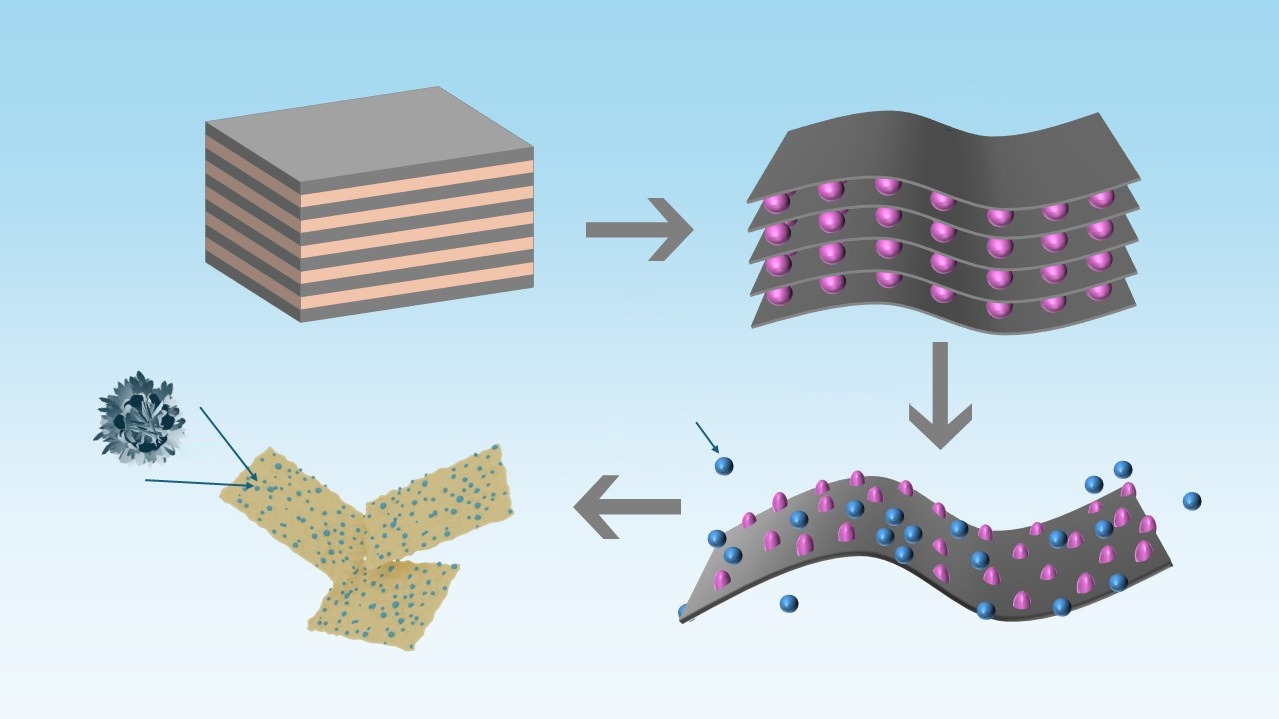
We employed a one-step hydrothermal method to in situ grow spherical NiS2 nanoparticles on the surface of MXene, successfully constructing a NiS2–MXene hybrid composite. This study demonstrates that the integration of a NiS2–MXene hybrid composite into MgH2 substantially improves its hydrogen storage performance. Specifically, the composite reduces the initial dehydrogenation temperature of MgH2 by 118°C, lowering it from 310°C (pure MgH2) to 192°C. At 300°C, it can release 5.87wt% of hydrogen within 12 min. Furthermore, it demonstrates the ability to absorb hydrogen under ambient temperature conditions, with approximately 2.96wt% of hydrogen being absorbed as the temperature increases from room temperature to 50°C. The activation energies for hydrogenation and dehydrogenation of the NiS2–MXene–MgH2 composite reduced by 33.7 and 40.6 kJ·mol−1, respectively, in comparison to those of pure MgH2. Mechanistic studies demonstrate that NiS2–MXene enhances hydrogen storage performance through multiple synergistic effects. Specifically, the multivalent titanium in MXene establishes efficient electron transport pathways, promoting hydrogen binding and dissociation. Moreover, the in situ formation of Mg2Ni/Mg2NiH4 and MgS creates numerous phase interfaces, offering abundant active sites that facilitate both the dissociation and recombination of hydrogen molecules. Furthermore, the high specific surface area of MXene effectively inhibits agglomeration between the catalyst and Mg/MgH2, thereby maintaining structural stability and reactivity.
1. Introduction
Hydrogen energy is recognized as a clean energy source and has attracted significant interest owing to its environmentally friendly nature and high efficiency. However, its application in the transportation sector remains considerably constrained, primarily due to unresolved safety challenges associated with hydrogen storage and transportation. Among various types of hydrogen storage materials, NaBH4 and AlH3 offer certain advantages, yet their widespread use is limited by issues such as poor reversibility and demanding reaction conditions. As a result, magnesium-based materials have emerged as a promising research focus owing to their superior overall performance [1–6]. Nonetheless, their practical deployment still suffers from issues such as high hydrogenation/dehydrogenation temperatures and sluggish kinetics.
To overcome these drawbacks, researchers have proposed various modification strategies, including alloying [7–10], nanostructuring [11–13], and the addition of catalysts [14–20]. Among these approaches, the introduction of catalysts has emerged as one of the most effective methods for improving the hydrogen storage capabilities of magnesium-based materials due to its simplicity and significant impact. In recent years, the development of catalysts for MgH2 has evolved from the use of single metals or simple compounds to the design of composite catalyst systems that leverage synergistic effects among multiple components and interfaces. This shift aligns with the trends reviewed in recent literature [21], which systematically summarizes the research progress in multi-component materials and high-entropy materials for catalyzing Mg-based hydrogen storage systems, with a focus on catalyst categories and performance optimization strategies, and further outlines prospective research directions for advancing their practical application. In addition, as summarized in earlier literature [22–25], a variety of catalysts—including carbon-based materials, metal oxides, high-entropy borides, and emerging MXenes—have effectively enhanced the hydrogen sorption kinetics of MgH2 through mechanisms such as facilitating hydrogen diffusion pathways, increasing active sites, promoting electron migration, and weakening Mg–H bonds.
Beyond these conventional strategies, interface engineering has emerged as a paradigm shift recognized as a key approach to fundamentally transforming magnesium-based hydrogen storage systems [26]. Jiang et al. [27] emphasized in their forward-looking review that precise design of one-dimensional, two-dimensional, and three-dimensional interface structures can modulate hydrogen storage kinetics while achieving an optimal balance between thermodynamic instability and kinetic enhancement. This framework opens new perspectives for designing next-generation high-performance hydrogen storage materials. Shi et al. [26] designed transition metal oxides through anionic modulation (fluorination), significantly improving the hydrogen storage performance of MgH2. This work reported for the first time on the interaction between partially reduced fluorinated titanium dioxide and MgH2
Loading authentic research manuscript (Pages 1–5)...
Ruolin Zhao, Jun Li, Sizhi Ding, Yi Fan, Haizhen Liu, Jin Guo, Zhiqiang Lan (2025). NiS2–MXene hybrid composite: Facile synthesis and improved hydrogen storage properties of magnesium hydride. Journal of Mineral Metallurgy and Materials Science. https://doi.org/10.1007/s12613-025-3347-8
Research & Educational Purpose Only:The translations, structured abstracts, analytical annotations, and data reports provided by SinoTechIntel are intended exclusively for academic research, internal corporate R&D, and educational benchmarking. They do not constitute formal engineering, chemical safety, legal, or professional advice.
Copyright & Intellectual Property Notice: Original copyright of the underlying source articles and experimental data remains with the respective authors, institutions, and original publishing journals. SinoTechIntel claims intellectual property only over its proprietary translations, analytical syntheses, and AEO structured enhancements in accordance with international fair use and academic citation principles.
Frequently Asked Questions
What is the main contribution of this paper?
The paper demonstrates a NiS2-MXene hybrid composite synthesized via a one-step hydrothermal method that significantly improves the hydrogen storage performance of MgH2, reducing the dehydrogenation temperature by 118°C and enhancing kinetics.
How does the NiS2-MXene composite improve hydrogen storage?
It works through multiple synergistic effects including electron transport pathways provided by multivalent titanium in MXene, formation of Mg2Ni/Mg2NiH4 and MgS phase interfaces that offer active sites, and the high surface area of MXene preventing catalyst agglomeration.
What are the specific performance metrics reported?
The composite releases 5.87 wt% hydrogen within 12 minutes at 300°C and absorbs about 2.96 wt% hydrogen from room temperature to 50°C. Activation energies for hydrogenation and dehydrogenation are reduced by 33.7 and 40.6 kJ·mol−1, respectively.
What method was used to synthesize the composite?
A one-step hydrothermal method was used to grow spherical NiS2 nanoparticles on the surface of MXene.
Why is this research significant for hydrogen storage applications?
It addresses key limitations of MgH2, such as high operating temperatures and sluggish kinetics, by introducing a multifunctional catalyst that enhances both thermodynamics and kinetics, paving the way for practical hydrogen storage solutions.
Related Technical Papers & Translations

Design and optimization of a high-efficiency distillation process for cellulosic fuel ethanol integrated with thermal coupling and molecular sieve adsorption
To address the challenges of high energy consumption and prominent costs in the traditional three-columns distillation process for cellulosic fuel ethanol, a distillation—molecular sieve coupling separation process is proposed. This process integrates a three-column (crude distillation column, first distillation column, second distillation column) system with a 3A molecular sieve adsorption deep dehydration unit. A thermal coupling network is constructed via differential pressure design (steam from medium/high-pressure columns as mutual heat sources, reboiler liquid waste heat for feed preheating), and molecular sieve adsorption conditions are optimized. The study first performs a thermodynamic consistency test on the ethanol—water system, determines optimal non-random two-liquid (NRTL) model binary interaction parameters via experimental data regression for Aspen Plus simulation. Aiming at minimum total annual cost (TAC), Aspen Plus is used to optimize process parameters (theoretical tray number, feed location, reflux ratio, side-draw position, etc.). Economic analysis shows this process reduces CO2 emission costs by 27.56%, TAC by 15.58% (to 5.123 × 10⁶ USD·a-1), and increases ethanol purity to >99.6%, providing an effective solution for green, efficient separation.

A cohesion loss model for determining residual strength of deep bedded sandstone
Rock residual strength, as an important input parameter, plays an indispensable role in proposing the reasonable and scientific scheme about stope design, underground tunnel excavation and stability evaluation of deep chambers. Therefore, previous residual strength models of rocks established were reviewed. And corresponding related problems were stated. Subsequently, starting from the effects of bedding and whole life-cycle evolution process, series of triaxial mechanical tests of deep bedded s

Federated model with contrastive learning and adaptive control variates for human activity recognition
Recent attention to privacy issues demands a communication-safe method for training human activity recognition (HAR) models on client activity data. Federated learning (FL) has become a compelling technique to facilitate model training between the server and clients while preserving data privacy. However, classical FL methods often assume independent and identically distributed (IID) data among clients. This assumption does not hold true in practical scenarios. Human activity in real-world scena