Key Takeaways & Executive Findings
- •• MXene materials exhibit high surface area, tunable surface chemistry, and excellent electrical conductivity, making them promising cathodes or collectors for magnesium-ion batteries. • The review systematically summarizes MXene synthesis and delamination methods, highlighting their impact on electrochemical performance in MIBs. • MXene-based electrodes can mitigate volume expansion and improve cycling stability, as demonstrated by VS4@Ti3C2/C composites retaining 80% capacity after 900 cycles. • Challenges in MXene preparation and layering are identified, and future research strategies are proposed to enhance Mg-ion storage.
Abstract
Magnesium-ion batteries (MIBs) have attracted extensive attention due to their high theoretical capacity, superior safety, and low cost. Nonetheless, the development of MIBs is hindered by the lack of cathode materials with long cycle life and rate capability. MXene stands out as a prime choice for MIB cathode or collector for anode-free magnesium batteries (AFMBs) because of its larger surface area, adjustable surface properties, and good electrical conductivity. In this paper, we summarized the preparation and layering methods of MXene and discussed the prospects of MXene as a cathode or collector for MIBs. This review will be immensely beneficial in critically analyzing the synthesis techniques and the applications of MXene material as MIB cathode or AFMB collector. In addition, the challenges of the preparation and layering were concluded, along with raising the research strategies of MXene for storing Mg ions.
1. Introduction
The development of energy storage devices that are both efficient and clean is of utmost importance, especially considering the dwindling availability of conventional fuels and the escalating need for energy. Despite the use of rechargeable lithium-ion batteries (LIBs) in certain electronics, their continued use is hindered by the steep expenses due to lithium scarcity and safety concerns stemming from dendritic growth. Conversely, magnesium anode has the advantages of rich resources (~104 times more than lithium), high volume specific capacity (3833 mA·h·cm−3), and low redox potential (−2.37 V). Additionally, magnesium metal avoids the formation of dendrites in the electrochemical deposition process, ensuring its safety. Therefore, magnesium metal can be directly used as the anode of rechargeable magnesium-ion batteries (MIBs), making it suitable for widespread utilization of MIBs.
Unfortunately, the development of MIBs is still in the early stage. MIBs' performance is constrained by cathode materials, including cyclic stability and rate capability. The reason of the aforementioned problem can be summarized in the following two aspects. Firstly, the strong electrostatic interaction between cathode and divalent magnesium ions adversely affects the intercalation and migration of Mg2+. Moreover, with the increase of Mg2+ intercalation, the repulsion among Mg2+ ions affects the additional intercalation of the same. Secondly, Mg2+ insertion/extraction with large diameters causes the cathode to expand over time, affecting the cycle performance. Furthermore, bulk magnesium is commonly used as an anode to carry out research into MIBs, but excessive magnesium notably diminishes energy density. The strategy called “no anode” was raised to solve the previously mentioned issues. Consequently, identifying an appropriate collector is now crucial.
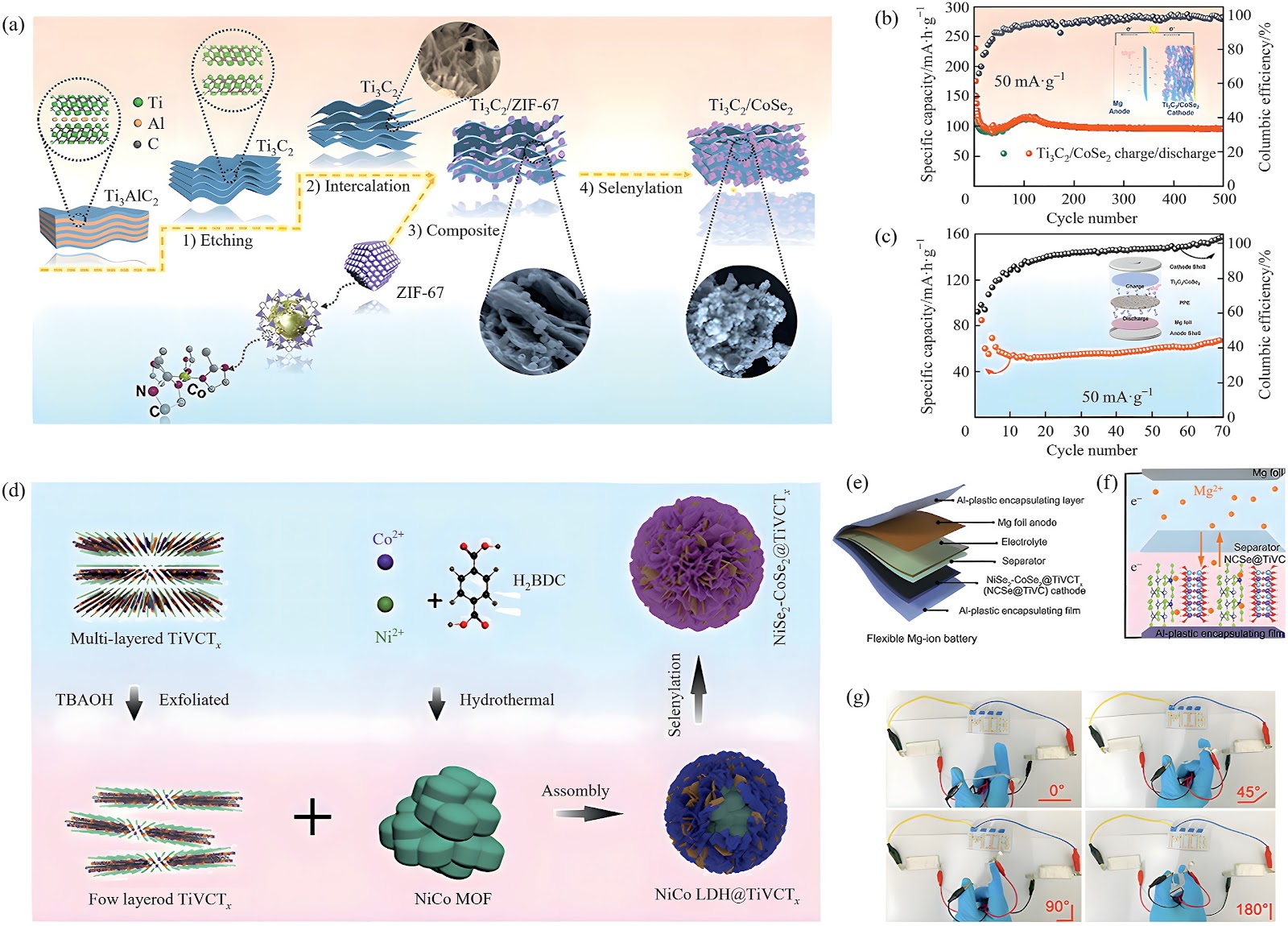
Two-dimensional (2D) transition metal carbides or nitrides (called MXenes) have been widely used in energy storage and conversion, optoelectronics and optical devices, sensors, electromagnetic interference shielding, and environmental remediation materials since it has been discovered in 2011. The general formula of MXene is Mn+1XnTx (n = 1–3), where M represents an early transition metal (such as Ti, Nb, Mo, V), X can be C and/or N, and Tx is surface terminations (such as hydroxyl, oxygen, or fluorine), which is closely related to the selected etching solution. Compared with most other 2D materials, MXenes possess adjustable surface structure characteristics, high metal conductivity (6000–8000 S·cm−1), and high theoretical capacity, showing significant advantages in energy storage devices such as lithium-ion batteries, lithium-sulfur battery, sodium-ion batteries, and supercapacitors. In addition, MXene is a promising candidate for frame or matrix materials. Its stable layered structure can effectively alleviate the volume expansion of some electrode materials (such as transition-metal chalcogenide (TMC)) during charge–discharge cycles and markedly improve the cycle performance of electrode materials. For example, Zhu et al. used Ti3C2 as a VS4 matrix to synthesize VS4@Ti3C2/C as the cathode of MIBs. After 900 cycles, it can still maintain 80% of magnesium storage capacity.
Loading authentic research manuscript (Pages 1–5)...
Liuyu Song, Haibo Li, Pengkai Wang, Yu Shang, Yue Yang, Zhaoyu Wu (2024). MXene: Promising materials for magnesium-ion batteries. Chinese Journal of Chemical Engineering. https://doi.org/10.1016/j_cjche_1448
Research & Educational Purpose Only:The translations, structured abstracts, analytical annotations, and data reports provided by SinoTechIntel are intended exclusively for academic research, internal corporate R&D, and educational benchmarking. They do not constitute formal engineering, chemical safety, legal, or professional advice.
Copyright & Intellectual Property Notice: Original copyright of the underlying source articles and experimental data remains with the respective authors, institutions, and original publishing journals. SinoTechIntel claims intellectual property only over its proprietary translations, analytical syntheses, and AEO structured enhancements in accordance with international fair use and academic citation principles.
Frequently Asked Questions
What are MXenes and why are they promising for magnesium-ion batteries?
MXenes are two-dimensional transition metal carbides or nitrides with high surface area, tunable surface chemistry, and excellent electrical conductivity. These properties make them promising as cathode materials or collectors for magnesium-ion batteries, potentially improving cycle life and rate capability.
What challenges do magnesium-ion batteries face?
Magnesium-ion batteries face challenges such as strong electrostatic interactions between the cathode and Mg2+ ions, which hinder intercalation and migration, and volume expansion during cycling due to the large size of Mg2+ ions. These issues lead to poor cycle stability and rate capability.
How can MXenes address the issues in magnesium-ion batteries?
MXenes can mitigate volume expansion through their stable layered structure, provide high electrical conductivity for efficient charge transfer, and offer adjustable surface properties that can be optimized for Mg-ion storage, thereby enhancing cycling stability and rate performance.
What is the significance of the 'anode-free' concept in magnesium batteries?
The 'anode-free' concept eliminates the use of bulk magnesium anode, which reduces weight and increases energy density. In this design, MXene serves as a collector for magnesium deposition, leveraging its high surface area and conductivity to improve battery performance.
What are the main synthesis methods for MXene discussed in the review?
The review summarizes various preparation and delamination methods for MXene, including selective etching of MAX phases and subsequent delamination techniques. These methods influence the surface terminations and quality of MXene, which are critical for its electrochemical performance in magnesium-ion batteries.
Related Technical Papers & Translations

Design and optimization of a high-efficiency distillation process for cellulosic fuel ethanol integrated with thermal coupling and molecular sieve adsorption
To address the challenges of high energy consumption and prominent costs in the traditional three-columns distillation process for cellulosic fuel ethanol, a distillation—molecular sieve coupling separation process is proposed. This process integrates a three-column (crude distillation column, first distillation column, second distillation column) system with a 3A molecular sieve adsorption deep dehydration unit. A thermal coupling network is constructed via differential pressure design (steam from medium/high-pressure columns as mutual heat sources, reboiler liquid waste heat for feed preheating), and molecular sieve adsorption conditions are optimized. The study first performs a thermodynamic consistency test on the ethanol—water system, determines optimal non-random two-liquid (NRTL) model binary interaction parameters via experimental data regression for Aspen Plus simulation. Aiming at minimum total annual cost (TAC), Aspen Plus is used to optimize process parameters (theoretical tray number, feed location, reflux ratio, side-draw position, etc.). Economic analysis shows this process reduces CO2 emission costs by 27.56%, TAC by 15.58% (to 5.123 × 10⁶ USD·a-1), and increases ethanol purity to >99.6%, providing an effective solution for green, efficient separation.

A cohesion loss model for determining residual strength of deep bedded sandstone
Rock residual strength, as an important input parameter, plays an indispensable role in proposing the reasonable and scientific scheme about stope design, underground tunnel excavation and stability evaluation of deep chambers. Therefore, previous residual strength models of rocks established were reviewed. And corresponding related problems were stated. Subsequently, starting from the effects of bedding and whole life-cycle evolution process, series of triaxial mechanical tests of deep bedded s

Federated model with contrastive learning and adaptive control variates for human activity recognition
Recent attention to privacy issues demands a communication-safe method for training human activity recognition (HAR) models on client activity data. Federated learning (FL) has become a compelling technique to facilitate model training between the server and clients while preserving data privacy. However, classical FL methods often assume independent and identically distributed (IID) data among clients. This assumption does not hold true in practical scenarios. Human activity in real-world scena