Key Takeaways & Executive Findings
- •• BCC high-entropy alloys (HEAs) enable multiscale regulation of thermodynamics and kinetics, offering a promising pathway to overcome the capacity–stability trade-offs of conventional hydrogen storage alloys. • Composition screening via empirical descriptors, CALPHAD thermodynamic modeling, and machine learning accelerates the rational design of high-performance BCC HEAs. • Processing routes such as melting, mechanical alloying, and emerging methods control chemical homogeneity and defect structures, critically influencing hydrogen storage behavior. • Hydrogen storage performance in BCC HEAs is determined by activation, thermodynamics, kinetics, and cyclic stability, with mechanistic origins linked to lattice distortion and local chemical environments.
Abstract
The thermodynamic and kinetic properties of body-centered-cubic (BCC) hydrogen storage alloys highly depend on their chemical compositions, making high-entropy alloying a promising strategy for performance optimization. However, clarifying how multi-principal element compositions regulate multiscale structures and thereby influence their hydrogen storage performance remains challenging, which limits the rational design of high-performance BCC high-entropy alloys (HEAs). This review provides a comprehensive overview of the recent advances in BCC HEAs for hydrogen storage, with emphasis on the multiscale regulation of their thermodynamics and kinetics. Empirical descriptor-guided composition screening, thermodynamic modeling based on the CALculation of PHAse Diagrams, and data-driven and machine learning-assisted approaches are discussed. In addition, the roles of melting-based processing, mechanical alloying, and emerging fabrication strategies in controlling the chemical homogeneity, defect structures, and microstructural stability of materials are examined. The hydrogen storage performance is analyzed in terms of activation behavior, thermodynamics, kinetics, and cyclic stability, with a focus on the underlying governing factors and mechanistic origins. Finally, prospective challenges and research directions are outlined to guide the design and processing of BCC HEAs.
1. Introduction
Owing to its high gravimetric energy density and zero point-of-use carbon emissions, hydrogen is widely regarded as a potential secondary energy carrier for future low-carbon energy systems [1–6]. However, hydrogen storage and transportation in the form of a compressed gas or cryogenic liquid suffer from high energy consumption, high cost, and safety concerns, which severely limit its large-scale deployment [7–11]. Solid-state hydrogen storage materials, particularly metal and alloy hydrides, offer high volumetric hydrogen storage density and improved safety and are therefore considered one of the most promising candidates for hydrogen storage across multiple application scenarios [12–18]. However, conventional metal hydrides are generally constrained by intrinsic trade-offs among hydrogen capacity, desorption temperature, absorption/desorption kinetics, and cycling stability [19–25]. For example, Mg/MgH2 possesses a high theoretical gravimetric hydrogen capacity of 7.6wt% [26–27]; however, strong Mg–H bonding leads to increased desorption temperatures and sluggish kinetics [28–34]. By contrast, intermetallic compounds, such as TiFe and LaNi5, can reversibly absorb and desorb hydrogen under mild conditions but typically exhibit low gravimetric hydrogen storage capacities [35–39].
By incorporating multiple principal elements, the resulting high configurational entropy stabilizes simple solid-solution phases. Lattice distortion and diverse local chemical environments provide unique flexibility for tuning hydrogen occupancy, diffusion pathways, and metal–hydrogen interactions [35,40–41]. The tuned characteristics introduce additional degrees of freedom for regulating hydride active sites, hydrogen diffusion pathways, and metal–hydrogen interactions, thereby offering new opportunities and design strategies for advanced hydrogen storage materials.
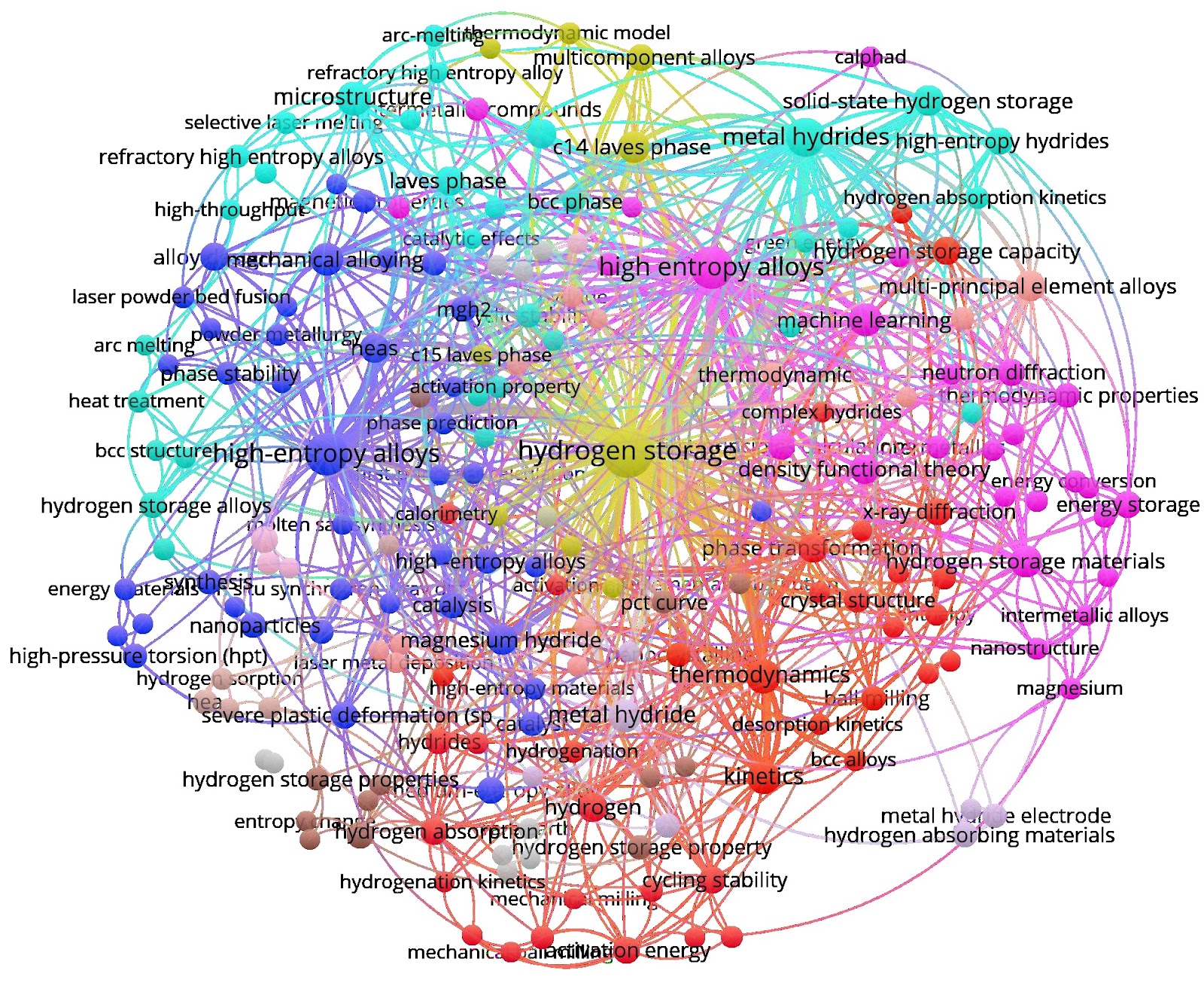
The Web of Science Core Collection was searched on December 31, 2025, using “high entropy alloys for hydrogen storage” as the topic search term. To ensure a fair comparison, the annual publication statistics in Fig. 1(a) are plotted by year and limited to the 1996–2025 period. As Fig. 1(a) shows, the number of annual publications on high-entropy alloys (HEAs) for hydrogen storage has been increasing significantly since 2019, reaching 129 by 2025. This trend demonstrates the notable development and growing research interest in the field. Fig. 1(b) presents the keyword co-occurrence network of research on high-entropy hydrogen storage alloys, revealing four closely interconnected research themes: alloy design (magenta clusters), synthesis and processing (blue clusters), microstructure regulation (cyan clusters), and fundamental mechanisms (red clusters). Keywords related to alloy design, such as HEAs, multi-principal element alloys, body-centered-cubic (BCC) alloys, and Laves phases, form a prominent cluster.
Loading authentic research manuscript (Pages 1–5)...
Zefeng Li, Yi Jiang, Junjie Li, Yangfan Lu, Xiaoming Xiong, Shenglan Yang, Qun Luo, Yan Yang, Qian Li (2025). Multiscale regulation of thermodynamics and kinetics in high-entropy body-centered cubic type hydrogen storage alloys. Journal of Mineral Metallurgy and Materials Science. https://doi.org/10.1007/s12613-026-3456-z
Research & Educational Purpose Only:The translations, structured abstracts, analytical annotations, and data reports provided by SinoTechIntel are intended exclusively for academic research, internal corporate R&D, and educational benchmarking. They do not constitute formal engineering, chemical safety, legal, or professional advice.
Copyright & Intellectual Property Notice: Original copyright of the underlying source articles and experimental data remains with the respective authors, institutions, and original publishing journals. SinoTechIntel claims intellectual property only over its proprietary translations, analytical syntheses, and AEO structured enhancements in accordance with international fair use and academic citation principles.
Frequently Asked Questions
What are body-centered-cubic (BCC) high-entropy alloys for hydrogen storage?
BCC high-entropy alloys (HEAs) are multi-principal element alloys with a body-centered cubic crystal structure. Their high configurational entropy stabilizes simple solid-solution phases, and the lattice distortion and diverse local chemical environments provide unique flexibility for tuning hydrogen occupancy, diffusion pathways, and metal–hydrogen interactions, making them promising for solid-state hydrogen storage.
How does high-entropy alloying improve hydrogen storage performance?
High-entropy alloying introduces multiple principal elements, which creates a high configurational entropy that stabilizes simple solid-solution phases. This results in lattice distortion and diverse local chemical environments, allowing for the tuning of hydrogen occupancy, diffusion pathways, and metal–hydrogen interactions. This provides additional degrees of freedom to regulate hydride active sites and hydrogen diffusion pathways, leading to improved thermodynamics and kinetics.
What are the main challenges in designing BCC HEAs for hydrogen storage?
The main challenges include clarifying how multi-principal element compositions regulate multiscale structures and influence hydrogen storage performance, as well as overcoming the intrinsic trade-offs among hydrogen capacity, desorption temperature, absorption/desorption kinetics, and cycling stability. Rational design requires integrating empirical descriptors, thermodynamic modeling, and machine learning approaches.
What processing methods are used to fabricate BCC high-entropy hydrogen storage alloys?
Common processing methods include melting-based processing, mechanical alloying, and emerging fabrication strategies. These methods control the chemical homogeneity, defect structures, and microstructural stability of the materials, which in turn affect their hydrogen storage performance.
What is the significance of multiscale regulation in BCC high-entropy hydrogen storage alloys?
Multiscale regulation refers to the control of thermodynamics and kinetics across different length scales, from atomic-level composition to microstructural features. In BCC HEAs, this is achieved through composition screening, thermodynamic modeling, and processing control, enabling the optimization of activation behavior, thermodynamics, kinetics, and cyclic stability for advanced hydrogen storage applications.
Related Technical Papers & Translations

Design and optimization of a high-efficiency distillation process for cellulosic fuel ethanol integrated with thermal coupling and molecular sieve adsorption
To address the challenges of high energy consumption and prominent costs in the traditional three-columns distillation process for cellulosic fuel ethanol, a distillation—molecular sieve coupling separation process is proposed. This process integrates a three-column (crude distillation column, first distillation column, second distillation column) system with a 3A molecular sieve adsorption deep dehydration unit. A thermal coupling network is constructed via differential pressure design (steam from medium/high-pressure columns as mutual heat sources, reboiler liquid waste heat for feed preheating), and molecular sieve adsorption conditions are optimized. The study first performs a thermodynamic consistency test on the ethanol—water system, determines optimal non-random two-liquid (NRTL) model binary interaction parameters via experimental data regression for Aspen Plus simulation. Aiming at minimum total annual cost (TAC), Aspen Plus is used to optimize process parameters (theoretical tray number, feed location, reflux ratio, side-draw position, etc.). Economic analysis shows this process reduces CO2 emission costs by 27.56%, TAC by 15.58% (to 5.123 × 10⁶ USD·a-1), and increases ethanol purity to >99.6%, providing an effective solution for green, efficient separation.

A cohesion loss model for determining residual strength of deep bedded sandstone
Rock residual strength, as an important input parameter, plays an indispensable role in proposing the reasonable and scientific scheme about stope design, underground tunnel excavation and stability evaluation of deep chambers. Therefore, previous residual strength models of rocks established were reviewed. And corresponding related problems were stated. Subsequently, starting from the effects of bedding and whole life-cycle evolution process, series of triaxial mechanical tests of deep bedded s

Federated model with contrastive learning and adaptive control variates for human activity recognition
Recent attention to privacy issues demands a communication-safe method for training human activity recognition (HAR) models on client activity data. Federated learning (FL) has become a compelling technique to facilitate model training between the server and clients while preserving data privacy. However, classical FL methods often assume independent and identically distributed (IID) data among clients. This assumption does not hold true in practical scenarios. Human activity in real-world scena