Key Takeaways & Executive Findings
- •• Proposes a novel multi-timescale feature extraction method using adaptive entropy to handle varying sampling frequencies in wastewater treatment. • Integrates expert knowledge graph with multiscale entropy analysis and partial least squares to enhance data representation and monitoring. • Demonstrates improved water quality data representation and monitoring capabilities through experimental validation. • Addresses the challenge of information loss and errors from data interpolation in multi-timescale wastewater data.
Abstract
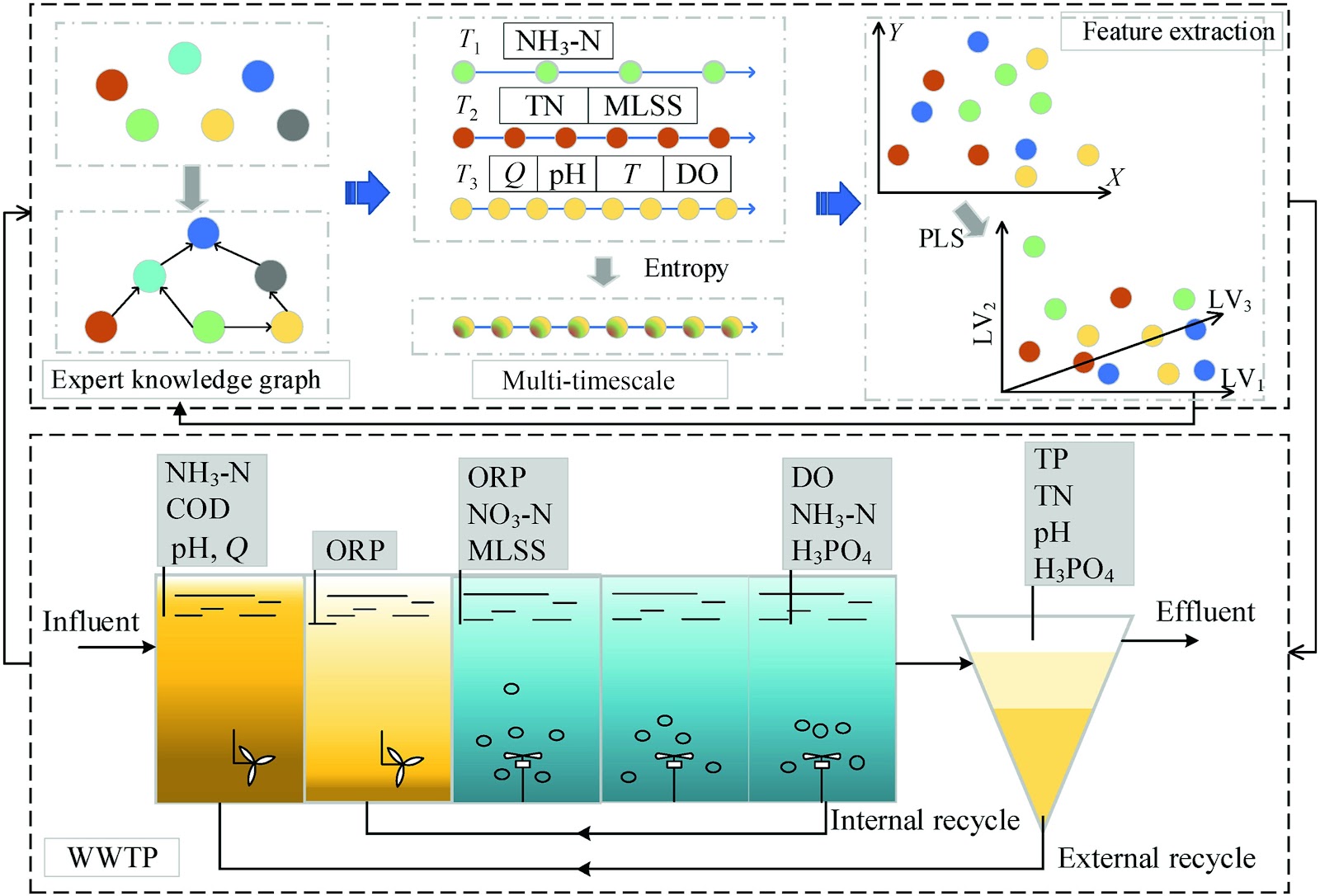
In wastewater treatment systems, extracting meaningful features from process data is essential for effective monitoring and control. However, the multi-time scale data generated by different sampling frequencies pose a challenge to accurately extract features. To solve this issue, a multi-timescale feature extraction method based on adaptive entropy is proposed. Firstly, the expert knowledge graph is constructed by analyzing the characteristics of wastewater components and water quality data, which can illustrate various water quality parameters and the network of relationships among them. Secondly, multiscale entropy analysis is used to investigate the inherent multi-timescale patterns of water quality data in depth, which enables us to minimize information loss while uniformly optimizing the timescale. Thirdly, we harness partial least squares for feature extraction, resulting in an enhanced representation of sample data and the iterative enhancement of our expert knowledge graph. The experimental results show that the multi-timescale feature extraction algorithm can enhance the representation of water quality data and improve monitoring capabilities.
1. Introduction
With the increasing awareness of environmental protection, wastewater treatment has become a crucial issue [1e4]. In order to meet the effluent quality requirements, the wastewater treatment process (WWTP) and effluent must be monitored and reported. In recent years, water quality monitoring systems that use sensors to collect real-time data of water environment have been extensively applied [5e7]. At the same time, massive amounts of historical data are collected and stored. Data analysis plays a critical role in supporting the development and optimization of wastewater treatment systems [8e11]. The raw data often contains a lot of redundant information, noise, and irrelevant features that can interfere with subsequent analysis [12,13]. Feature extraction which can improve data quality, reduce dimensionality, increase model performance, enhance interpretability, and facilitate data visualization, is essential for analyzing data [14e16]. Wastewater treatment involves multi-timescale, as the treatment process includes transient events and long-term trends [17,18]. However, in practice, the multi-timescale data caused by different sampling frequencies will make the feature extraction insufficient. Specifically, there may be loss of information and additional errors introduced due to data interpolation. Therefore, multi-timescale feature extraction of WWTP is an important and necessary step before applying data analysis.
WWTP involves a large number of water quality parameters. The relationship between the parameters is complex and there is a coupling relationship. This makes it necessary to have expertise in the field of wastewater treatment prior to data analysis. Knowledge graph (KG) is a graph-based data structure used to describe concepts and their relationships in the physical world [19,20]. KG technology can obtain structured knowledge from massive data, achieve unified expression and efficient storage, and is an effective means to solve the problem of massive data management in the process of wastewater treatment. In order to support domain-specific applications, domain KG have also received attention. Based on multi-source heterogeneous data, a knowledge graph was built as information integration system for contaminated site [21].
Loading authentic research manuscript (Pages 1–5)...
Honggui Han, Yaqian Zhao, Xiaolong Wu, Hongyan Yang (2024). Multi-timescale feature extraction method of wastewater treatment process based on adaptive entropy. Chinese Journal of Chemical Engineering. https://doi.org/10.1016/j_cjche_1448
Research & Educational Purpose Only:The translations, structured abstracts, analytical annotations, and data reports provided by SinoTechIntel are intended exclusively for academic research, internal corporate R&D, and educational benchmarking. They do not constitute formal engineering, chemical safety, legal, or professional advice.
Copyright & Intellectual Property Notice: Original copyright of the underlying source articles and experimental data remains with the respective authors, institutions, and original publishing journals. SinoTechIntel claims intellectual property only over its proprietary translations, analytical syntheses, and AEO structured enhancements in accordance with international fair use and academic citation principles.
Frequently Asked Questions
What is the main challenge addressed by this paper?
The paper addresses the challenge of extracting meaningful features from multi-timescale data in wastewater treatment processes, where different sampling frequencies can lead to information loss and errors due to data interpolation.
How does the proposed method work?
The method constructs an expert knowledge graph to represent water quality parameters and their relationships, uses multiscale entropy analysis to capture inherent multi-timescale patterns, and applies partial least squares for feature extraction, iteratively enhancing the knowledge graph.
What are the key benefits of the proposed approach?
The approach minimizes information loss, optimizes timescale uniformly, enhances data representation, and improves monitoring capabilities in wastewater treatment systems.
What is the role of the knowledge graph in this method?
The knowledge graph illustrates various water quality parameters and their relationships, providing structured domain knowledge that supports feature extraction and is iteratively enhanced during the process.
What are the experimental results?
The experimental results show that the multi-timescale feature extraction algorithm enhances the representation of water quality data and improves monitoring capabilities, validating the effectiveness of the proposed method.
Related Technical Papers & Translations

Design and optimization of a high-efficiency distillation process for cellulosic fuel ethanol integrated with thermal coupling and molecular sieve adsorption
To address the challenges of high energy consumption and prominent costs in the traditional three-columns distillation process for cellulosic fuel ethanol, a distillation—molecular sieve coupling separation process is proposed. This process integrates a three-column (crude distillation column, first distillation column, second distillation column) system with a 3A molecular sieve adsorption deep dehydration unit. A thermal coupling network is constructed via differential pressure design (steam from medium/high-pressure columns as mutual heat sources, reboiler liquid waste heat for feed preheating), and molecular sieve adsorption conditions are optimized. The study first performs a thermodynamic consistency test on the ethanol—water system, determines optimal non-random two-liquid (NRTL) model binary interaction parameters via experimental data regression for Aspen Plus simulation. Aiming at minimum total annual cost (TAC), Aspen Plus is used to optimize process parameters (theoretical tray number, feed location, reflux ratio, side-draw position, etc.). Economic analysis shows this process reduces CO2 emission costs by 27.56%, TAC by 15.58% (to 5.123 × 10⁶ USD·a-1), and increases ethanol purity to >99.6%, providing an effective solution for green, efficient separation.

A cohesion loss model for determining residual strength of deep bedded sandstone
Rock residual strength, as an important input parameter, plays an indispensable role in proposing the reasonable and scientific scheme about stope design, underground tunnel excavation and stability evaluation of deep chambers. Therefore, previous residual strength models of rocks established were reviewed. And corresponding related problems were stated. Subsequently, starting from the effects of bedding and whole life-cycle evolution process, series of triaxial mechanical tests of deep bedded s

Federated model with contrastive learning and adaptive control variates for human activity recognition
Recent attention to privacy issues demands a communication-safe method for training human activity recognition (HAR) models on client activity data. Federated learning (FL) has become a compelling technique to facilitate model training between the server and clients while preserving data privacy. However, classical FL methods often assume independent and identically distributed (IID) data among clients. This assumption does not hold true in practical scenarios. Human activity in real-world scena