Key Takeaways & Executive Findings
- •• A miniaturized HMSIW-based diplexer using TE101/TE301 dual-mode resonator achieves wide stopband up to 2.16f1 with >20 dB out-of-band rejection. • The TE202 mode is effectively suppressed in HMSIRCs due to magnetic wall symmetry, overcoming the conventional 2f1 stopband limitation. • The second-order prototype at 10.34/13.90 GHz exhibits a compact footprint of only 1.363λg², enabled by eliminating T-junctions and reducing resonator count. • The proposed design offers high isolation and low insertion loss with simplified manufacturing, making it suitable for advanced wireless communication systems.
Abstract
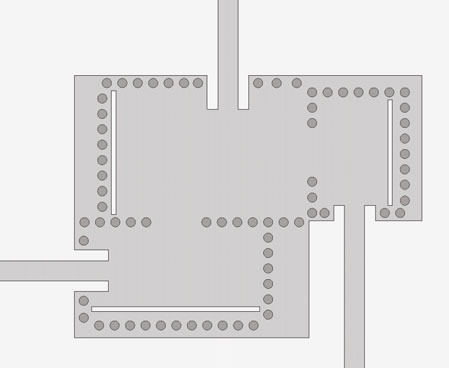
A miniaturized diplexer with a wide-stopband based on half-mode substrate integrated waveguide (HMSIW) is proposed. The diplexer combines a dual-mode resonator (DMR) with single-mode resonators (SMRs). The employment of HMSIW technology breaks through the limitations of SMRs on miniaturization, while effectively addressing the limitation on wide-stopband performance that is typically encountered with the TE202 mode in the SMRs. A second-order prototype, centered at 10.34 GHz and 13.90 GHz, has been designed and fabricated, using a TE101/TE301 DMR. The measured out-of-band rejection is better than 20 dB with a frequency of up to 2.16f1 (f1 is the center frequency of channel 1). Meanwhile, the size of the diplexer is reduced to 1.363λg² (λg is the guided wavelength in the dielectric substrate at f1).
1. Introduction
As a special type of filter, diplexers separate the transmission and reception channels of a common antenna. Due to the significant impact on wireless communication systems, the trend in diplexer design focuses on wide-stopband performance, high isolation, low insertion loss, and miniaturization (Bavandpour et al., 2021; Roshani et al., 2023). Substrate integrated waveguide (SIW) technology has become an effective solution for diplexer designs as it provides high Q and electromagnetic interference shielding while significantly reducing the size.
In a conventional design, T-junctions are used in diplexers to separate two passbands (Sirci et al., 2015). Many studies aim to minimize the circuit size by eliminating T-junctions. A compact diplexer has been proposed (Cheng et al., 2013), using multiple DMR connections, which cannot control the bandwidth of two channels separately. Another approach integrates DMR and SMRs within a diplexer to independently control the bandwidth of each passband, establishing a classic topology (Zhou et al., 2018a). However, this topology still incorporates multiple SMRs, which occupy a significant amount of space and hinder further miniaturization. Alternative miniaturization methods have been proposed, such as multi-layer stacking technology (Iqbal et al., 2019), HMSIW (Zhou and Wu, 2021), and folded SIW (Sieganschin et al., 2021). Nevertheless, both multi-layer technology and folded SIW increase the design complexity and manufacturing costs.
The stopband characteristic is also one of the key performances of diplexers, as the wide-stopband can effectively reduce the external or internal signal interference. However, designing compact SIW diplexers with a wide-stopband remains a challenge. Building on the topology that combines DMR and SMRs, various techniques have been implemented to achieve wide-stopband SIW diplexers without T-junctions, such as the harmonic staggered technique (Zhou et al., 2020), orthogonal transmission (Xie et al., 2020), and center-coupled windows (Ma et al., 2023). However, in these studies, since the TE202 mode in the SMRs is not completely suppressed, the boundary of the stopband is limited to around 2f1.
In this study, a compact and wide-stopband SIW diplexer is proposed, based on the HMSIW technology. Using half-mode substrate integrated rectangular cavities (HMSIRCs) as DMR and SMRs overcomes the limitations of SMRs on the miniaturization and wide-stopband performance. The TE202 mode is effectively eliminated from SMRs as the specific even modes in HMSIRC are not excited due to magnetic walls in the symmetry plane (Lai et al., 2009). The TE102 mode is suppressed, elevating TE301 as the first unsuppressed mode in SMRs. Therefore, the diplexer can obtain a wider stopband only through second-order resonance. The usage of HMSIRCs, coupled with a reduced number of resonators, further minimizes the circuit size. A second-order prototype based on TE101/TE301 DMR is designed and fabricated, covering a wide range of frequency ratios. Measurements show that the prototype exhibits excellent stopband performance with a small size.
Loading authentic research manuscript (Pages 1–5)...
Ziyu Zhou, Gang Dong, Xinqing Lei, Zhangming Zhu (2025). Miniaturized diplexer with wide-stopband based on half-mode substrate integrated waveguide. Frontiers of Information Technology & Electronic Engineering. https://doi.org/10.1631/FITEE_2400944
Research & Educational Purpose Only:The translations, structured abstracts, analytical annotations, and data reports provided by SinoTechIntel are intended exclusively for academic research, internal corporate R&D, and educational benchmarking. They do not constitute formal engineering, chemical safety, legal, or professional advice.
Copyright & Intellectual Property Notice: Original copyright of the underlying source articles and experimental data remains with the respective authors, institutions, and original publishing journals. SinoTechIntel claims intellectual property only over its proprietary translations, analytical syntheses, and AEO structured enhancements in accordance with international fair use and academic citation principles.
Frequently Asked Questions
What is the main contribution of this paper?
The paper proposes a miniaturized SIW diplexer using half-mode substrate integrated waveguide (HMSIW) and a TE101/TE301 dual-mode resonator, achieving a wide stopband up to 2.16f1 and a compact size of only 1.363λg².
How does the proposed diplexer achieve a wide stopband?
It exploits HMSIRCs to suppress the TE202 mode via magnetic wall symmetry, eliminating the harmonic that typically limits the stopband to about 2f1. This extends the stopband to 2.16f1 with out-of-band rejection better than 20 dB.
What are the measured results of the prototype?
A second-order prototype operating at 10.34 GHz and 13.90 GHz achieves out-of-band rejection better than 20 dB up to 2.16f1, with a compact footprint of 1.363λg².
How is miniaturization achieved in this design?
Miniaturization is achieved by using HMSIW technology, which reduces the number of resonators and eliminates T-junctions, resulting in a significantly smaller circuit area.
What is the significance of eliminating the T-junction?
Eliminating the T-junction simplifies the design and reduces circuit size while maintaining independent control of each passband's bandwidth, which is a key improvement over conventional diplexer topologies.
Related Technical Papers & Translations

Design and optimization of a high-efficiency distillation process for cellulosic fuel ethanol integrated with thermal coupling and molecular sieve adsorption
To address the challenges of high energy consumption and prominent costs in the traditional three-columns distillation process for cellulosic fuel ethanol, a distillation—molecular sieve coupling separation process is proposed. This process integrates a three-column (crude distillation column, first distillation column, second distillation column) system with a 3A molecular sieve adsorption deep dehydration unit. A thermal coupling network is constructed via differential pressure design (steam from medium/high-pressure columns as mutual heat sources, reboiler liquid waste heat for feed preheating), and molecular sieve adsorption conditions are optimized. The study first performs a thermodynamic consistency test on the ethanol—water system, determines optimal non-random two-liquid (NRTL) model binary interaction parameters via experimental data regression for Aspen Plus simulation. Aiming at minimum total annual cost (TAC), Aspen Plus is used to optimize process parameters (theoretical tray number, feed location, reflux ratio, side-draw position, etc.). Economic analysis shows this process reduces CO2 emission costs by 27.56%, TAC by 15.58% (to 5.123 × 10⁶ USD·a-1), and increases ethanol purity to >99.6%, providing an effective solution for green, efficient separation.

A cohesion loss model for determining residual strength of deep bedded sandstone
Rock residual strength, as an important input parameter, plays an indispensable role in proposing the reasonable and scientific scheme about stope design, underground tunnel excavation and stability evaluation of deep chambers. Therefore, previous residual strength models of rocks established were reviewed. And corresponding related problems were stated. Subsequently, starting from the effects of bedding and whole life-cycle evolution process, series of triaxial mechanical tests of deep bedded s

Federated model with contrastive learning and adaptive control variates for human activity recognition
Recent attention to privacy issues demands a communication-safe method for training human activity recognition (HAR) models on client activity data. Federated learning (FL) has become a compelling technique to facilitate model training between the server and clients while preserving data privacy. However, classical FL methods often assume independent and identically distributed (IID) data among clients. This assumption does not hold true in practical scenarios. Human activity in real-world scena