Key Takeaways & Executive Findings
- •• SiC-TiC particle reinforcement achieves near-full density (up to 100%) in SLM-fabricated Al-Mg-Sc-Zr composites, significantly improving forming quality. • In-situ formation of acicular Al4SiC4 bands via interfacial reaction between SiC and Al matrix, while TiC forms a semi-coherent interface with strong bonding. • TiC nanoparticles exert grain-boundary pinning, refining equiaxial grains and preventing transition to columnar structure. • The composite achieves UTS ~394 MPa, YS ~262 MPa, EL ~8.2%, and elastic modulus ~86 GPa, addressing the low elastic modulus limitation of SLMed aluminum alloys.
Abstract
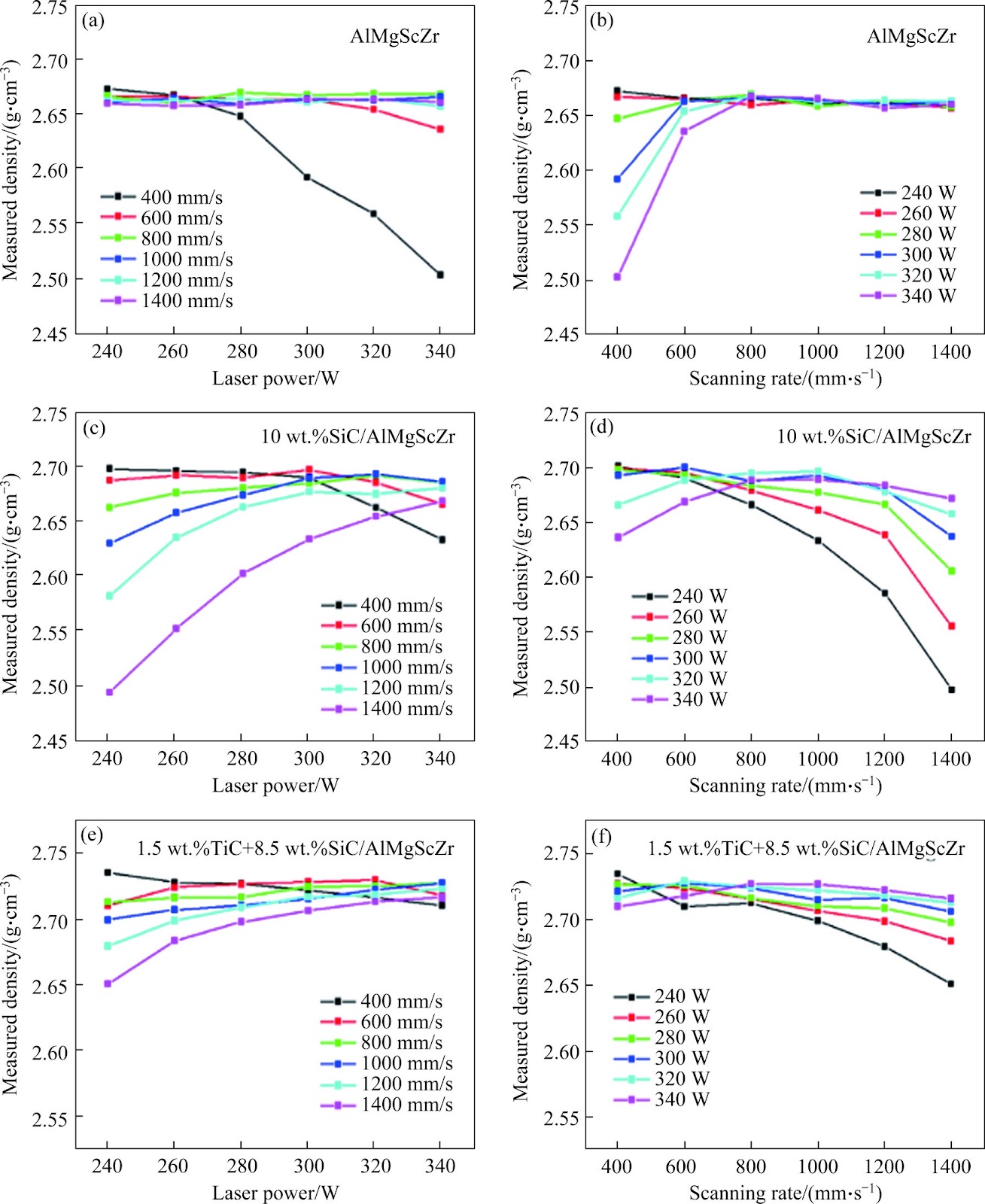
In order to obtain high-density dual-scale ceramic particles (8.5 wt.% SiC+1.5 wt.% TiC) reinforced Al-Mg-Sc-Zr composites with uniform microstructure, 50 nm TiC and 7 μm SiC particles were pre-dispersed into 15−53 μm aluminum alloy powders by low-speed ball milling and mechanical mixing technology, respectively. Then, the effects of laser energy density, power and scanning rate on the density of the composites were investigated based on selective laser melting (SLM) technology. The effect of micron-sized SiC and nano-sized TiC particles on solidification structure, mechanical properties and fracture behaviors of the composites was revealed and analyzed in detail. Interfacial reaction and phase variations in the composites with varying reinforced particles were emphatically considered. Results showed that SiC-TiC particles could significantly improve forming quality and density of the SLMed composites, and the optimal relative density was up to 100%. In the process of laser melting, a strong chemical reaction occurs between SiC and aluminum matrix, and micron-scale acicular Al4SiC4 bands were formed in situ. There was no interfacial reaction between TiC particles and aluminum matrix. TiC/Al semi-coherent interface had good bonding strength. Pinning effect of TiC particles in grain boundaries could prevent the equiaxial crystals from growing and transforming into columnar crystals, resulting in grain refinement. The optimal ultimate tensile strength (UTS), yield strength (YS), elongation (EL) and elastic modulus of the SiC-TiC/Al-Mg-Sc-Zr composite were ~394 MPa, ~262 MPa, ~8.2% and ~86 GPa, respectively. The fracture behavior of the composites included ductile fracture of Al matrix and brittle cleavage fracture of Al4SiC4 phases. A large number of cross-distributed acicular Al4SiC4 bands were the main factors leading to premature failure and fracture of SiC-TiC/Al-Mg-Sc-Zr composites.
1. Introduction
Selective laser melting (SLM), as one of the most promising additive manufacturing (AM) technologies, brings tremendous opportunities for fabricating metallic components, especially those with complex structures [1−3]. Aluminum alloys are widely used in automotive and aerospace industries due to their high specific strength, corrosion resistance and low production cost [4−6]. Nevertheless, the low absorption rate of aluminum to laser energy [7−9], the easy burning loss of alloying elements with low melting point and the high affinity of aluminum melt to oxygen [10] make it difficult to fabricate aluminum alloy parts with high forming quality and high mechanical properties by laser additive technology.
So far, SLMed aluminum alloy investigations mainly focus on Al-Si alloy systems, such as AlSi10Mg [11, 12] and Al-12Si [13] alloys. This is due to the fact that these alloys have near eutectic composition and a narrow solidification range, which display good processability of SLM. However, SLMed Al-Si alloys have low tensile strength (about 350 MPa) and cannot meet increasing demands of advanced engineering materials. Al-Mg alloys, a type of Al-based materials with high strength, favorability ductility and good weldability, especially, the Sc/Zr-modified Al-Mg alloys possessing good weldability, have obtained extensive attention within the research and engineering communities. The addition of Sc and Zr alloying elements can effectively reduce the hot cracking sensitivity of high-strength aluminum alloy and eliminate the crack. After aging treatment, the tensile strength of SLMed Al-Mg-Sc-Zr alloy can reach more than 500 MPa, but the elastic modulus is still at a low level (60−70 GPa) [14, 15], much lower than that of titanium alloy (~110 GPa). The poor elastic modulus is one of the key hurdles impeding further applications of SLMed aluminum alloys as high-performance structural materials.
Fortunately, it is well established that adding reinforced particles to aluminum alloys can effectively improve their tensile strength and elastic modulus [12−14]. Aluminum matrix composites (AMCs) can combine the toughness and ductility of the Al matrix with the hardness and stiffness of reinforced particles.
Loading authentic research manuscript (Pages 1–5)...
LU Ren-yi, MA Guo-nan, BAI Guan-shun, ZHAO Wen-tian, ZHANG Hui-hua, ZHAO Shu-ming, ZHUANG Xin-peng (2025). Microstructure and mechanical properties of novel SiC-TiC/Al-Mg-Sc-Zr composites prepared by selective laser melting. Journal of Central South University. https://doi.org/10.1007/s11771-025-5963-x
Research & Educational Purpose Only:The translations, structured abstracts, analytical annotations, and data reports provided by SinoTechIntel are intended exclusively for academic research, internal corporate R&D, and educational benchmarking. They do not constitute formal engineering, chemical safety, legal, or professional advice.
Copyright & Intellectual Property Notice: Original copyright of the underlying source articles and experimental data remains with the respective authors, institutions, and original publishing journals. SinoTechIntel claims intellectual property only over its proprietary translations, analytical syntheses, and AEO structured enhancements in accordance with international fair use and academic citation principles.
Frequently Asked Questions
What are the key mechanical properties of the SiC-TiC/Al-Mg-Sc-Zr composite produced by selective laser melting?
The optimized composite exhibits an ultimate tensile strength of ~394 MPa, yield strength of ~262 MPa, elongation of ~8.2%, and elastic modulus of ~86 GPa, significantly improving the elastic modulus compared to conventional SLMed Al-Mg-Sc-Zr alloys (60–70 GPa).
How does the addition of SiC and TiC particles enhance the forming quality of the SLM composite?
The dual-scale ceramic particles (8.5 wt.% SiC + 1.5 wt.% TiC) significantly improve forming quality and density, achieving a relative density of up to 100% during selective laser melting.
What interfacial reactions occur between the reinforcements and the aluminum matrix?
During laser melting, SiC reacts strongly with the aluminum matrix to form in-situ micron-scale acicular Al4SiC4 bands, while TiC particles show no interfacial reaction and form a semi-coherent interface with good bonding strength.
How do TiC nanoparticles contribute to grain refinement?
TiC nanoparticles exert a pinning effect at grain boundaries, preventing equiaxed crystals from growing and transforming into columnar crystals, thereby refining the grain structure.
Why is this research significant for additive manufacturing of aluminum alloys?
The study demonstrates a novel approach to enhance the elastic modulus of SLMed aluminum alloys through hybrid particle reinforcement, addressing a key limitation for high-performance structural and engineering applications.
Related Technical Papers & Translations

Design and optimization of a high-efficiency distillation process for cellulosic fuel ethanol integrated with thermal coupling and molecular sieve adsorption
To address the challenges of high energy consumption and prominent costs in the traditional three-columns distillation process for cellulosic fuel ethanol, a distillation—molecular sieve coupling separation process is proposed. This process integrates a three-column (crude distillation column, first distillation column, second distillation column) system with a 3A molecular sieve adsorption deep dehydration unit. A thermal coupling network is constructed via differential pressure design (steam from medium/high-pressure columns as mutual heat sources, reboiler liquid waste heat for feed preheating), and molecular sieve adsorption conditions are optimized. The study first performs a thermodynamic consistency test on the ethanol—water system, determines optimal non-random two-liquid (NRTL) model binary interaction parameters via experimental data regression for Aspen Plus simulation. Aiming at minimum total annual cost (TAC), Aspen Plus is used to optimize process parameters (theoretical tray number, feed location, reflux ratio, side-draw position, etc.). Economic analysis shows this process reduces CO2 emission costs by 27.56%, TAC by 15.58% (to 5.123 × 10⁶ USD·a-1), and increases ethanol purity to >99.6%, providing an effective solution for green, efficient separation.

A cohesion loss model for determining residual strength of deep bedded sandstone
Rock residual strength, as an important input parameter, plays an indispensable role in proposing the reasonable and scientific scheme about stope design, underground tunnel excavation and stability evaluation of deep chambers. Therefore, previous residual strength models of rocks established were reviewed. And corresponding related problems were stated. Subsequently, starting from the effects of bedding and whole life-cycle evolution process, series of triaxial mechanical tests of deep bedded s

Federated model with contrastive learning and adaptive control variates for human activity recognition
Recent attention to privacy issues demands a communication-safe method for training human activity recognition (HAR) models on client activity data. Federated learning (FL) has become a compelling technique to facilitate model training between the server and clients while preserving data privacy. However, classical FL methods often assume independent and identically distributed (IID) data among clients. This assumption does not hold true in practical scenarios. Human activity in real-world scena