Key Takeaways & Executive Findings
- •• Increasing NaCl concentration accelerates the initial dissociation rate of methane hydrates at 268.15 K, with negligible self-preservation observed at 3.35% NaCl and in seawater systems. • In situ Raman spectroscopy and confocal microscopy reveal that hydrate dissociation below the ice point proceeds via intermediate liquid water before ice formation, not directly to solid ice. • Salt ions disrupt the water-to-ice transition, thereby weakening the self-preservation effect of methane hydrates. • These findings inform strategies for gas storage/transport and natural gas hydrate exploitation, highlighting the need to account for salinity in self-preservation applications.
Abstract
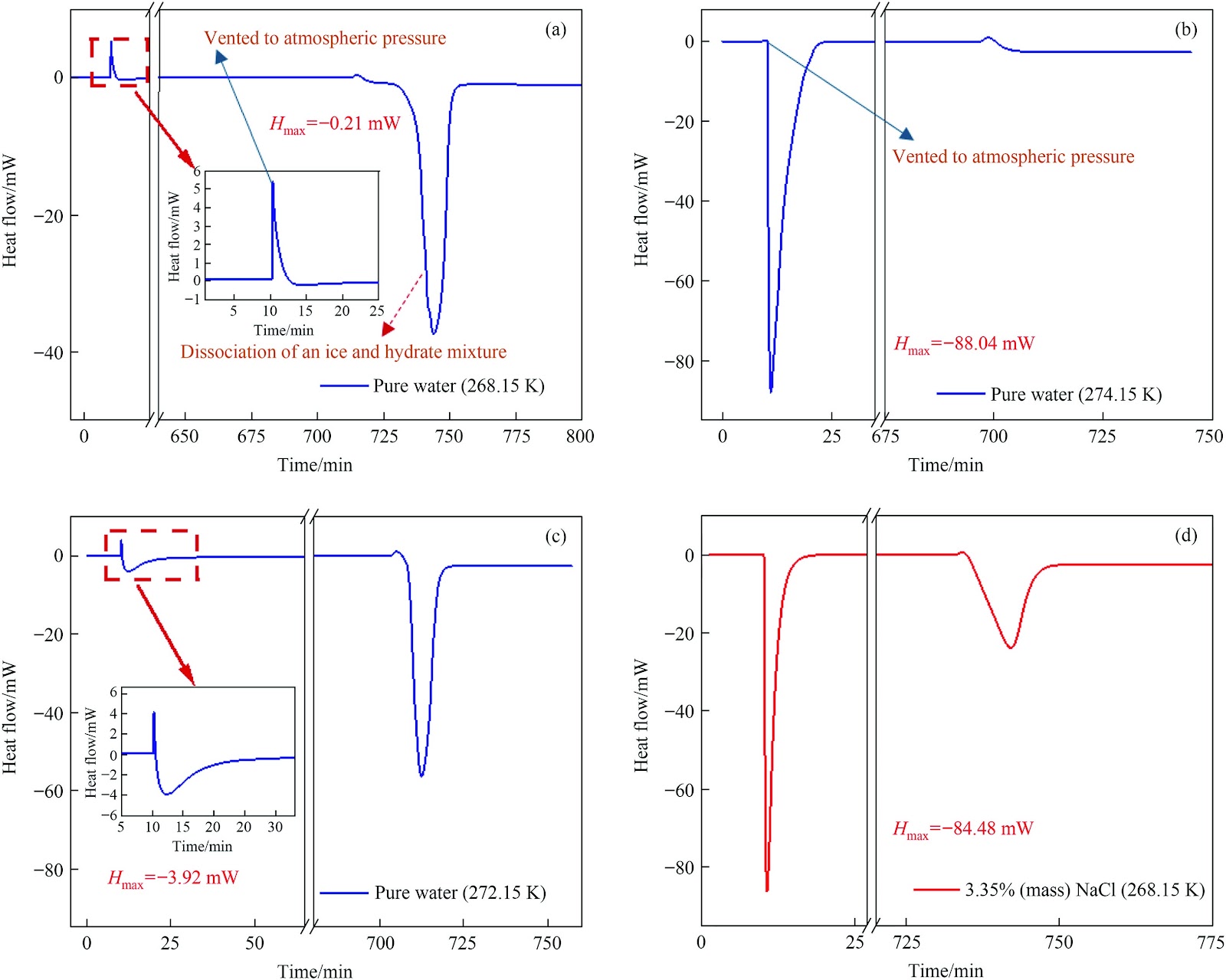
It is known that salt ions are abundant in the natural environment where natural gas hydrates are located; thus, it is essential to investigate the self-preservation effect of salt ions on methane hydrates. The dissociation behaviors of gas hydrates formed from various NaCl concentration solutions in a quartz sand system at 268.15 K were investigated to reveal the microscopic mechanism of the self-preservation effect under different salt concentrations. Results showed that as the salt concentration rises, the initial rate of hydrate decomposition quickens. Methane hydrate hardly shows self-preservation ability in the 3.35% (mass) NaCl and seawater systems at 268.15 K. Combined the morphology of hydrate observed by the confocal microscope with results obtained from in situ Raman spectroscopy, it was found that during the initial decomposition stage of gas hydrate below the ice point, gas hydrate firstly converts into liquid water and gas molecules, then turns from water to solid ice rather than directly transforming into solid ice and gas molecules. The presence of salt ions interferes with the ability of liquid water to condense into solid ice. The results of this study provide an important guide for the mechanism and application of the self-preservation effect on the storage and transport of gas and the exploitation of natural gas hydrates.
1. Introduction
Gas hydrates are generated by gas and water at low temperatures and high pressures, which are cage-like crystal non-stoichiometric compounds [1]. The structure of gas hydrate was classified into three types based on the size of guest molecules that participated in the formation of hydrate: sI, sII, and sH [1e3]. Since the first discovery of hydrate in 1810, gas hydrate as a potential energy in the future has attracted much attention from many scholars, due to its considerable reserves, clean energy, global distribution, etc. [4,5]. In almost two centuries of study on gas hydrates [1], it not only could be used as a carrier of energy storage and transportation [6,7], but also as the medium of gas separation [8,9] and desalination [10]. The formation and decomposition kinetics of gas hydrates are essential for flow assurance [11,12] and the applications mentioned above. Therefore, scholars have carried out a large number of studies about the formation and decomposition processes of gas hydrates. Especially during the studies of gas hydrate decomposition below the ice point [13e20], an anomalous dissociation behavior of methane hydrate below the ice point was observed, namely, that methane hydrate can be maintained for a longer period of time even when the system pressure is much lower than the equilibrium pressure, which is called self-preservation [21e23]. Due to the unique ability of methane hydrates to decompose below the ice point, effective use of the self-preservation effect of hydrates is essential for the storage and transport of gases using gas hydrates [13].
Compared with traditional natural gas transportation methods such as liquefied natural gas (LNG) and compressed natural gas (CNG), solidified natural gas (SNG) is more cost-effective [24]. Therefore, since the self-preservation effect of methane hydrate was first discovered [25], its abnormal decomposition behavior below the freezing point and its mechanism have been focused on. Stern et al. [14] measured the decomposition rate of methane hydrate at different temperatures, provided a graph that depicts the decomposition rate of pure methane hydrate at 0.1 MPa, defined the abnormal decomposition region of methane hydrate, and discovered that the dissociation rate of hydrate is the slowest at 268.15 K. Takeya et al. [15,17] investigated the decomposition of methane hydrate below different freezing temperatures via an in situ X-ray diffractometer. Zhang et al. [26] evaluated that gas hydrates are thought to dissociate completely in about 120 days in the temperature range of -7.5 °C to -3 °C. In the process of studying the self-preservation effect, some scholars discovered that the process by which methane hydrate decomposes in the self-preservation region is mainly divided into two steps: the first step is the fast decomposition o
Loading authentic research manuscript (Pages 1–5)...
Yu-Jie Zhu, Yu-Zhou Chen, Yan Xie, Jin-Rong Zhong, Xiao-Hui Wang, Peng Xiao, Yi-Fei Sun, Chang-Yu Sun, Guang-Jin Chen (2023). Microscopic experimental study on the effects of NaCl concentration on the self-preservation effect of methane hydrates under 268.15 K. Chinese Journal of Chemical Engineering. https://doi.org/10.1016/j_cjche_144878043
Research & Educational Purpose Only:The translations, structured abstracts, analytical annotations, and data reports provided by SinoTechIntel are intended exclusively for academic research, internal corporate R&D, and educational benchmarking. They do not constitute formal engineering, chemical safety, legal, or professional advice.
Copyright & Intellectual Property Notice: Original copyright of the underlying source articles and experimental data remains with the respective authors, institutions, and original publishing journals. SinoTechIntel claims intellectual property only over its proprietary translations, analytical syntheses, and AEO structured enhancements in accordance with international fair use and academic citation principles.
Frequently Asked Questions
What is the self-preservation effect of methane hydrates?
The self-preservation effect refers to the anomalous ability of methane hydrates to remain stable for extended periods at temperatures below the ice point, even when the system pressure is significantly lower than the equilibrium pressure. This phenomenon is crucial for gas storage and transport applications.
How does NaCl concentration affect the self-preservation of methane hydrates?
The study found that increasing NaCl concentration accelerates the initial dissociation rate of methane hydrates at 268.15 K. At a concentration of 3.35% (mass) NaCl and in seawater systems, the self-preservation effect is almost completely lost, indicating that salt ions interfere with the water-to-ice transition that is essential for self-preservation.
What microscopic techniques were used in this study?
The researchers employed confocal microscopy to observe hydrate morphology and in situ Raman spectroscopy to analyze the dissociation process at the molecular level. These techniques revealed that hydrate dissociation below the ice point proceeds through an intermediate liquid water phase before ice formation.
Why is the self-preservation effect important for natural gas hydrate exploitation?
Understanding the self-preservation effect is vital for developing efficient methods for gas storage and transport using hydrates, as well as for natural gas hydrate exploitation. The findings highlight that salinity in natural environments can significantly impact the stability of hydrates, which must be considered in engineering applications.
What are the practical implications of this research?
The research provides insights into the microscopic mechanism of self-preservation under saline conditions, which is essential for optimizing gas storage and transport technologies and for predicting the behavior of natural gas hydrates in marine sediments where salt ions are abundant.
Related Technical Papers & Translations

Design and optimization of a high-efficiency distillation process for cellulosic fuel ethanol integrated with thermal coupling and molecular sieve adsorption
To address the challenges of high energy consumption and prominent costs in the traditional three-columns distillation process for cellulosic fuel ethanol, a distillation—molecular sieve coupling separation process is proposed. This process integrates a three-column (crude distillation column, first distillation column, second distillation column) system with a 3A molecular sieve adsorption deep dehydration unit. A thermal coupling network is constructed via differential pressure design (steam from medium/high-pressure columns as mutual heat sources, reboiler liquid waste heat for feed preheating), and molecular sieve adsorption conditions are optimized. The study first performs a thermodynamic consistency test on the ethanol—water system, determines optimal non-random two-liquid (NRTL) model binary interaction parameters via experimental data regression for Aspen Plus simulation. Aiming at minimum total annual cost (TAC), Aspen Plus is used to optimize process parameters (theoretical tray number, feed location, reflux ratio, side-draw position, etc.). Economic analysis shows this process reduces CO2 emission costs by 27.56%, TAC by 15.58% (to 5.123 × 10⁶ USD·a-1), and increases ethanol purity to >99.6%, providing an effective solution for green, efficient separation.

A cohesion loss model for determining residual strength of deep bedded sandstone
Rock residual strength, as an important input parameter, plays an indispensable role in proposing the reasonable and scientific scheme about stope design, underground tunnel excavation and stability evaluation of deep chambers. Therefore, previous residual strength models of rocks established were reviewed. And corresponding related problems were stated. Subsequently, starting from the effects of bedding and whole life-cycle evolution process, series of triaxial mechanical tests of deep bedded s

Federated model with contrastive learning and adaptive control variates for human activity recognition
Recent attention to privacy issues demands a communication-safe method for training human activity recognition (HAR) models on client activity data. Federated learning (FL) has become a compelling technique to facilitate model training between the server and clients while preserving data privacy. However, classical FL methods often assume independent and identically distributed (IID) data among clients. This assumption does not hold true in practical scenarios. Human activity in real-world scena