Key Takeaways & Executive Findings
- •• Cyclone slurry electrolysis combines cyclone technology with slurry electrolysis for direct bismuth extraction from sulfide concentrates in a single process. • Achieves 95.19% bismuth leaching efficiency into anodic acid solution under optimal conditions. • Cathodic recovery efficiency reaches 91.13% with bismuth purity of 99.26%, outperforming traditional hydrometallurgy. • Eliminates low-concentration SO2 pollution and shortens process time compared to conventional methods.
Abstract
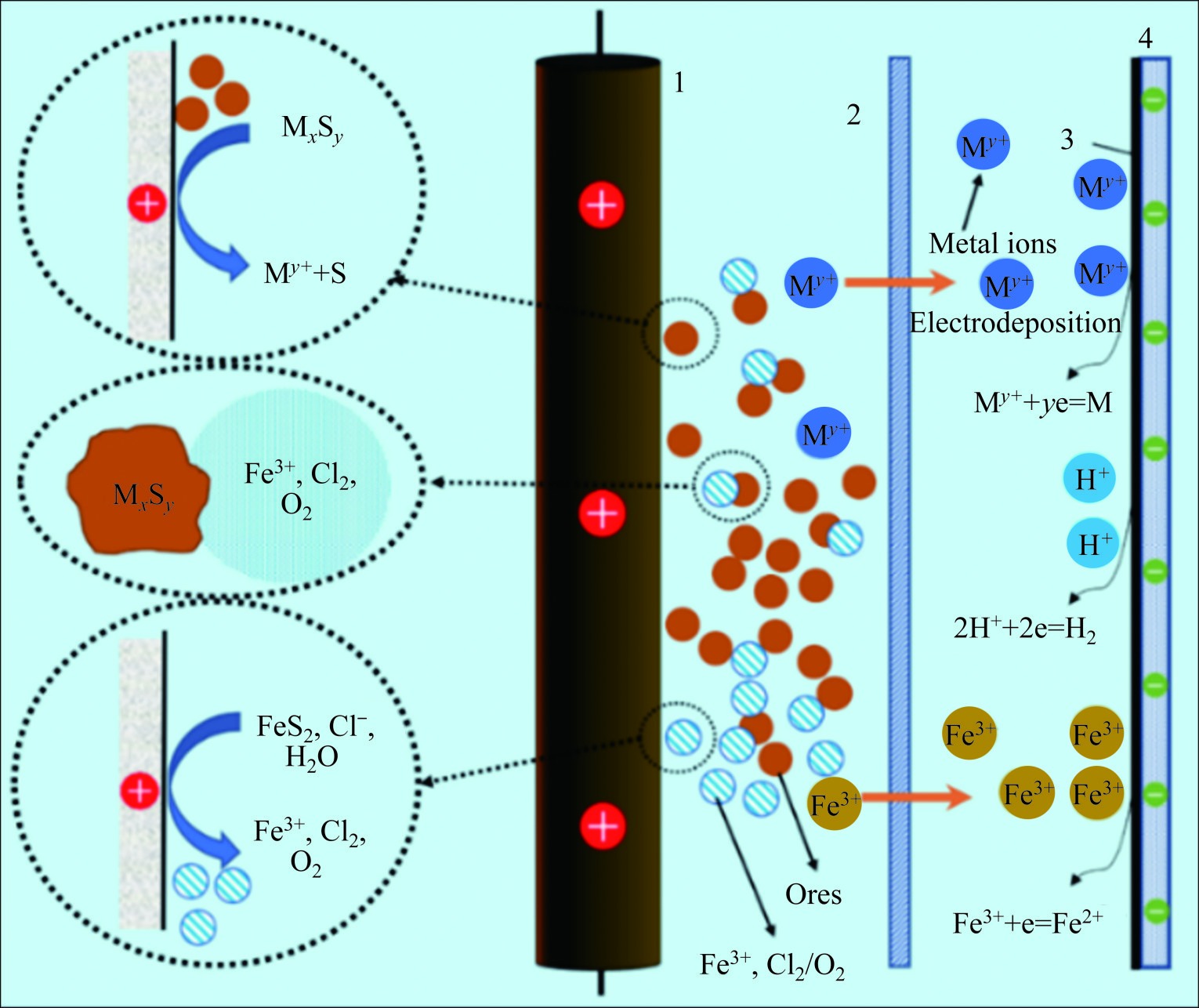
Traditional pyrometallurgical and hydrometallurgical methods to extract bismuth from sulfide ores face problems such as high cost, low-concentration SO2 generation, and long process time. In this study, the cyclone technology and slurry electrolysis method were combined. The bismuth sulfide ore was dissolved directly at the anode, while the high purity bismuth was deposited efficiently at the cathode under the advantages of the two methods. The short process and high-efficiency extraction of bismuth sulfide ore were realized, and the pollution of low-concentration SO2 was avoided. Then, the effects of several crucial experimental conditions (current density, reaction time, temperature, pH, liquid-solid ratio, and circulation flow rate) on the leaching efficiency and recovery efficiency of bismuth were investigated. The leaching and electrowinning mechanisms during the recovery process were also analyzed according to the research results of this paper to better understand the cyclone slurry electrolysis process. The experimental results showed that 95.19% bismuth was leached into the acid solution in the anode area under optimal conditions, and the recovery efficiency and purity of bismuth on the cathode reached 91.13% and 99.26%, respectively, which were better than those by the traditional hydrometallurgy recovery process.
1. Introduction
Bismuth, known as a green metal [1], is widely used in medicine, photoelectric materials, high-temperature superconducting materials, flame retardants, nuclear energy materials, and other fields for its excellent physical and chemical properties, such as thermoelectric sensitivity, super diamagnetism, low thermal conductivity, and high resistivity [1 −3]. Bismuth sulfide concentrates are important raw materials for the extraction of bismuth [4 −6], which are enriched from bismuth-containing polymetallic complex ores through flotation and other complex pretreatment process [7, 8]. The pyro-smelting has always been the mainstream recovery process of bismuth sulfide concentrates in the industry [9−11], which has the advantages of large processing capacity and simple operation [12]. However, pyrometallurgy methods face problems such as high equipment costs and strict treatment requirements for low-concentration SO2 [13, 14]. The low-temperature alkaline melting process can effectively reduce the melting temperature and does not generate SO2 gas [15, 16], but the high cost and difficult treatment of molten salt slag prevent its industrial promotion [17].
The hydrometallurgical methods are often applied to treat sulfide concentrates with the advantages of relatively low cost, mild conditions, high recovery efficiency, and no SO2 generation [18, 19]. During the acid leaching process, bismuth sulfide concentrates are dissolved in solution in the presence of oxidizers such as O2, O3, HNO3, Cl2, FeCl3, followed by purification, precipitation, electrolysis, and other processes to obtain bismuth or its compounds [9, 20 −22], which faces the problems of long process time and complex operation.
Slurry electrolysis (SE), also called suspension electrolysis, has attracted extensive attention for its advantages of environment-friendly and shorter procedure, which combines ionic leaching, electrolytic purification, and metal deposition within one apparatus [23]. SE process has been widely used in treating waste electronic and electric equipment (WEEE), waste battery cathode materials, and metallic minerals [24−26], which can also effectively solve the problem of the complex and unstable composition of some materials. In addition, the slurry electrolysis process can fully utilize the anodic half-reaction in the mineral dissolution process. However, due to passivation and serious side reactions, the current efficiency of the slurry electrolysis process is low [27], and extra energy consumption is needed. Cyclone technology takes advantage of the high-speed flow to accelerate the ion diffusion rate, avoiding the problems of current efficiency reduction and concentration polarization that often occur in the electrolysis process of traditional electrolyzers [28 −30]. This method can effectively treat raw materials with high impurity cont
Loading authentic research manuscript (Pages 1–5)...
TIAN Qing-hua, HUANG Zhu, XU Zhi-peng, GUO Xue-yi, LU Ding-nan (2025). Metal extraction from bismuth sulfide concentrates by cyclone slurry electrolysis. Journal of Central South University. https://doi.org/10.1007/s11771-025-5930-6
Research & Educational Purpose Only:The translations, structured abstracts, analytical annotations, and data reports provided by SinoTechIntel are intended exclusively for academic research, internal corporate R&D, and educational benchmarking. They do not constitute formal engineering, chemical safety, legal, or professional advice.
Copyright & Intellectual Property Notice: Original copyright of the underlying source articles and experimental data remains with the respective authors, institutions, and original publishing journals. SinoTechIntel claims intellectual property only over its proprietary translations, analytical syntheses, and AEO structured enhancements in accordance with international fair use and academic citation principles.
Frequently Asked Questions
What is cyclone slurry electrolysis?
Cyclone slurry electrolysis combines cyclone technology with slurry electrolysis to directly dissolve bismuth sulfide ore at the anode and deposit high-purity bismuth at the cathode in one apparatus, achieving a short, efficient extraction process.
How does this method mitigate environmental pollution?
Unlike traditional pyrometallurgy, cyclone slurry electrolysis avoids the generation of low-concentration SO2 gas and reduces the process time, offering a more environmentally friendly alternative.
What are the optimal recovery results achieved?
Under optimal conditions, 95.19% of bismuth was leached into the acid solution in the anode area, while the recovery efficiency and purity of bismuth on the cathode reached 91.13% and 99.26%, respectively.
How does it compare to traditional hydrometallurgy?
The cyclone slurry electrolysis process provides a shorter procedure, higher efficiency, and better recovery performance than traditional hydrometallurgy, which often involves long process times and complex operations.
What experimental conditions were investigated in the study?
The study examined the effects of current density, reaction time, temperature, pH, liquid-solid ratio, and circulation flow rate on the leaching efficiency and recovery efficiency of bismuth.
Related Technical Papers & Translations

Design and optimization of a high-efficiency distillation process for cellulosic fuel ethanol integrated with thermal coupling and molecular sieve adsorption
To address the challenges of high energy consumption and prominent costs in the traditional three-columns distillation process for cellulosic fuel ethanol, a distillation—molecular sieve coupling separation process is proposed. This process integrates a three-column (crude distillation column, first distillation column, second distillation column) system with a 3A molecular sieve adsorption deep dehydration unit. A thermal coupling network is constructed via differential pressure design (steam from medium/high-pressure columns as mutual heat sources, reboiler liquid waste heat for feed preheating), and molecular sieve adsorption conditions are optimized. The study first performs a thermodynamic consistency test on the ethanol—water system, determines optimal non-random two-liquid (NRTL) model binary interaction parameters via experimental data regression for Aspen Plus simulation. Aiming at minimum total annual cost (TAC), Aspen Plus is used to optimize process parameters (theoretical tray number, feed location, reflux ratio, side-draw position, etc.). Economic analysis shows this process reduces CO2 emission costs by 27.56%, TAC by 15.58% (to 5.123 × 10⁶ USD·a-1), and increases ethanol purity to >99.6%, providing an effective solution for green, efficient separation.

A cohesion loss model for determining residual strength of deep bedded sandstone
Rock residual strength, as an important input parameter, plays an indispensable role in proposing the reasonable and scientific scheme about stope design, underground tunnel excavation and stability evaluation of deep chambers. Therefore, previous residual strength models of rocks established were reviewed. And corresponding related problems were stated. Subsequently, starting from the effects of bedding and whole life-cycle evolution process, series of triaxial mechanical tests of deep bedded s

Federated model with contrastive learning and adaptive control variates for human activity recognition
Recent attention to privacy issues demands a communication-safe method for training human activity recognition (HAR) models on client activity data. Federated learning (FL) has become a compelling technique to facilitate model training between the server and clients while preserving data privacy. However, classical FL methods often assume independent and identically distributed (IID) data among clients. This assumption does not hold true in practical scenarios. Human activity in real-world scena