Key Takeaways & Executive Findings
- •• Triaxial tests reveal that increasing confining pressure enhances peak stress, dilatancy stress, peak strain, and elastic modulus while reducing Poisson's ratio and secondary crack formation. • Pore pressure and confining pressure exert opposing effects on sandstone mechanical behavior. • Permeability evolution exhibits three distinct stages (initial compaction, linear elasticity, plastic deformation), with peak permeability coinciding with maximum volumetric dilatancy. • Salt solutions with pH 7 and 4 significantly degrade mechanical properties and increase permeability, highlighting the impact of hydrochemical corrosion.
Abstract
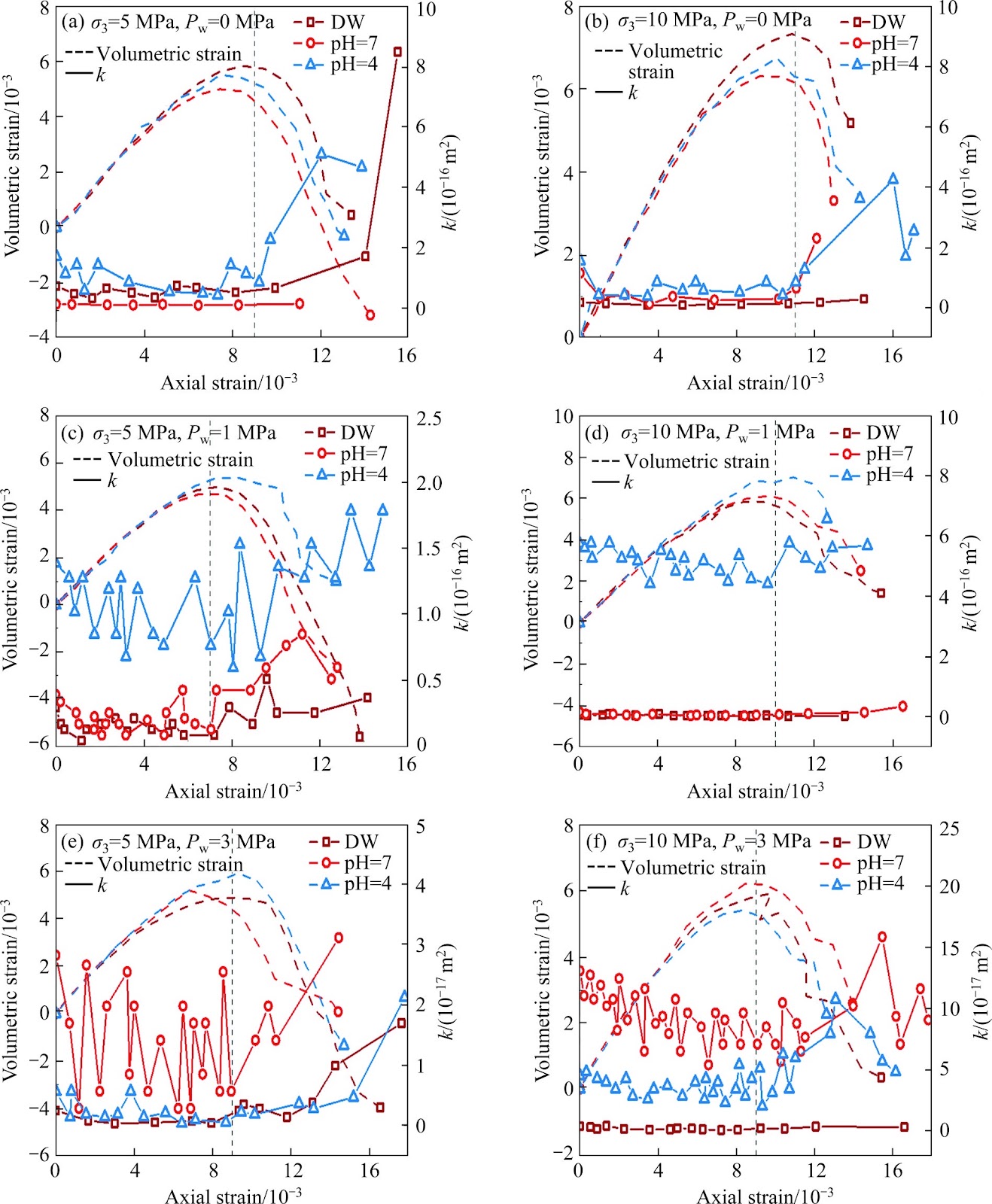
In this study, a series of triaxial tests are conducted on sandstone specimens to investigate the evolution of their mechanics and permeability characteristics under the combined action of immersion corrosion and seepage of different chemical solutions. It is observed that with the increase of confining pressure, the peak stress, dilatancy stress, dilatancy stress ratio, peak strain, and elastic modulus of the sandstone increase while the Poisson ratio decreases and less secondary cracks are produced when the samples are broken. The pore pressure and confining pressure have opposite influences on the mechanical properties. With the increase of the applied axial stress, three stages are clearly identified in the permeability evolution curves: initial compaction stage, linear elasticity stage and plastic deformation stage. The permeability reaches the maximum value when the highest volumetric dilatancy is obtained. In addition, the hydrochemical action of salt solution with pH=7 and 4 has an obvious deteriorating effect on the mechanical properties and induces the increase of permeability. The obtained results will be useful in engineering to understand the mechanical and seepage properties of sandstone under the coupled chemical-seepage-stress multiple fields.
1. Introduction
As a consequence of anthropogenic activities, a significant influx of chemical pollutants progressively infiltrates the subsurface, leading to the contamination of groundwater [1, 2]. Chemical seepage not only redistributes chemical elements in the rock, but also alters the microstructure [3]. A large number of cracks and pores are then formed in rock after the corrosion induced by chemical seepage. These cracks and pores provide new flow paths for groundwater runoff and then change the seepage path of porous rock. This can change the mechanical and permeability properties of rock. In view of this, the present study focuses on the evolution of strength and deformation properties and permeability of sandstone under the coupling of chemical-seepage-stress fields.
Extensive experimental studies have been performed to study the mechanical properties and permeability of rocks under multi-field coupling. Prior studies [4−6] have shown that the chemical environments can initiate crack propagation in materials, e.g., quartz and ceramics. Later, it is also found that the mechanical properties of rocks are significantly affected by the chemical corrosion. For example, RUTTER et al [7] carried out a series of stress relaxation tests on fractured and intact sandstones to investigate the influence of pore water on the rock strength. Seismic velocity, attenuation, and acoustic emission of saturated granite in two chemical solutions were measured by ISHIDO et al [8]. They studied the effect of the pH and concentration of solutions on the propagation of microcracks and the fracture strength of the studied rock. LAJTAI et al [9] conducted a series of short-term and long-term tests to study the effect of water on the deformation and strength of granite. Triaxial compression tests on prefabricated cracked sandstone were carried out by FEUCHT et al [10] to study the effect of the hydrochemical solutions on the ultimate friction strength. They found that the ionic concentration, ionic charge, and pH value affected the friction factor and significantly reduced the friction strength of the cracked surface. FENG et al [11−15] conducted triaxial compression tests on nodular limestone under the action of percolation of different chemical solutions. They carried out real-time observation and digital recording of the microfracture process and analyzed the effects of chemical corrosion on the crack propagation rate, the crack morphology, the initial angle of the new cracks, and the mechanism of the microcrack propagation.
Loading authentic research manuscript (Pages 1–5)...
WANG Wei, CHEN Chao-wei, CAO Ya-jun, JIA Yun, LIU Shi-fan, SHEN Wan-qing (2025). Mechanical properties and permeability evolution of sandstone subjected to the coupling effects of chemical-seepage-stress. Journal of Central South University. https://doi.org/10.1007/s11771-025-5882-x
Research & Educational Purpose Only:The translations, structured abstracts, analytical annotations, and data reports provided by SinoTechIntel are intended exclusively for academic research, internal corporate R&D, and educational benchmarking. They do not constitute formal engineering, chemical safety, legal, or professional advice.
Copyright & Intellectual Property Notice: Original copyright of the underlying source articles and experimental data remains with the respective authors, institutions, and original publishing journals. SinoTechIntel claims intellectual property only over its proprietary translations, analytical syntheses, and AEO structured enhancements in accordance with international fair use and academic citation principles.
Frequently Asked Questions
How does confining pressure affect sandstone strength and deformation?
Higher confining pressure increases peak stress, dilatancy stress, peak strain, and elastic modulus, while decreasing Poisson's ratio and secondary crack formation.
What are the three stages of permeability evolution in sandstone?
The stages are initial compaction, linear elasticity, and plastic deformation. Permeability reaches a maximum at the highest volumetric dilatancy.
What is the impact of chemical solutions on sandstone permeability?
Salt solutions with pH 7 and 4 cause significant deterioration of mechanical properties and increase permeability due to corrosion-induced microcracks and pores.
Why is the coupled chemical-seepage-stress study important?
It helps predict groundwater contamination and stability of rock masses in engineering projects, such as tunnels, dams, and deep mining, where chemical seepage alters rock structure.
What experimental method was used in this study?
Series of triaxial compression tests were performed on sandstone specimens under immersion corrosion and seepage conditions of different chemical solutions.
Related Technical Papers & Translations

Design and optimization of a high-efficiency distillation process for cellulosic fuel ethanol integrated with thermal coupling and molecular sieve adsorption
To address the challenges of high energy consumption and prominent costs in the traditional three-columns distillation process for cellulosic fuel ethanol, a distillation—molecular sieve coupling separation process is proposed. This process integrates a three-column (crude distillation column, first distillation column, second distillation column) system with a 3A molecular sieve adsorption deep dehydration unit. A thermal coupling network is constructed via differential pressure design (steam from medium/high-pressure columns as mutual heat sources, reboiler liquid waste heat for feed preheating), and molecular sieve adsorption conditions are optimized. The study first performs a thermodynamic consistency test on the ethanol—water system, determines optimal non-random two-liquid (NRTL) model binary interaction parameters via experimental data regression for Aspen Plus simulation. Aiming at minimum total annual cost (TAC), Aspen Plus is used to optimize process parameters (theoretical tray number, feed location, reflux ratio, side-draw position, etc.). Economic analysis shows this process reduces CO2 emission costs by 27.56%, TAC by 15.58% (to 5.123 × 10⁶ USD·a-1), and increases ethanol purity to >99.6%, providing an effective solution for green, efficient separation.

A cohesion loss model for determining residual strength of deep bedded sandstone
Rock residual strength, as an important input parameter, plays an indispensable role in proposing the reasonable and scientific scheme about stope design, underground tunnel excavation and stability evaluation of deep chambers. Therefore, previous residual strength models of rocks established were reviewed. And corresponding related problems were stated. Subsequently, starting from the effects of bedding and whole life-cycle evolution process, series of triaxial mechanical tests of deep bedded s

Federated model with contrastive learning and adaptive control variates for human activity recognition
Recent attention to privacy issues demands a communication-safe method for training human activity recognition (HAR) models on client activity data. Federated learning (FL) has become a compelling technique to facilitate model training between the server and clients while preserving data privacy. However, classical FL methods often assume independent and identically distributed (IID) data among clients. This assumption does not hold true in practical scenarios. Human activity in real-world scena