Key Takeaways & Executive Findings
- •• Penta-coordinated Cu ions on the malachite (201) and (010) surfaces exhibit stronger activity, highlighting surface anisotropy's role in sulfidation. • HS− adsorption forms more stable tetra-coordinated structures on (010) and (201) surfaces than the hexa-coordinated structure on (201), as indicated by more negative adsorption energies. • Sulfidized malachite gains an additional π electron pair and a smaller HOMO-LUMO gap with xanthate, enhancing π backbonding and collector adsorption. • The findings offer a theoretical basis for designing targeted flotation reagents that leverage coordination chemistry and Jahn-Teller effects in malachite beneficiation.
Abstract
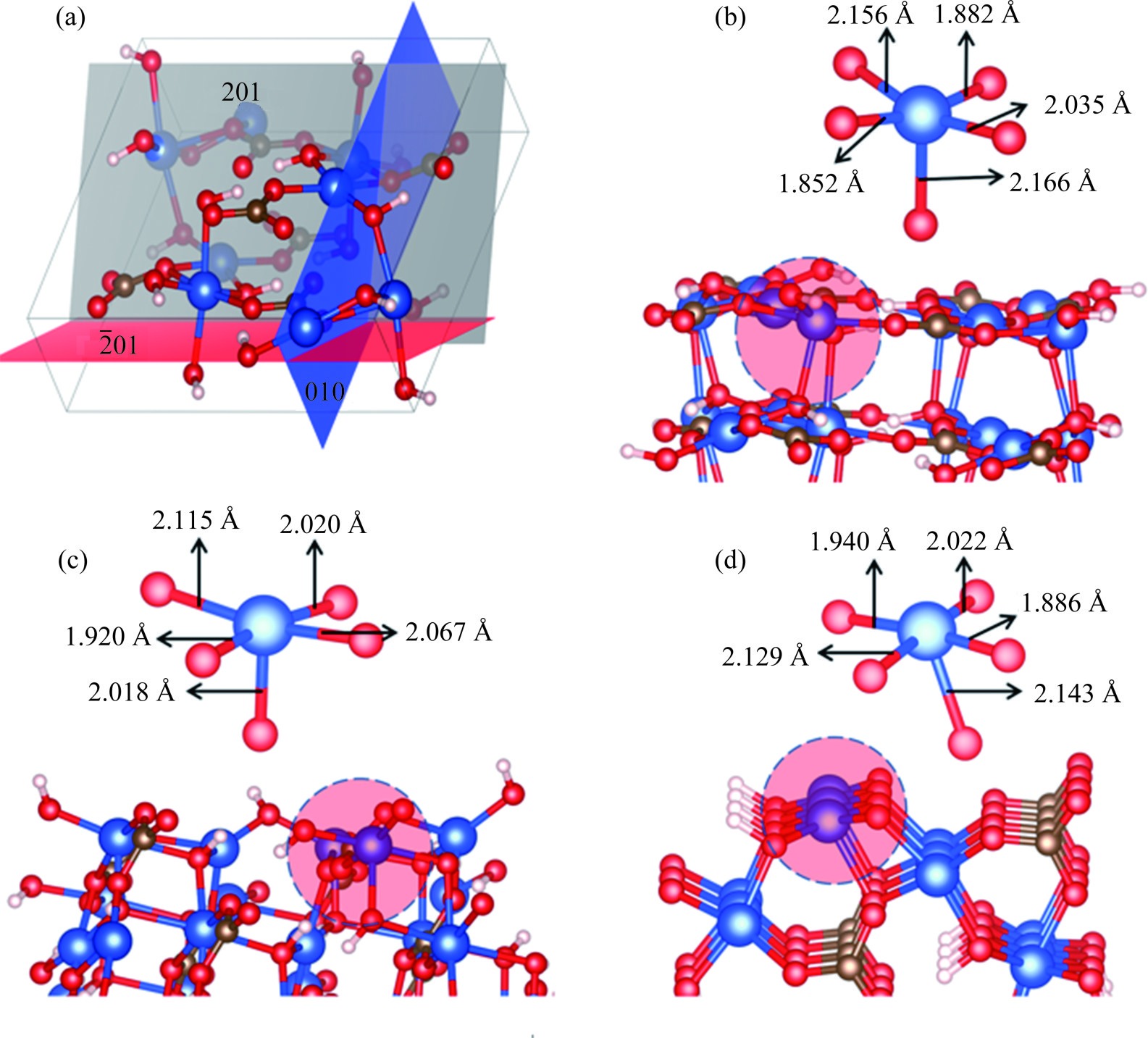
Malachite, being highly hydrophilic and difficult to be floated conventionally, is usually beneficiated by sulfidation flotation in industry. However, the complex crystal structure of malachite leads to the formation of various fracture surfaces with distinct properties during crushing and grinding, resulting in surface anisotropy. In this study, we explored the surface anisotropy of malachite and further investigated its sulfidation mechanism from the coordination chemistry perspective, considering the influence of the Jahn-Teller effect on malachite sulfidation. Computational results reveal that the penta-coordinated Cu ions on the malachite (201) and (010) surfaces exhibit stronger activity compared to those on the malachite (201) surface. Additionally, the tetra-coordinated structure formed by HS− adsorption on the malachite (010) and (201) surfaces is more stable, with more negative adsorption energy, compared to the hexa-coordinated structure formed by HS− adsorption on the (201) surface. The sulfidized malachite surface has an additional pair of π electron and smaller HOMO (highest occupied molecular orbital)-LUMO (lowest unoccupied molecular orbital) gap with xanthate molecules, causing stronger π backbonding with xanthate. This study provides new insights into the surface sulfidation mechanism of malachite and offers a theoretical reference for the design of targeted flotation reagents.
1. Introduction
Copper, as one of the essential and important metals for industrial development, is mostly extracted from copper sulfide ores [1]. However, with the increasing demand for copper, the depletion of copper sulfide resources, and the increasingly poor, fine, and miscellaneous characteristics of copper sulfide minerals, copper oxide minerals have begun to be developed and utilized. Malachite, as one of the main copper oxide minerals, has also been widely studied. At present, forth flotation is the main method for enriching and purifying Cu in malachite, which requires that sulfur-terminated collectors have excellent interaction with the malachite surface. Nevertheless, the malachite surface has strong hydroxylation behavior [2] and high solubility [3], and the ionic bonds present on the surface can form a strong hydration layer through electrostatic interaction with water molecules, which results in unsatisfactory direct flotation effect [4]. Sulfide flotation has been proposed as a good solution to solve this problem [5, 6]. The addition of sulfidation reagents (such as Na2S, NaHS, H2S) can form a sulfide film on the malachite surface [7, 8], improving surface hydrophobicity and facilitating the subsequent adsorption of the collector xanthate.
In sulfidation-flotation system, the interaction between the sulfidation reagent and the mineral surface plays a decisive role in the effectiveness of sulfidation. It is worth noting that the structure of copper oxide minerals is complex with properties varying on different surfaces, which will have significant impact on sulfidation progress, such as nonuniform surface sulfidation. However, current research on the sulfide flot...
Loading authentic research manuscript (Pages 1–5)...
Rao Xin, Zhang Chen-yang, Sun Wei, Liu Si-yuan, Yao Yu-yun, Chen Jian-hua, Zhu Yang-ge, Pei Yong, Zhang Hong-liang (2025). Malachite sulfidation flotation mechanism: Sulfidation anisotropy insights. Journal of Central South University. https://doi.org/10.1007/s11771-024-5773-6
Research & Educational Purpose Only:The translations, structured abstracts, analytical annotations, and data reports provided by SinoTechIntel are intended exclusively for academic research, internal corporate R&D, and educational benchmarking. They do not constitute formal engineering, chemical safety, legal, or professional advice.
Copyright & Intellectual Property Notice: Original copyright of the underlying source articles and experimental data remains with the respective authors, institutions, and original publishing journals. SinoTechIntel claims intellectual property only over its proprietary translations, analytical syntheses, and AEO structured enhancements in accordance with international fair use and academic citation principles.
Frequently Asked Questions
What is the main challenge in malachite flotation?
Malachite is highly hydrophilic and has high solubility, leading to a strong hydration layer on its surface. This results in poor direct flotation. Sulfidation flotation is used to form a sulfide film that improves hydrophobicity and enables subsequent xanthate adsorption.
How does surface anisotropy affect malachite sulfidation?
Different crystal surfaces of malachite have distinct coordination environments and reactivities. The study found that penta-coordinated Cu ions on the (201) and (010) surfaces are more active, leading to nonuniform sulfidation and influencing collector adsorption.
What is the role of the Jahn-Teller effect in sulfidation?
The Jahn-Teller effect causes distortion in copper coordination geometries, which alters the stability of HS− adsorption and the electronic structure of the sulfidized surface. This ultimately affects the reactivity toward xanthate collectors.
How does sulfidation improve xanthate adsorption on malachite?
The sulfidized malachite surface has an additional pair of π electrons and a smaller HOMO-LUMO gap with xanthate, resulting in stronger π backbonding. This enhances the binding between the sulfidized surface and xanthate molecules, improving flotation efficiency.
What computational methods were used in this study?
Density functional theory (DFT) calculations were employed to explore the sulfidation mechanism from a coordination chemistry perspective, focusing on the Jahn-Teller effect and surface anisotropy.
Related Technical Papers & Translations

Design and optimization of a high-efficiency distillation process for cellulosic fuel ethanol integrated with thermal coupling and molecular sieve adsorption
To address the challenges of high energy consumption and prominent costs in the traditional three-columns distillation process for cellulosic fuel ethanol, a distillation—molecular sieve coupling separation process is proposed. This process integrates a three-column (crude distillation column, first distillation column, second distillation column) system with a 3A molecular sieve adsorption deep dehydration unit. A thermal coupling network is constructed via differential pressure design (steam from medium/high-pressure columns as mutual heat sources, reboiler liquid waste heat for feed preheating), and molecular sieve adsorption conditions are optimized. The study first performs a thermodynamic consistency test on the ethanol—water system, determines optimal non-random two-liquid (NRTL) model binary interaction parameters via experimental data regression for Aspen Plus simulation. Aiming at minimum total annual cost (TAC), Aspen Plus is used to optimize process parameters (theoretical tray number, feed location, reflux ratio, side-draw position, etc.). Economic analysis shows this process reduces CO2 emission costs by 27.56%, TAC by 15.58% (to 5.123 × 10⁶ USD·a-1), and increases ethanol purity to >99.6%, providing an effective solution for green, efficient separation.

A cohesion loss model for determining residual strength of deep bedded sandstone
Rock residual strength, as an important input parameter, plays an indispensable role in proposing the reasonable and scientific scheme about stope design, underground tunnel excavation and stability evaluation of deep chambers. Therefore, previous residual strength models of rocks established were reviewed. And corresponding related problems were stated. Subsequently, starting from the effects of bedding and whole life-cycle evolution process, series of triaxial mechanical tests of deep bedded s

Federated model with contrastive learning and adaptive control variates for human activity recognition
Recent attention to privacy issues demands a communication-safe method for training human activity recognition (HAR) models on client activity data. Federated learning (FL) has become a compelling technique to facilitate model training between the server and clients while preserving data privacy. However, classical FL methods often assume independent and identically distributed (IID) data among clients. This assumption does not hold true in practical scenarios. Human activity in real-world scena