Key Takeaways & Executive Findings
- •• A novel MINLP model integrates fouling dynamics, concentration cycle, and variable frequency drives for long-term CCWS optimization. • Optimizing the concentration cycle balances water conservation and fouling control, reducing energy and water usage. • Sensitivity analysis shows diminishing marginal benefits of increasing cycle, guiding optimal operation intervals. • The model provides actionable operating parameters (pump count, frequency, valve resistance) for different conditions.
Abstract
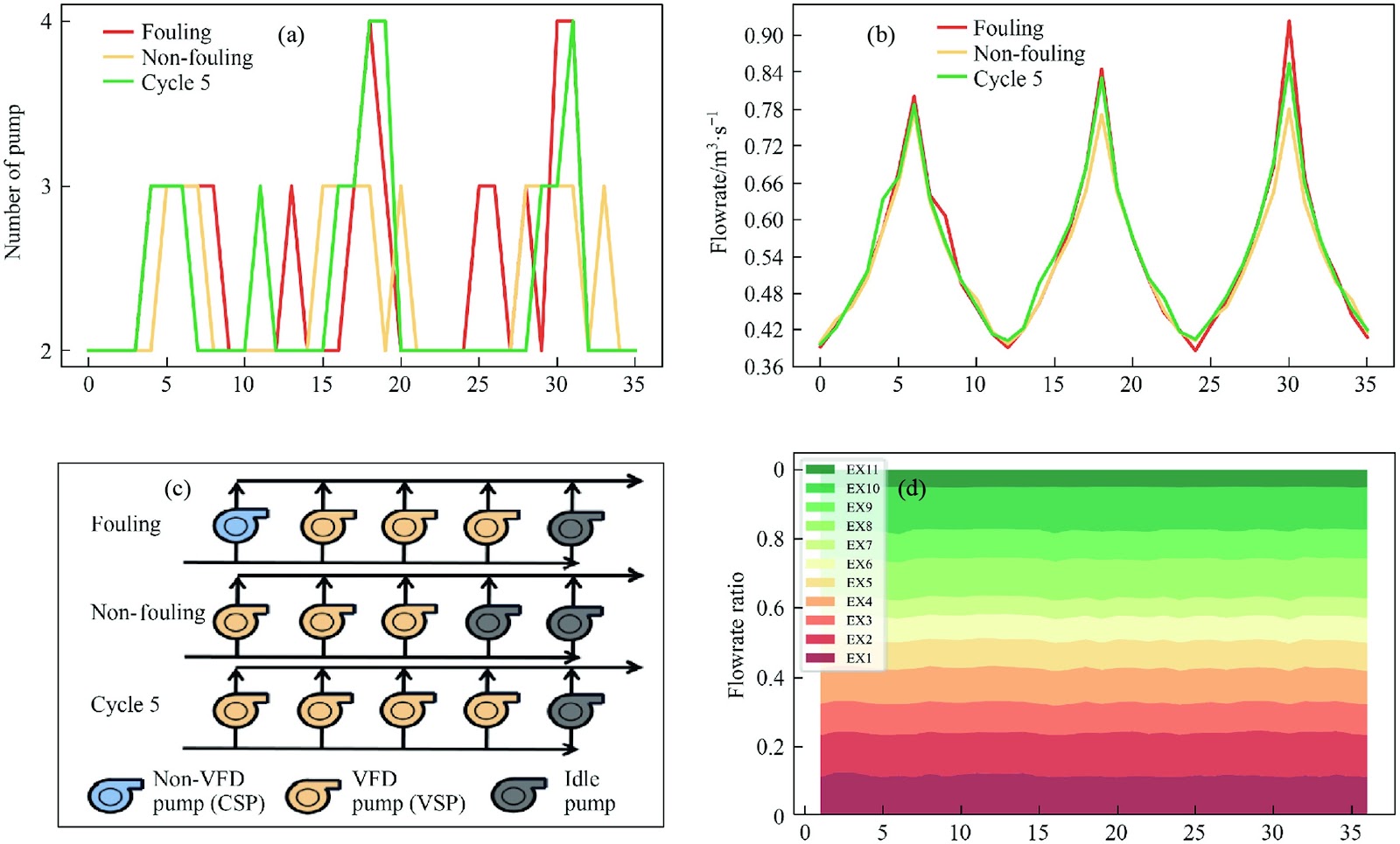
Fouling caused by excess metal ions in hard water can negatively impact the performance of the circulating cooling water system (CCWS) by depositing ions on the heat exchanger's surface. Currently, the operation optimization of CCWS often prioritizes short-term flow velocity optimization for minimizing power consumption, without considering fouling. However, low flow velocity promotes fouling. Therefore, it's crucial to balance fouling and energy/water conservation for optimal CCWS long-term operation. This study proposes a mixed-integer nonlinear programming (MINLP) model to achieve this goal. The model considers fouling in the pipeline, dynamic concentration cycle, and variable frequency drive to optimize the synergy between heat transfer, pressure drop, and fouling. By optimizing the concentration cycle of the CCWS, water conservation and fouling control can be achieved. The model can obtain the optimal operating parameters for different operation intervals, including the number of pumps, frequency, and valve local resistance coefficient. Sensitivity experiments on cycle and environmental temperature reveal that as the cycle increases, the marginal benefits of energy/water conservation decrease. In periods with minimal impact on fouling rate, energy/water conservation can be achieved by increasing the cycle while maintaining a low fouling rate. Overall, the proposed model has significant energy/water saving effects and can comprehensively optimize the CCWS through its incorporation of fouling and cycle optimization.
1. Introduction
Circulating cooling water systems (CCWS) are widely applied in industrial production as water treatment systems for cooling, heating and conveying. They are used to release industrial waste heat to the environment. Optimizing circulating water systems improves water utilization and reduces operating costs. Several studies have optimized individual components when designing circulating water systems, including pumps [1,2], cooling towers [3], heat transfer networks [4], or through air coolers [5], variable frequency drives (VFD) [6,7] for system optimization. The main optimization methods are the pinch method [8] and the mathematical programming method [9], etc.
Despite numerous experimental and simulation studies, predicting and preventing fouling is still an unsolved problem in engineering, resulting in huge economic losses and environmental damage [10]. More than 90% heat exchangers in various industries are experiencing fouling [11]. Circulating water contains a large number of mineral ions, such as calcium, magnesium, etc., evaporation in the cooling tower makes the ions constantly concentrated. When the circulating water in the exchanger is heated, the solubility of minerals is reduced, previously dissolved in the fluid calcium carbonate began to precipitate, and deposited on the surface of the pipeline. Fouling of circulating water system includes (i) particle fouling, (ii) crystalline fouling, (iii) corrosion fouling, (iv) biofouling, etc [12]. Fouling increases the thermal resistance between the fluid and the heated surface, decreasing the heat transfer performance. The inner diameter of the heat exchanger tube decreases continuously with the accumulation of fouling. The velocity of the heat exchanger tubes will increase, results in a rise of pressure drop under the same flow rate.
Loading authentic research manuscript (Pages 1–5)...
Jiarui Liang, Yong Tian, Shutong Yang, Yong Wang, Ruiqi Yin, Yufei Wang (2023). Long-term operation optimization of circulating cooling water systems under fouling conditions. Chinese Journal of Chemical Engineering. https://doi.org/10.1016/j_cjche_144877520
Research & Educational Purpose Only:The translations, structured abstracts, analytical annotations, and data reports provided by SinoTechIntel are intended exclusively for academic research, internal corporate R&D, and educational benchmarking. They do not constitute formal engineering, chemical safety, legal, or professional advice.
Copyright & Intellectual Property Notice: Original copyright of the underlying source articles and experimental data remains with the respective authors, institutions, and original publishing journals. SinoTechIntel claims intellectual property only over its proprietary translations, analytical syntheses, and AEO structured enhancements in accordance with international fair use and academic citation principles.
Frequently Asked Questions
What is the main objective of the proposed optimization model?
The model aims to optimize the long-term operation of circulating cooling water systems by balancing fouling control with energy and water conservation, using a mixed-integer nonlinear programming approach.
How does the model address fouling in cooling water systems?
It incorporates fouling dynamics in pipelines and heat exchangers, considering the trade-off between flow velocity and fouling rate, and optimizes the concentration cycle to mitigate fouling while saving water.
What are the key decision variables in the optimization?
The key decision variables include the number of pumps in operation, pump frequency (via variable frequency drives), and valve local resistance coefficients, which are optimized for different operation intervals.
What are the main findings from the sensitivity analysis?
Sensitivity analysis on cycle and environmental temperature reveals that as the concentration cycle increases, the marginal benefits of energy and water conservation decrease, indicating an optimal cycle range.
How can the model be applied in practice?
The model provides optimal operating parameters for different conditions, enabling plant operators to adjust pump settings and valve positions to achieve energy and water savings while controlling fouling.
Related Technical Papers & Translations

Design and optimization of a high-efficiency distillation process for cellulosic fuel ethanol integrated with thermal coupling and molecular sieve adsorption
To address the challenges of high energy consumption and prominent costs in the traditional three-columns distillation process for cellulosic fuel ethanol, a distillation—molecular sieve coupling separation process is proposed. This process integrates a three-column (crude distillation column, first distillation column, second distillation column) system with a 3A molecular sieve adsorption deep dehydration unit. A thermal coupling network is constructed via differential pressure design (steam from medium/high-pressure columns as mutual heat sources, reboiler liquid waste heat for feed preheating), and molecular sieve adsorption conditions are optimized. The study first performs a thermodynamic consistency test on the ethanol—water system, determines optimal non-random two-liquid (NRTL) model binary interaction parameters via experimental data regression for Aspen Plus simulation. Aiming at minimum total annual cost (TAC), Aspen Plus is used to optimize process parameters (theoretical tray number, feed location, reflux ratio, side-draw position, etc.). Economic analysis shows this process reduces CO2 emission costs by 27.56%, TAC by 15.58% (to 5.123 × 10⁶ USD·a-1), and increases ethanol purity to >99.6%, providing an effective solution for green, efficient separation.

A cohesion loss model for determining residual strength of deep bedded sandstone
Rock residual strength, as an important input parameter, plays an indispensable role in proposing the reasonable and scientific scheme about stope design, underground tunnel excavation and stability evaluation of deep chambers. Therefore, previous residual strength models of rocks established were reviewed. And corresponding related problems were stated. Subsequently, starting from the effects of bedding and whole life-cycle evolution process, series of triaxial mechanical tests of deep bedded s

Federated model with contrastive learning and adaptive control variates for human activity recognition
Recent attention to privacy issues demands a communication-safe method for training human activity recognition (HAR) models on client activity data. Federated learning (FL) has become a compelling technique to facilitate model training between the server and clients while preserving data privacy. However, classical FL methods often assume independent and identically distributed (IID) data among clients. This assumption does not hold true in practical scenarios. Human activity in real-world scena