Key Takeaways & Executive Findings
- •• A time-delay compensated centralized extended Kalman filter (TD-CEKF) is proposed to mitigate underwater acoustic transmission delays. • The AUV's mobility is leveraged to optimize USN topology, balancing energy efficiency and tracking accuracy. • A penalty function and gradient descent method are used to determine the optimal AUV position for topology optimization. • Simulation results confirm that the proposed approach effectively overcomes delay effects and achieves superior tracking performance.
Abstract
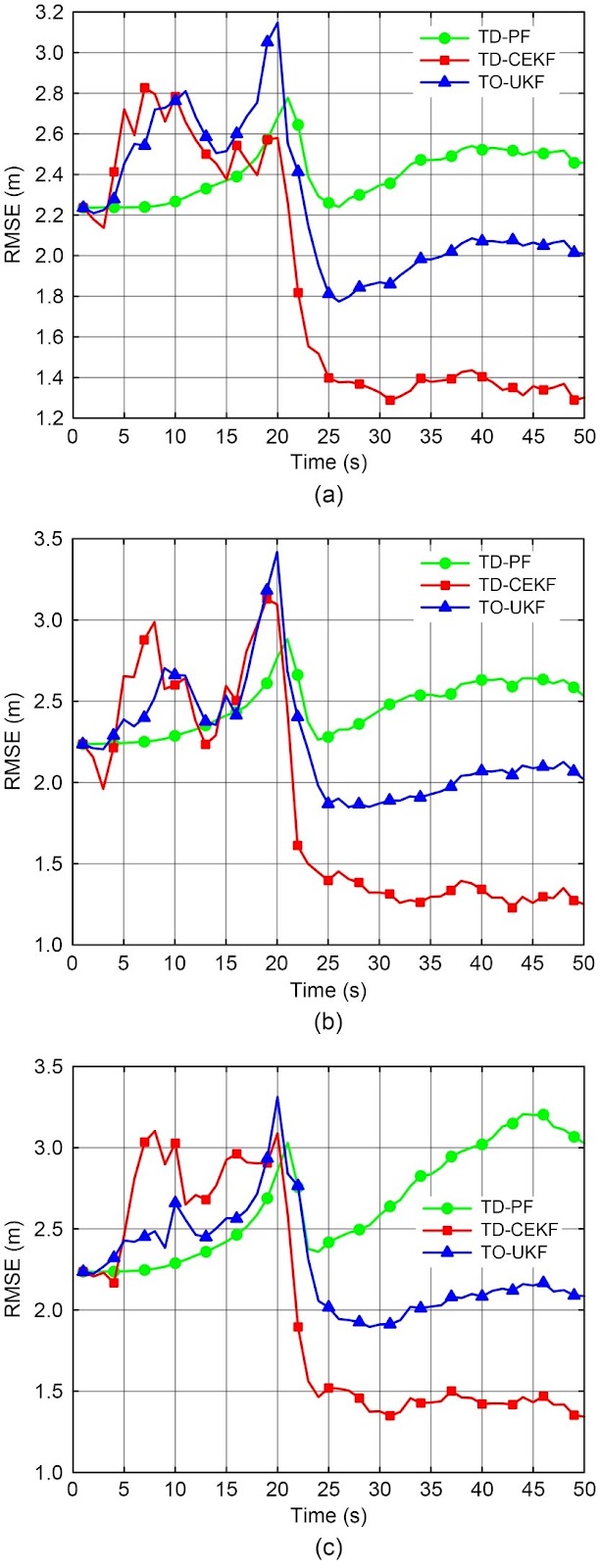
Because underwater sensor networks (USNs) have limited energy resources due to environmental constraints, it is essential to improve energy utilization. For this purpose, an autonomous underwater vehicle (AUV) with greater onboard computation power is used to process measurement data, and the mobility of the AUV is leveraged to optimize the USN topology, enhancing tracking accuracy. First, to address the transmission delay of underwater acoustic signals, a time-delay compensated centralized extended Kalman filter (TD-CEKF) algorithm is proposed. Next, the mathematical relationship between AUV position and USN topology is established, based on which the optimization target is constructed. Subsequently, a penalty function is introduced to remove the constraints from the objective function, and the optimal AUV position is searched using the gradient descent method to optimize the USN topology. The simulation results demonstrate that the proposed algorithm can effectively overcome the influence of transmission delay on target tracking and achieve improved tracking performance.
1. Introduction
With the increasing emphasis on marine resources and security, the Internet of Underwater Things (IoUT) has gradually started to take shape (Jahanbakht et al., 2021). As an early practical form of IoUT, underwater sensor networks (USNs) have been widely used in underwater resource exploration, marine environmental monitoring, and marine military applications (Alostad, 2020; Mohsan et al., 2022). Among them, target tracking technology based on USNs has become a research hotspot due to its stealth, low cost, and flexibility, and it has been applied in scenarios such as diver navigation, underwater search and rescue, and hostile target monitoring (Tang et al., 2024). Target tracking technology based on USNs faces two main challenges—the complex underwater acoustic environment, characterized by narrow bandwidth and significant transmission delays, which makes tracking difficult, and energy constraints on USN nodes, which cannot have their batteries replaced, resulting in a limited lifetime. The problem of limited bandwidth resources in underwater acoustic channel communication can be addressed by improving the communication bandwidth utilization rate. Zhang SL et al. (2017) quantized the sensor communication data to reduce the communication bandwidth occupation and improved the quantization error by selecting quantization bounds. Luo et al. (2019) further improved underwater target tracking performance by selecting different quantization bits for different sensor nodes. Zhang Q et al. (2015) derived the Cramér–Rao lower bound under quantized measurements and used it as an optimization objective to select the best fusion node to improve the tracking performance. To address the issue of transmission delays in underwater acoustic signals, Su et al. (2020) considered the impact of transmission delay of ranging echoes and proposed an unscented Kalman filter (UKF) fusion method based on delay estimation. On this basis, Zhang ZK et al. (2023) improved the calculation of transmission delay and proposed an improved asynchronous fusion method for particle filters.
Many studies have focused on improvements in the energy utilization of USNs. Li et al. (2025) used the topological structure and energy consumption of nodes as indicators to select neighboring nodes for tracking, thereby reducing energy consumption while meeting tracking accuracy requirements. Zhang D et al. (2019) studied the relationship between node transmission energy consumption and the Fisher information matrix (FIM), on the basis of which the energy of sensor nodes in a period of time is reasonably allocated. Tian and Zhang (2022) considered the errors caused by the positional uncertainty of USNs. Using the FIM, mutual information, and the number of nodes as objectives, they employed the non-dominated sorting genetic algorithm II (NSGA-II) and the technique for order preference by similarity to ideal solution (TOPSIS) to select sp...
Loading authentic research manuscript (Pages 1–5)...
Zhaohong LV, Zhenkai ZHANG, Boon-Chong SEET, Yi YANG (2025). Joint target tracking using an autonomous underwater vehicle and underwater sensor networks for underwater applications. Frontiers of Information Technology & Electronic Engineering. https://doi.org/10.1631/FITEE_2400869
Research & Educational Purpose Only:The translations, structured abstracts, analytical annotations, and data reports provided by SinoTechIntel are intended exclusively for academic research, internal corporate R&D, and educational benchmarking. They do not constitute formal engineering, chemical safety, legal, or professional advice.
Copyright & Intellectual Property Notice: Original copyright of the underlying source articles and experimental data remains with the respective authors, institutions, and original publishing journals. SinoTechIntel claims intellectual property only over its proprietary translations, analytical syntheses, and AEO structured enhancements in accordance with international fair use and academic citation principles.
Frequently Asked Questions
What is the main contribution of this paper?
The paper proposes a joint target tracking framework using an AUV and USNs, introducing a time-delay compensated centralized extended Kalman filter (TD-CEKF) and an AUV position optimization method to enhance tracking accuracy while improving energy utilization.
How does the proposed TD-CEKF algorithm handle transmission delays?
The TD-CEKF algorithm incorporates a time-delay compensation mechanism that explicitly accounts for the propagation delay of underwater acoustic signals, allowing the filter to fuse delayed measurements effectively.
What role does the AUV play in optimizing USN topology?
The AUV, with its mobility and superior onboard computation, is repositioned optimally based on gradient descent and a penalty function method to reshape the USN topology, thereby improving both energy efficiency and tracking performance.
What are the key challenges in USN-based target tracking?
The two main challenges are the complex underwater acoustic environment (narrow bandwidth, significant transmission delays) and the strict energy constraints of USN nodes, whose batteries cannot be replaced.
What are the simulation results of the proposed scheme?
Simulation results demonstrate that the proposed algorithm effectively overcomes the influence of transmission delay on target tracking and achieves improved tracking performance compared to conventional methods.
Related Technical Papers & Translations

Design and optimization of a high-efficiency distillation process for cellulosic fuel ethanol integrated with thermal coupling and molecular sieve adsorption
To address the challenges of high energy consumption and prominent costs in the traditional three-columns distillation process for cellulosic fuel ethanol, a distillation—molecular sieve coupling separation process is proposed. This process integrates a three-column (crude distillation column, first distillation column, second distillation column) system with a 3A molecular sieve adsorption deep dehydration unit. A thermal coupling network is constructed via differential pressure design (steam from medium/high-pressure columns as mutual heat sources, reboiler liquid waste heat for feed preheating), and molecular sieve adsorption conditions are optimized. The study first performs a thermodynamic consistency test on the ethanol—water system, determines optimal non-random two-liquid (NRTL) model binary interaction parameters via experimental data regression for Aspen Plus simulation. Aiming at minimum total annual cost (TAC), Aspen Plus is used to optimize process parameters (theoretical tray number, feed location, reflux ratio, side-draw position, etc.). Economic analysis shows this process reduces CO2 emission costs by 27.56%, TAC by 15.58% (to 5.123 × 10⁶ USD·a-1), and increases ethanol purity to >99.6%, providing an effective solution for green, efficient separation.

A cohesion loss model for determining residual strength of deep bedded sandstone
Rock residual strength, as an important input parameter, plays an indispensable role in proposing the reasonable and scientific scheme about stope design, underground tunnel excavation and stability evaluation of deep chambers. Therefore, previous residual strength models of rocks established were reviewed. And corresponding related problems were stated. Subsequently, starting from the effects of bedding and whole life-cycle evolution process, series of triaxial mechanical tests of deep bedded s

Federated model with contrastive learning and adaptive control variates for human activity recognition
Recent attention to privacy issues demands a communication-safe method for training human activity recognition (HAR) models on client activity data. Federated learning (FL) has become a compelling technique to facilitate model training between the server and clients while preserving data privacy. However, classical FL methods often assume independent and identically distributed (IID) data among clients. This assumption does not hold true in practical scenarios. Human activity in real-world scena