Key Takeaways & Executive Findings
- •• The FVMP model accurately characterizes rail pad viscoelasticity across ±20 °C and 1–1000 Hz. • The nonlinear coupled model converges well for time steps below 0.001 s, with best convergence for relaxation factors 0.3–0.5. • Rail pad viscoelasticity significantly affects high-frequency vibrations, especially around 50 Hz in the wheel-rail coupled resonance range. • The cross-iteration algorithm with relaxation factor effectively solves the coupled nonlinear dynamic response and adjusts wheel-rail force.
Abstract
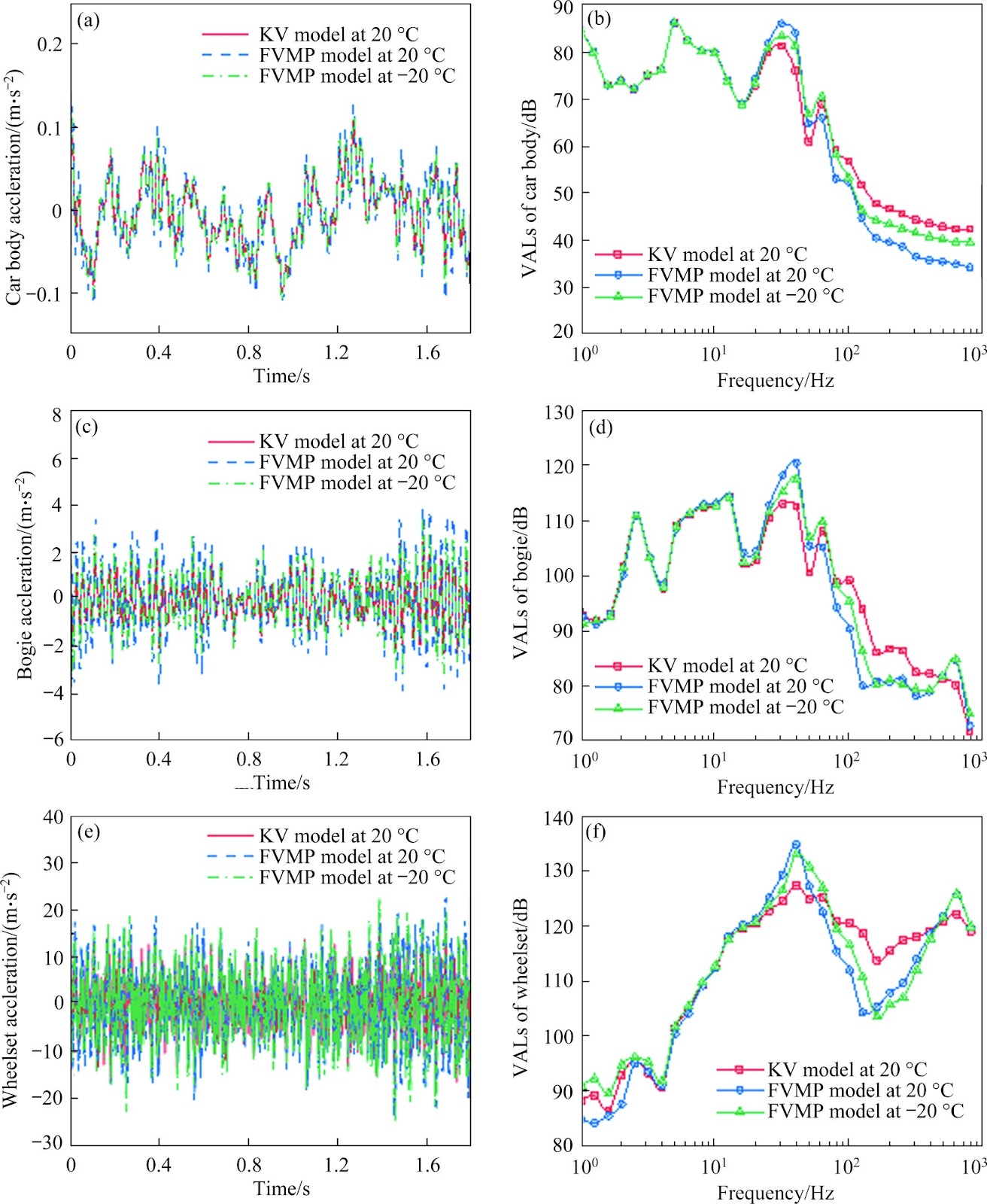
To investigate the effect of rail pad viscoelasticity on vehicle-track-bridge coupled vibration, the fractional Voigt and Maxwell model in parallel (FVMP) was used to characterize the viscoelastic properties of the rail pad based on dynamic performance test results. The FVMP model was then incorporated into the vehicle-track-bridge nonlinear coupled model, and its dynamic response was solved using a cross-iteration algorithm with a relaxation factor. Results indicate that the nonlinear coupled model achieves good convergence when the time step is less than 0.001 s, with the cross-iteration algorithm adjusting the wheel-rail force. In particular, the best convergence is achieved when the relaxation factor is within the range of 0.3−0.5. The FVMP model effectively characterizes the viscoelasticity of rail pads across a temperature range of ±20 ℃ and a frequency range of 1−1000 Hz. The viscoelasticity of rail pads significantly affects high-frequency vibrations in the coupled system, particularly around 50 Hz, corresponding to the wheel-rail coupled resonance range. Considering rail pad viscoelasticity is essential for accurately predicting track structure vibrations.
1. Introduction
Bridges are widely used in high-speed railway lines due to their minimal land occupation and high smoothness [1−3]. When trains traverse bridges, they induce vibrations in the tracks and bridge structures. Excessive vibration poses risks to the integrity of the track structure, including issues such as rail wear [4] and track slab cracks [5]. Moreover, it can also affect the quality of life for residents along the railway line [6, 7].
Viscoelastic materials are used to mitigate vibrations in railway track structures. Fasteners serve as the primary components for reducing vibration in ballastless track systems [8−11]. ZHANG et al [12] proposed that higher fastener stiffness isolates vibrations above 50 Hz in the rail, track slab, and bridge. CHEN et al [13] revealed that reducing fastener stiffness increases the vertical deflection of the track and bridge, as well as high-frequency vibration energy. As viscoelastic materials, rail pads exhibit temperature- and frequency-dependent properties. Researchers have studied the viscoelastic properties and theoretical characterization of rail pads [14−16]. THOMPSON et al [17, 18] proposed an experimental method to measure the dynamic stiffness of fasteners within the 100−1000 Hz frequency range. MAES et al [19] conducted experiments to determine the stiffness and damping values of rail pads at various preloads within the frequency range of 20−2500 Hz. OREGUI et al [20] proposed dynamic mechanical analysis (DMA) and the time-temperature superposition principle (TTSP) to predict the dynamic properties of rail pads. The Prony series material model was introduced to describe this dynamic behavior. With advances in fractional derivative theory, researchers have found that fractional derivative models can more accurately characterize the viscoelastic properties of materials using fewer parameters [21]. WEI et al [22, 23] and LI et al [24] utilized the fractional derivative Kelvin-Voigt (KV) model to describe frequency-dependent behavior. ARIKOGLU [25] proposed a ten-parameter fractional derivative model to simulate the viscoelastic behavior of rail pads. LIU et al [26] demonstrated that the fraction Voigt and Maxwell mode in parallel (FVMP) model could accurately represent the viscoelastic behavior of rail pads.
Loading authentic research manuscript (Pages 1–5)...
CUI Wei-tao, GAO Liang, XIAO Hong, MIAO Shuai-jie, NIU Zhen-yu, XIAO Yi-xiong (2025). Iterative solution and numerical analysis of vehicle-track-bridge nonlinear coupled vibration considering viscoelasticity of rail pads. Journal of Central South University. https://doi.org/10.1007/s11771-025-6011-6
Research & Educational Purpose Only:The translations, structured abstracts, analytical annotations, and data reports provided by SinoTechIntel are intended exclusively for academic research, internal corporate R&D, and educational benchmarking. They do not constitute formal engineering, chemical safety, legal, or professional advice.
Copyright & Intellectual Property Notice: Original copyright of the underlying source articles and experimental data remains with the respective authors, institutions, and original publishing journals. SinoTechIntel claims intellectual property only over its proprietary translations, analytical syntheses, and AEO structured enhancements in accordance with international fair use and academic citation principles.
Frequently Asked Questions
What is the FVMP model used in this study?
The FVMP model combines fractional Voigt and Maxwell models in parallel to characterize the viscoelastic behavior of rail pads, accurately representing their temperature- and frequency-dependent dynamic properties.
What numerical algorithm is proposed?
A cross-iteration algorithm with a relaxation factor is used to solve the vehicle-track-bridge nonlinear coupled vibration model, achieving good convergence and adjusting the wheel-rail force during iteration.
What are the optimal numerical parameters for convergence?
The nonlinear coupled model converges well when the time step is less than 0.001 s, and the best convergence is achieved with a relaxation factor between 0.3 and 0.5.
How does rail pad viscoelasticity affect vehicle-track-bridge vibration?
Rail pad viscoelasticity significantly affects high-frequency vibrations in the coupled system, particularly around 50 Hz, which corresponds to the wheel-rail coupled resonance range.
In what temperature and frequency ranges does the FVMP model apply?
The FVMP model effectively characterizes the viscoelasticity of rail pads across a temperature range of ±20 °C and a frequency range of 1–1000 Hz.
Related Technical Papers & Translations

Design and optimization of a high-efficiency distillation process for cellulosic fuel ethanol integrated with thermal coupling and molecular sieve adsorption
To address the challenges of high energy consumption and prominent costs in the traditional three-columns distillation process for cellulosic fuel ethanol, a distillation—molecular sieve coupling separation process is proposed. This process integrates a three-column (crude distillation column, first distillation column, second distillation column) system with a 3A molecular sieve adsorption deep dehydration unit. A thermal coupling network is constructed via differential pressure design (steam from medium/high-pressure columns as mutual heat sources, reboiler liquid waste heat for feed preheating), and molecular sieve adsorption conditions are optimized. The study first performs a thermodynamic consistency test on the ethanol—water system, determines optimal non-random two-liquid (NRTL) model binary interaction parameters via experimental data regression for Aspen Plus simulation. Aiming at minimum total annual cost (TAC), Aspen Plus is used to optimize process parameters (theoretical tray number, feed location, reflux ratio, side-draw position, etc.). Economic analysis shows this process reduces CO2 emission costs by 27.56%, TAC by 15.58% (to 5.123 × 10⁶ USD·a-1), and increases ethanol purity to >99.6%, providing an effective solution for green, efficient separation.

A cohesion loss model for determining residual strength of deep bedded sandstone
Rock residual strength, as an important input parameter, plays an indispensable role in proposing the reasonable and scientific scheme about stope design, underground tunnel excavation and stability evaluation of deep chambers. Therefore, previous residual strength models of rocks established were reviewed. And corresponding related problems were stated. Subsequently, starting from the effects of bedding and whole life-cycle evolution process, series of triaxial mechanical tests of deep bedded s

Federated model with contrastive learning and adaptive control variates for human activity recognition
Recent attention to privacy issues demands a communication-safe method for training human activity recognition (HAR) models on client activity data. Federated learning (FL) has become a compelling technique to facilitate model training between the server and clients while preserving data privacy. However, classical FL methods often assume independent and identically distributed (IID) data among clients. This assumption does not hold true in practical scenarios. Human activity in real-world scena