Key Takeaways & Executive Findings
- •• Microbial consortia offer advantages over monocultures for complex tasks, but instability and low efficiency hinder practical applications. • A progressive three-stage strategy (compromised, microenvironment-oriented, metabolite delivery-enhanced) is proposed for constructing stable and efficient consortia. • Key challenges include differential growth requirements, nutrient competition, and mass transfer limitations. • Integration of interdisciplinary approaches (e.g., materials science, mathematical models) is essential to advance consortium engineering.
Abstract
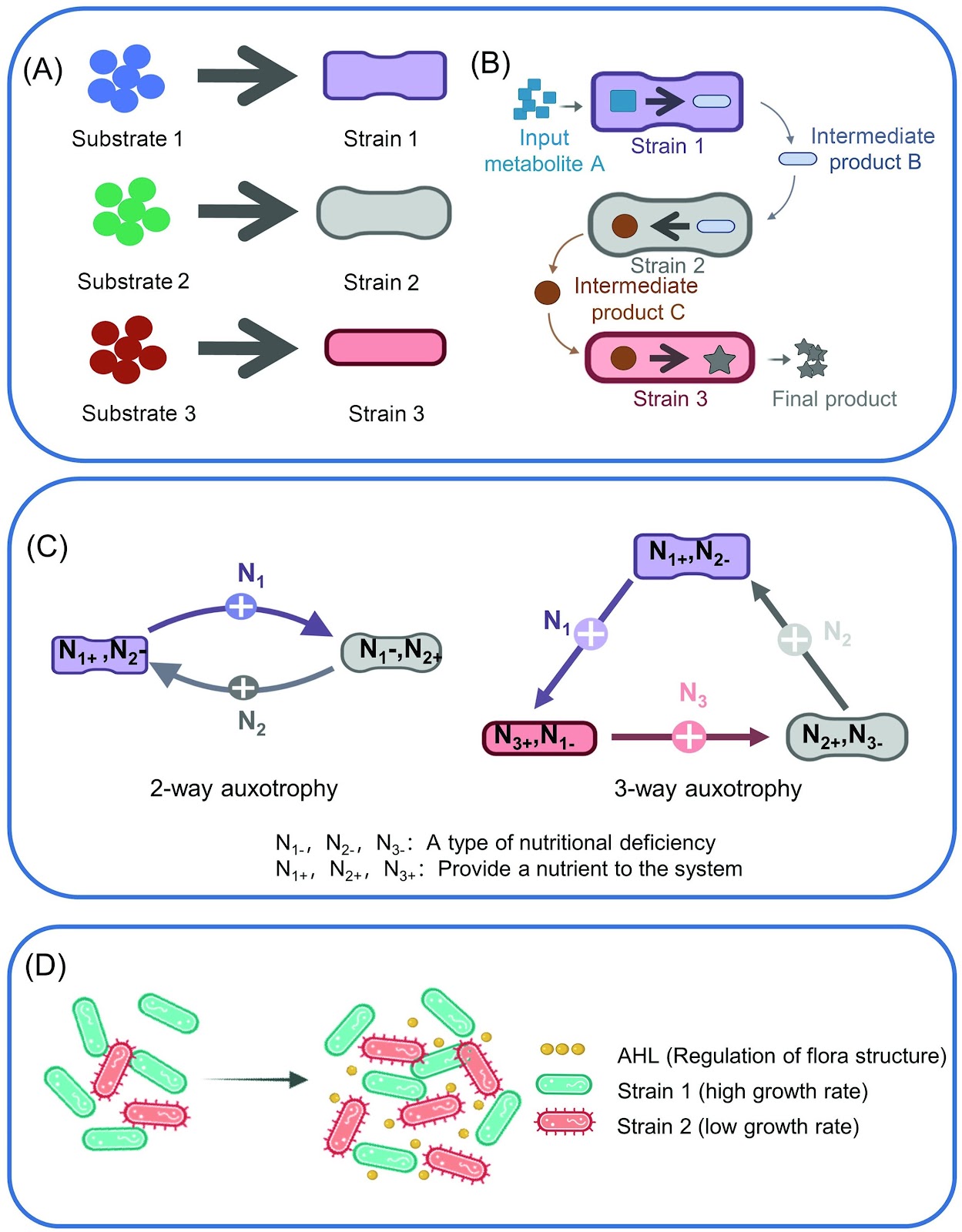
The concept of labor division and multi-module cooperation of microbial consortia offers it promising potentials in various areas, such as the utilization of complex substrates, synthesis of natural compounds with long metabolic pathways and remediation of environmental pollutants within a hostile environment. Consequently, synthetic microbial consortia represent a new frontier for synthetic biology because they can solve more complex problems than monocultures. However, current research on microbial consortia often involves the simple mixing of multiphase systems, where strains are co-cultured sequentially or individually cultured and then mixed-cultured. The instability and low efficiency of microbial consortia systems hindered their practical application. To construct a stable and efficient microbial consortium, it is essential to consider the different growth and metabolic characteristics of strains, the competition for various nutrients as well as the complex carbon, energy and signaling dynamics within the system. In this review, we provide a progressive strategy for constructing a stable and efficient microbial consortium system across three stages: compromised stage (work together), microenvironment-oriented stage (work better), and metabolite delivery-enhanced stage (work best). The detailed methods and points for attention of each stage are summarized, with a highlight on the technical bottleneck and application limitations. Through the integration of interdisciplinary strategies, such as materials science and mathematical models, the goal of building a stable and efficient microbial consortium is constantly advanced.
1. Introduction
Artificially synthesized microbial consortia have shattered the limitations imposed by monoculture, as they can reduce metabolic burden, streamline metabolic module optimization, and concurrently execute multiple tasks [1]. Accordingly, numerous research efforts have been dedicated to harnessing microbial consortia for diverse applications, such as the utilization of stubborn substrate, synthesis of complex natural chemicals, and remediation of hostile cultivation environments within the realm of synthetic biology [2]. However, recent studies have predominantly pursued purpose-oriented approaches, often relying on simplistic combinations of two microbial species, and occasionally employing sequential cultivation methods [3]. Regrettably, achieving a genuinely stable, controllable, high-yield, and robust microbial consortium remains an elusive goal in the present scientific landscape.
Maintaining stability and continuity in microbial consortia presents a substantial challenge compared to single-cell cultures, primarily due to the diverse cultivation conditions required, dynamic characteristics, and intricate communication among different microbial species [4,5]. Within microbial communities, fast-growing populations often outcompete slower-growing ones for nutrients, leading to the eventual disappearance of the latter from the consortia [6]. Moreover, various strains exhibit distinct temperature, pH and substrate cultivation preferences, making simple mixed cultures inadequate for providing the optimal growth environment. Furthermore, limitations in molecular transport across cell membranes and the dilution of intermediates in the extracellular space can reduce the effective concentration of substrates, thereby diminishing the efficiency of metabolic reactions [7]. Addressing these complexities necessitates innovative strategies and meticulous optimization to achieve the desired stability and performance in microbial consortia.
Loading authentic research manuscript (Pages 1–5)...
Yinshan Lin, Haohong Lin, Jingyuan Liu, Fengxue Xin, Minjiao Chen, Weiliang Dong, Xiujuan Qian, Min Jiang (2024). Insights into constructing a stable and efficient microbial consortium system. Chinese Journal of Chemical Engineering. https://doi.org/10.1016/j_cjche_1448
Research & Educational Purpose Only:The translations, structured abstracts, analytical annotations, and data reports provided by SinoTechIntel are intended exclusively for academic research, internal corporate R&D, and educational benchmarking. They do not constitute formal engineering, chemical safety, legal, or professional advice.
Copyright & Intellectual Property Notice: Original copyright of the underlying source articles and experimental data remains with the respective authors, institutions, and original publishing journals. SinoTechIntel claims intellectual property only over its proprietary translations, analytical syntheses, and AEO structured enhancements in accordance with international fair use and academic citation principles.
Frequently Asked Questions
What are the main challenges in constructing stable microbial consortia?
Challenges include differential growth requirements among strains, competition for nutrients, and limitations in mass transfer and communication, which can lead to instability and low efficiency.
What is the progressive strategy proposed in this review?
The strategy involves three stages: compromised stage (work together), microenvironment-oriented stage (work better), and metabolite delivery-enhanced stage (work best), each with specific methods and considerations.
How can interdisciplinary approaches help in microbial consortium engineering?
Integrating materials science and mathematical models can provide tools for designing microenvironments, predicting dynamics, and optimizing consortium performance, thereby advancing stability and efficiency.
What are the potential applications of microbial consortia?
Applications include utilization of complex substrates, synthesis of natural compounds with long metabolic pathways, and remediation of environmental pollutants in hostile environments.
What is the difference between 'Top-down' and 'Bottom-up' design strategies?
Top-down relies on environmental selection of existing microbiomes, while bottom-up involves deliberate design and construction of consortia from defined strains and metabolic pathways.
Related Technical Papers & Translations

Design and optimization of a high-efficiency distillation process for cellulosic fuel ethanol integrated with thermal coupling and molecular sieve adsorption
To address the challenges of high energy consumption and prominent costs in the traditional three-columns distillation process for cellulosic fuel ethanol, a distillation—molecular sieve coupling separation process is proposed. This process integrates a three-column (crude distillation column, first distillation column, second distillation column) system with a 3A molecular sieve adsorption deep dehydration unit. A thermal coupling network is constructed via differential pressure design (steam from medium/high-pressure columns as mutual heat sources, reboiler liquid waste heat for feed preheating), and molecular sieve adsorption conditions are optimized. The study first performs a thermodynamic consistency test on the ethanol—water system, determines optimal non-random two-liquid (NRTL) model binary interaction parameters via experimental data regression for Aspen Plus simulation. Aiming at minimum total annual cost (TAC), Aspen Plus is used to optimize process parameters (theoretical tray number, feed location, reflux ratio, side-draw position, etc.). Economic analysis shows this process reduces CO2 emission costs by 27.56%, TAC by 15.58% (to 5.123 × 10⁶ USD·a-1), and increases ethanol purity to >99.6%, providing an effective solution for green, efficient separation.

A cohesion loss model for determining residual strength of deep bedded sandstone
Rock residual strength, as an important input parameter, plays an indispensable role in proposing the reasonable and scientific scheme about stope design, underground tunnel excavation and stability evaluation of deep chambers. Therefore, previous residual strength models of rocks established were reviewed. And corresponding related problems were stated. Subsequently, starting from the effects of bedding and whole life-cycle evolution process, series of triaxial mechanical tests of deep bedded s

Federated model with contrastive learning and adaptive control variates for human activity recognition
Recent attention to privacy issues demands a communication-safe method for training human activity recognition (HAR) models on client activity data. Federated learning (FL) has become a compelling technique to facilitate model training between the server and clients while preserving data privacy. However, classical FL methods often assume independent and identically distributed (IID) data among clients. This assumption does not hold true in practical scenarios. Human activity in real-world scena