Key Takeaways & Executive Findings
- •• Addition of Y2O3 or CeO2 to AlCrFeNiCu high-entropy alloy coating refined the grain structure and modified solidification kinetics, significantly enhancing overall performance. • Doped coatings achieved hardness of 8.61 GPa (Y2O3) and 8.72 GPa (CeO2), with wear rate reductions of 41.3% and 38.0% respectively compared to the undoped coating. • Both modified coatings showed an order-of-magnitude decrease in self-corrosion current density in 0.1 mol/L KOH solution, indicating superior corrosion resistance. • Oxide-doped coatings maintained structural integrity after 90 min at 1200°C, while the undoped coating developed microcracks after only 30 min, demonstrating markedly improved high-temperature oxidation resistance.
Abstract
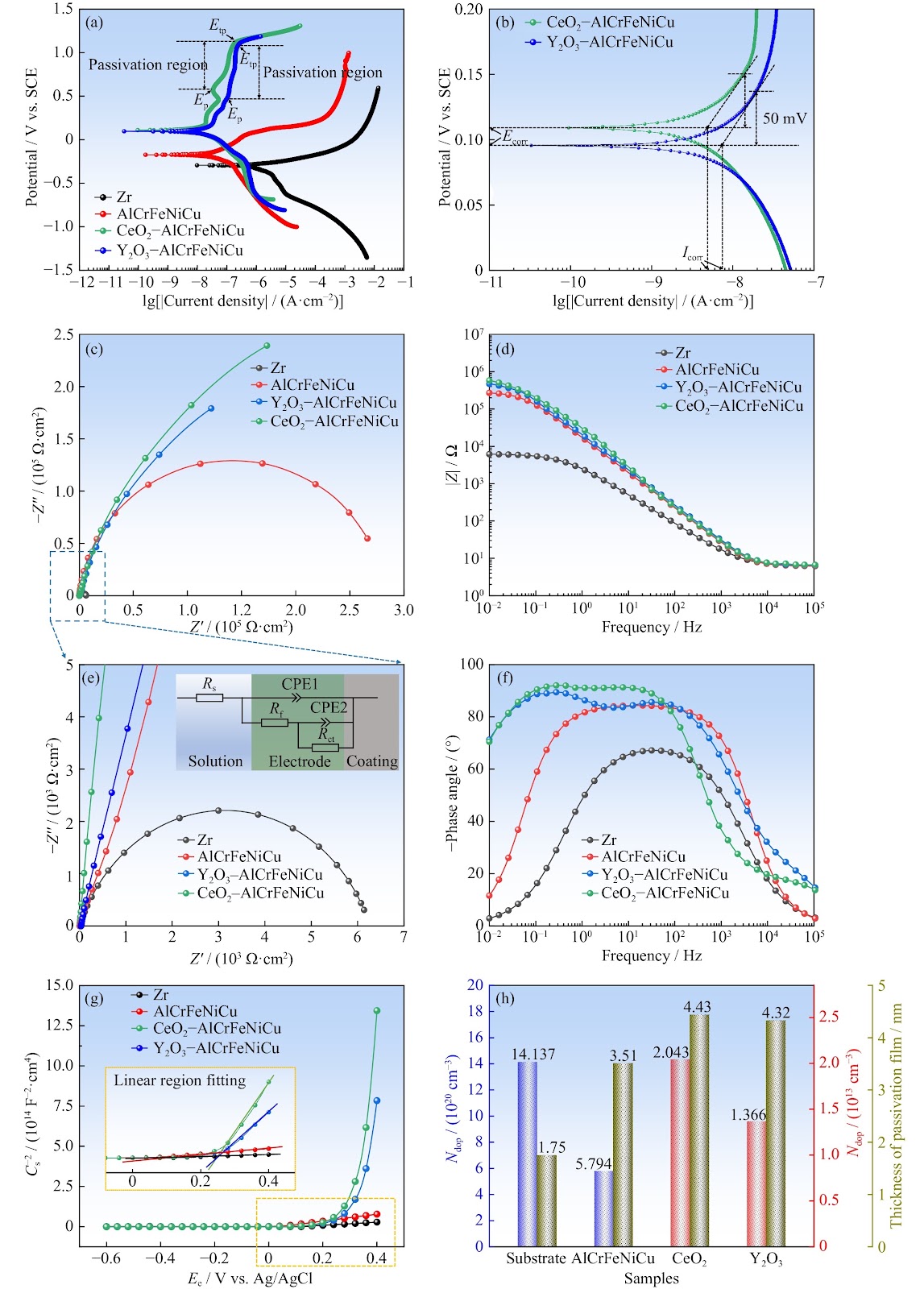
Y2O3 and CeO2 nanoparticles were individually incorporated into an AlCrFeNiCu coating applied to the surface of a Zr-4 rod. The microstructure, hardness, high-temperature fretting wear behavior, corrosion resistance, and high-temperature oxidation resistance of the coatings were comprehensively evaluated. The results demonstrate that the addition of Y2O3 or CeO2 notably modified the solidification kinetics of the molten pool, affected elemental diffusion pathways, and effectively refined the grain structure, thus significantly improving the overall performance of the AlCrFeNiCu coating. Specifically, the hardness of the AlCrFeNiCu coatings doped with Y2O3 and CeO2 reached 8.61 and 8.72 GPa, respectively, with corresponding wear rate reductions of 41.3% and 38.0% compared to the undoped coating. In a 0.1 mol/L KOH solution, the self-corrosion current densities of both modified coatings decreased by one order of magnitude in comparison to the unmodified AlCrFeNiCu coating. The oxidation behavior of both coatings conformed to parabolic kinetics, and the coatings retained their structural integrity after being exposed to air at 1200°C for 90 min, whereas the undoped coating exhibited microcracks after 30 min of exposure.
1. Introduction
Nuclear fuel cladding tubes, which encapsulate fuel pellets, serve as a critical safety barrier in reactors. Applying surface coatings to Zr alloy cladding presents a promising approach for enhancing accident tolerance, as it improves resistance to high-temperature steam oxidation while maintaining compatibility with existing reactor systems. Since 2017, high-entropy alloys (HEAs) such as V35Ti35Fe15Cr10Zr5 have been designed for nuclear applications [1]. Subsequent radiation resistance studies, initiated around 2019, have explored compositions like Ti2ZrHfV0.5Mo0.2 [2]. To date, refractory HEAs (RHEAs), including HfNbZrTi, Ti2ZrHfV0.5Mo0.2, TixWTaVCr, HfNbTaTiZr, and Mo0.5NbTiVCr0.25 as well as Mo0.5NbTiV0.5Zr0.25 [2–8], have demonstrated exceptional radiation tolerance, indicating strong potential for extreme nuclear environments. Based on the outstanding radiation resistance of HEAs, HEA coatings tailored for Zr alloys has been developed and fabricated via high-speed laser cladding (HSLC) [9–11].
HSLC is an advanced additive manufacturing technique that overcomes limitations of conventional cladding, such as excessive heat input and high dilution, by optimizing energy distribution during deposition. It enables higher processing speeds, improved efficiency, and reduced dilution [12–13]. The process involves rapid thermal cycles that modify grain growth, increase dislocation density, and enhance hardness and wear resistance. However, cracking remains a concern, necessitating careful evaluation of crack susceptibility. Studies indicate that incorporating minor amounts of rare earth oxides (e.g., CeO2, Y2O3, La2O3) refines grains, mitigates defects, and reduces cracking, thereby improving coating performance [14–16]. Among these, Y2O3 and CeO2 are widely utilized for enhancing strength and thermal stability. Their integration into HEA coatings—such as WMoTaNb, CoCrFeNiTiNb, FeCoNiCrMo, AlCoCrFeNiTi, AlCoCrFeNiCu, and FeCrNiMnAl—has proven effective in refining microstructure and boosting mechanical and corrosion resistance [17–21]. For example, the incorporation of Y2O3 led to a 26.5% increase in the microhardness of WMoTaNb, a 26.9% enhancement in the wear resistance of CoCrFeNiTiNb, and respective reductions of 60.3% and 40.3% in the oxidation rate and hot corrosion rate [17–18]. The addition of CeO2 reduced the crack sensitivity of the FeCoNiCrMo coating, increased its microhardness by 11.76%, and improved its corrosion resistance in a 3.5% NaCl solution [19]. The wear resistance of AlCoCrFeNiTi under dry-grinding and wet-grinding conditions increased by 55.14% and 50.69%, respectively [20].
In this study, AlCrFeNiCu coatings modified with Y2O3 and CeO2 were successfully deposited on Zr-4 substrates via HSLC. The influence of Y2O3 and CeO2 on microstructure, hardness, high-temperature fretting wear behavior, and corrosion resistance was systematically investigated, providing valuable insights for the development of rare earth oxide-reinforced HEA surface layers.
Loading authentic research manuscript (Pages 1–5)...
Xiaona Ren, Zhipei Chen, Qingzhi Yan, Peng Wang, Wenchang Wang, Yao Wang, Changchun Ge, Yong Zhang (2025). Influence of Y2O3/CeO2 on the microstructure and properties of AlCrFeNiCu high-entropy alloy coating. Journal of Mineral Metallurgy and Materials Science. https://doi.org/10.1007/s12613-026-3413-x
Research & Educational Purpose Only:The translations, structured abstracts, analytical annotations, and data reports provided by SinoTechIntel are intended exclusively for academic research, internal corporate R&D, and educational benchmarking. They do not constitute formal engineering, chemical safety, legal, or professional advice.
Copyright & Intellectual Property Notice: Original copyright of the underlying source articles and experimental data remains with the respective authors, institutions, and original publishing journals. SinoTechIntel claims intellectual property only over its proprietary translations, analytical syntheses, and AEO structured enhancements in accordance with international fair use and academic citation principles.
Frequently Asked Questions
What is the effect of Y2O3 and CeO2 on the AlCrFeNiCu high-entropy alloy coating?
The addition of Y2O3 or CeO2 nanoparticles modifies the solidification kinetics, refines the grain structure, and enhances the mechanical properties, corrosion resistance, and high-temperature oxidation resistance of the AlCrFeNiCu coating.
How did the rare earth oxides affect hardness and wear resistance?
The hardness of the AlCrFeNiCu coatings doped with Y2O3 and CeO2 reached 8.61 GPa and 8.72 GPa, respectively, with corresponding wear rate reductions of 41.3% and 38.0% compared to the undoped coating.
What was the improvement in corrosion resistance?
In a 0.1 mol/L KOH solution, the self-corrosion current densities of both modified coatings decreased by one order of magnitude compared to the unmodified AlCrFeNiCu coating, indicating significantly improved corrosion resistance.
How did the coatings behave under high-temperature oxidation?
The oxidation behavior of both doped coatings conformed to parabolic kinetics, and they retained structural integrity after exposure to air at 1200°C for 90 min. In contrast, the undoped coating exhibited microcracks after 30 min of exposure.
What fabrication technique was used for the coatings?
The coatings were fabricated via high-speed laser cladding (HSLC), an advanced additive manufacturing technique that optimizes energy distribution and enables higher processing speeds with reduced dilution.
Related Technical Papers & Translations

Design and optimization of a high-efficiency distillation process for cellulosic fuel ethanol integrated with thermal coupling and molecular sieve adsorption
To address the challenges of high energy consumption and prominent costs in the traditional three-columns distillation process for cellulosic fuel ethanol, a distillation—molecular sieve coupling separation process is proposed. This process integrates a three-column (crude distillation column, first distillation column, second distillation column) system with a 3A molecular sieve adsorption deep dehydration unit. A thermal coupling network is constructed via differential pressure design (steam from medium/high-pressure columns as mutual heat sources, reboiler liquid waste heat for feed preheating), and molecular sieve adsorption conditions are optimized. The study first performs a thermodynamic consistency test on the ethanol—water system, determines optimal non-random two-liquid (NRTL) model binary interaction parameters via experimental data regression for Aspen Plus simulation. Aiming at minimum total annual cost (TAC), Aspen Plus is used to optimize process parameters (theoretical tray number, feed location, reflux ratio, side-draw position, etc.). Economic analysis shows this process reduces CO2 emission costs by 27.56%, TAC by 15.58% (to 5.123 × 10⁶ USD·a-1), and increases ethanol purity to >99.6%, providing an effective solution for green, efficient separation.

A cohesion loss model for determining residual strength of deep bedded sandstone
Rock residual strength, as an important input parameter, plays an indispensable role in proposing the reasonable and scientific scheme about stope design, underground tunnel excavation and stability evaluation of deep chambers. Therefore, previous residual strength models of rocks established were reviewed. And corresponding related problems were stated. Subsequently, starting from the effects of bedding and whole life-cycle evolution process, series of triaxial mechanical tests of deep bedded s

Federated model with contrastive learning and adaptive control variates for human activity recognition
Recent attention to privacy issues demands a communication-safe method for training human activity recognition (HAR) models on client activity data. Federated learning (FL) has become a compelling technique to facilitate model training between the server and clients while preserving data privacy. However, classical FL methods often assume independent and identically distributed (IID) data among clients. This assumption does not hold true in practical scenarios. Human activity in real-world scena