Key Takeaways & Executive Findings
- •• A simple one-step high-temperature pyrolysis method fabricates hierarchical NiX@CNT catalysts with tunable non-metallic element doping. • Twelve catalyst variants were prepared by temperature adjustment, enabling systematic optimization of HER and OER activity. • Ni(NO3)2@CNT-900 demonstrates superior bifunctional performance with low overpotentials (145 mV for HER, 300 mV for OER at 10 mA/cm²). • The optimized catalyst exhibits excellent durability in alkaline electrolyte, highlighting its potential for practical water splitting.
Abstract
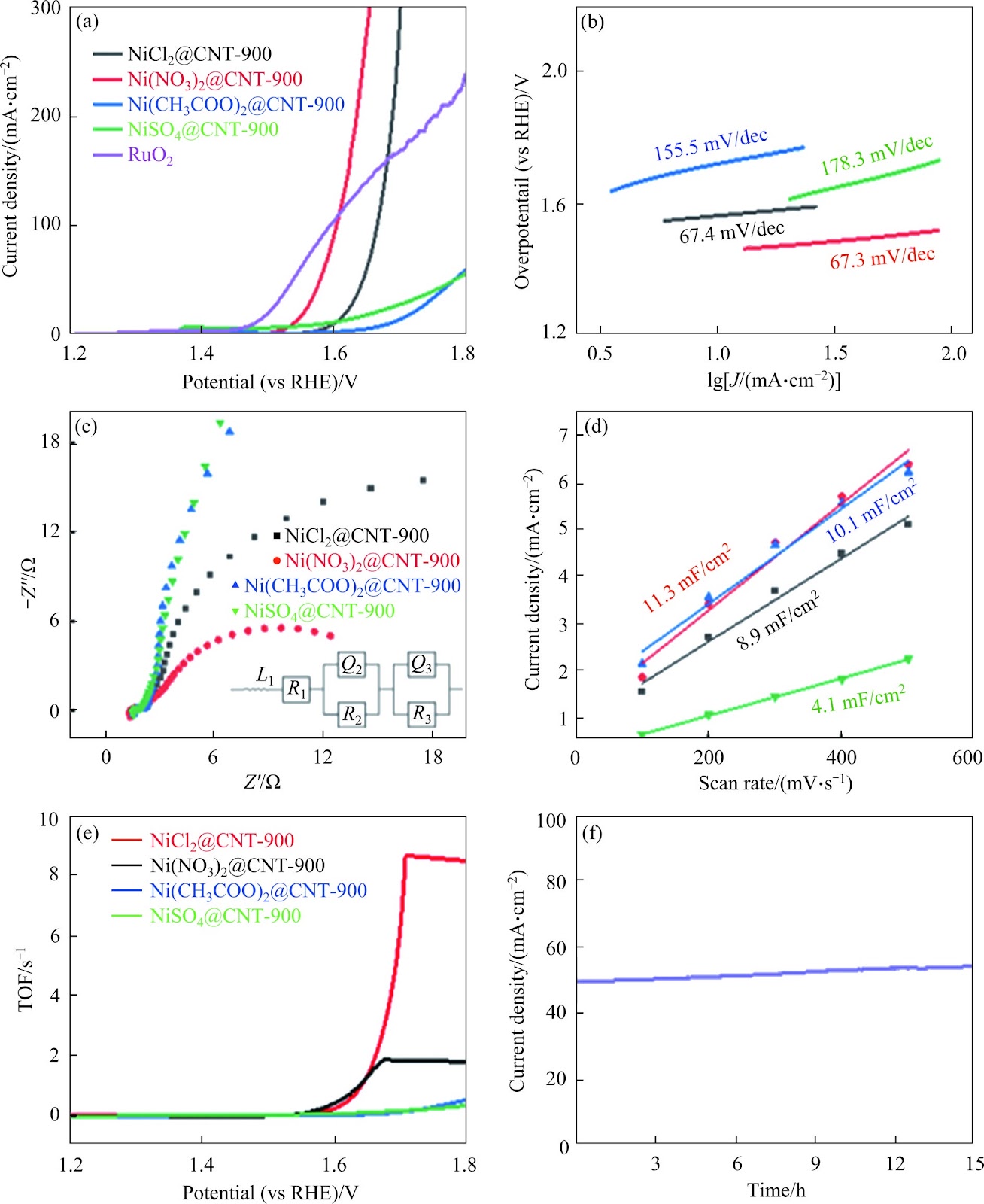
Developing efficient, durable, and precious metal-free electrocatalysts is currently a huge challenge. In this article, through a simple one-step high-temperature pyrolysis method, by incorporating various non-metallic element atoms, we prepared four different NiX(X=Cl2, (CH3COO)2, (NO3)2, SO4)@CNT catalysts. Additionally, by adjusting the temperature, these four materials were expanded into twelve catalyst materials for comparative optimization of hydrogen evolution reaction (HER) and oxygen evolution reaction (OER) activity. Ultimately, Ni(NO3)2@CNT-900 typically exhibits superior OER and HER activity. In 1 mol/L KOH solution with a current density of 10 mA/cm2, the overpotentials of HER and OER of Ni(NO3)2@CNT-900 are only 145 mV and 300 mV, respectively. Furthermore, the Ni(NO3)2@CNT-900 shows excellent durability in both HER and OER.
1. Introduction
The requirement for sustainable, pollution-free energy has drawn a lot of attention. Hydrogen is currently being focused on due to its high energy density and minimum carbon emissions during combustion [1−4]. Electrochemical water splitting for hydrogen production is an efficient approach for the storage of intermittent energy sources. However, the electrochemical water splitting is sluggish and usually occurs under high overpotentials [5−8]. Therefore, the electrocatalyst with excellent performance is very important to reduce the overpotential of hydrogen evolution reaction (HER) and oxygen evolution reaction. Currently, precious metal Pt is considered the most active catalyst toward the HER, while precious IrO2 and RuO2 are the most active catalysts toward the oxygen evolution reaction (OER). However, their high cost and scarcity seriously hinder their practical application. Therefore, it is highly desirable to exploit inexpensive and earth-abundant HER and OER electrocatalysts [9−13].
Among various promising alternatives, nickel-based materials have been explored as ideal and efficient non-noble metal electrocatalysts. Especially, nickel-based catalysts, including oxides [14, 15] and hydro(oxy)oxides [16] for the OER, and sulfides [17, 18], phosphides [19], carbides [20], and nitrides [21] for the HER have been investigated, owing to their facile electronic structure regulation. However, most of the above electrocatalysts have the strong bonding strength of OOH*/OH* intermediates with metal active substances, poor electronic conductivity, and instability in direct contact with highly alkaline electrolytes, leading to low activity. Modifications of these materials’ physical and chemical properties have been investigated to further improve the electrochemical stability of nickel compounds.
The strong metal-support interactions can effectively enhance the stability of the catalyst, as well as prevent the aggregation of loaded nanoparticles (NPs) and facilitate the electron transfer process [22, 23]. Recently, the coating of carbon frames has been beneficial in improving the activity and stability of transition metal-based catalysts [24]. Carbonaceous materials, such as porous activated carbon, graphene, carbon nanofibers, and carbon nanotubes (CNTs), showed good electrical conductivity, large surface area, and good chemical durability properties, which makes them excellent coating materials for various catalysts [25−28]. Carbon nanotubes have better electrical conductivity and mechanical strength among these carbon materials due to their one-dimensional characteristics and act as an efficient coating material for catalysts [29−42]. For example, Ru/Co-NCNTs [31], N-D-HCNT@pNi-Fe NPs [32], and Co/CNFs [33] exhibit excellent HER performance. Mn/V/N/S-doped-MWCNT [35], Fe0.6Co0.4-P@O [36], Ni2PNPs/NP-CNTs-850 [37], Fe/PVP-M [38], NiFeP@NC/CNT [39], CNTCo185H2 [40], Ni-Fe-P@CNTs-CC (carbon cloth) [41], and NiFeLDH/CNTs [42] exhibit good OER activities. However, the carbon frame-coated nickel-based bifunctional catalysts that can catalyze the HER and OER simultaneously in the same electrolyte have rarely been reported. Herein, we report a simple method by pyrolysis of dicyandiamid...
Loading authentic research manuscript (Pages 1–5)...
ZHANG Bai-qing, YIN Zhuo-xun, MA Xin-zhi, ZHOU Yang, LI Jin-long, WANG Yu-ping, WAN Li-juan, MA Zhan-chun (2025). In situ fabrication of hierarchical NiX@CNT: An efficient bifunctional electrocatalyst for water splitting. Journal of Central South University. https://doi.org/10.1007/s11771-025-5981-8
Research & Educational Purpose Only:The translations, structured abstracts, analytical annotations, and data reports provided by SinoTechIntel are intended exclusively for academic research, internal corporate R&D, and educational benchmarking. They do not constitute formal engineering, chemical safety, legal, or professional advice.
Copyright & Intellectual Property Notice: Original copyright of the underlying source articles and experimental data remains with the respective authors, institutions, and original publishing journals. SinoTechIntel claims intellectual property only over its proprietary translations, analytical syntheses, and AEO structured enhancements in accordance with international fair use and academic citation principles.
Frequently Asked Questions
What is the Ni(NO3)2@CNT-900 catalyst?
Ni(NO3)2@CNT-900 is a nickel-based catalyst synthesized by a one-step high-temperature pyrolysis method, where nickel nitrate is decomposed and supported on carbon nanotubes at 900 °C. It acts as an efficient bifunctional electrocatalyst for both the hydrogen evolution reaction and oxygen evolution reaction in alkaline media.
How were the NiX@CNT catalysts prepared?
The catalysts were prepared by a simple one-step high-temperature pyrolysis method using dicyandiamide and different nickel salts (chloride, acetate, nitrate, sulfate). By varying the pyrolysis temperature, a library of twelve catalysts was obtained for comparative optimization.
What are the overpotentials for HER and OER reported in the study?
In 1 mol/L KOH solution at a current density of 10 mA/cm², Ni(NO3)2@CNT-900 exhibits overpotentials of 145 mV for the hydrogen evolution reaction and 300 mV for the oxygen evolution reaction, demonstrating superior performance.
Why are non-precious metal catalysts important for water splitting?
Precious metals like Pt, IrO2, and RuO2 are highly active but expensive and scarce. Non-precious metal catalysts, such as nickel-based compounds, offer a cost-effective and earth-abundant alternative for large-scale hydrogen production via electrochemical water splitting.
What is the significance of using carbon nanotubes in the catalyst design?
Carbon nanotubes provide excellent electrical conductivity, high surface area, and mechanical strength, which enhance electron transfer and prevent nanoparticle aggregation. This leads to improved catalytic activity and stability of the nickel-based catalysts.
Related Technical Papers & Translations

Design and optimization of a high-efficiency distillation process for cellulosic fuel ethanol integrated with thermal coupling and molecular sieve adsorption
To address the challenges of high energy consumption and prominent costs in the traditional three-columns distillation process for cellulosic fuel ethanol, a distillation—molecular sieve coupling separation process is proposed. This process integrates a three-column (crude distillation column, first distillation column, second distillation column) system with a 3A molecular sieve adsorption deep dehydration unit. A thermal coupling network is constructed via differential pressure design (steam from medium/high-pressure columns as mutual heat sources, reboiler liquid waste heat for feed preheating), and molecular sieve adsorption conditions are optimized. The study first performs a thermodynamic consistency test on the ethanol—water system, determines optimal non-random two-liquid (NRTL) model binary interaction parameters via experimental data regression for Aspen Plus simulation. Aiming at minimum total annual cost (TAC), Aspen Plus is used to optimize process parameters (theoretical tray number, feed location, reflux ratio, side-draw position, etc.). Economic analysis shows this process reduces CO2 emission costs by 27.56%, TAC by 15.58% (to 5.123 × 10⁶ USD·a-1), and increases ethanol purity to >99.6%, providing an effective solution for green, efficient separation.

A cohesion loss model for determining residual strength of deep bedded sandstone
Rock residual strength, as an important input parameter, plays an indispensable role in proposing the reasonable and scientific scheme about stope design, underground tunnel excavation and stability evaluation of deep chambers. Therefore, previous residual strength models of rocks established were reviewed. And corresponding related problems were stated. Subsequently, starting from the effects of bedding and whole life-cycle evolution process, series of triaxial mechanical tests of deep bedded s

Federated model with contrastive learning and adaptive control variates for human activity recognition
Recent attention to privacy issues demands a communication-safe method for training human activity recognition (HAR) models on client activity data. Federated learning (FL) has become a compelling technique to facilitate model training between the server and clients while preserving data privacy. However, classical FL methods often assume independent and identically distributed (IID) data among clients. This assumption does not hold true in practical scenarios. Human activity in real-world scena