Key Takeaways & Executive Findings
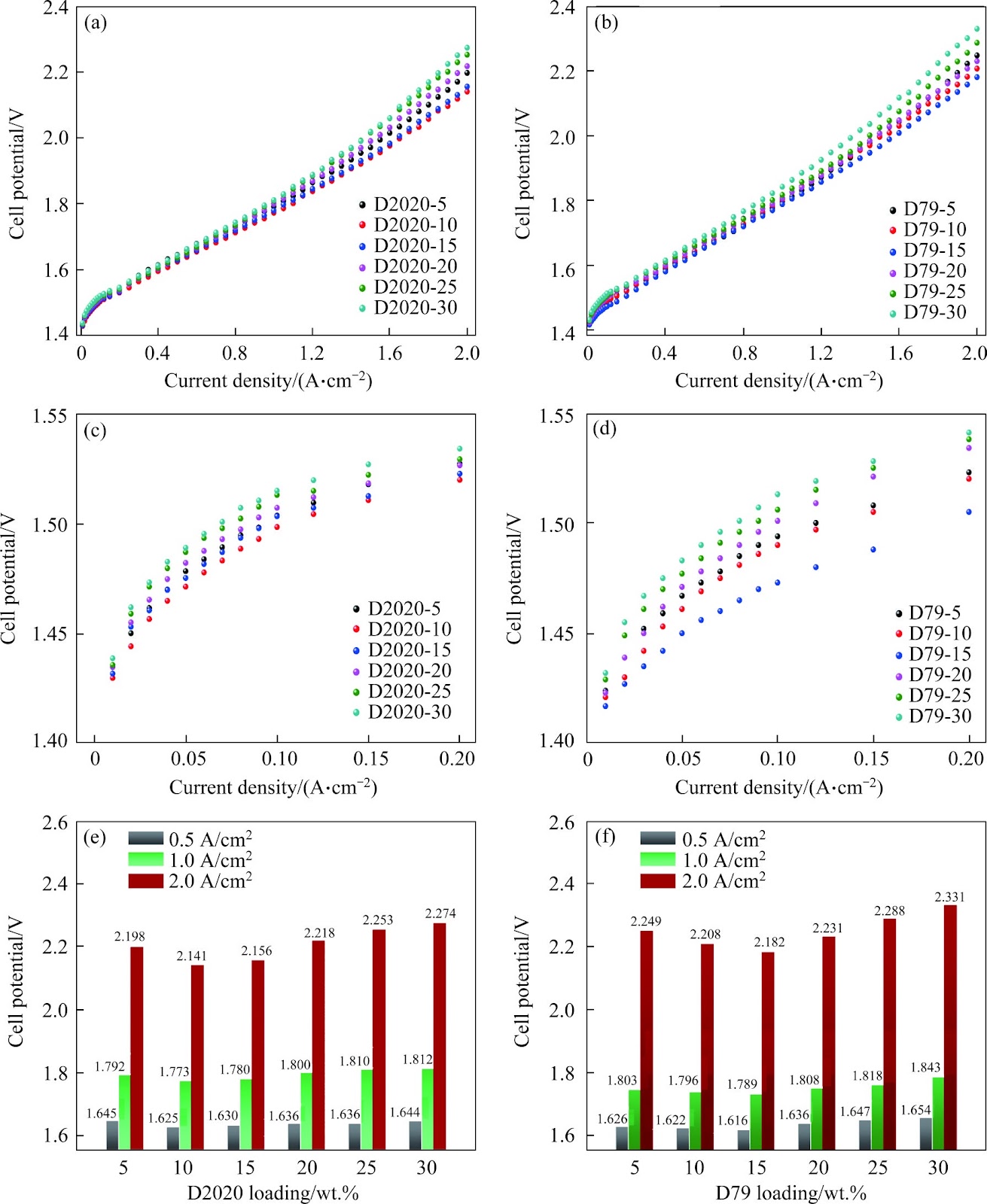
- •• At a 10 wt.% ionomer/Ir ratio, long-side-chain (LSC) ionomer achieves 2.141 V at 2.00 A/cm², outperforming short-side-chain (SSC) ionomer (2.208 V). • MEA with LSC ionomer shows better electrochemical performance than SSC at the same I/Ir ratio, especially at high current density. • LSC ionomer produces larger average pore size and porosity, improving mass-transfer properties and reducing ohmic and mass transfer resistances. • Optimizing ionomer side-chain structure and content is a cost-effective strategy to enhance PEM water electrolysis performance.
Abstract
As the proton transport channel and binder within the catalytic layer (CL), the physicochemical properties of the ionomer can affect the CL microstructure and performance of the membrane electrode assembly. In this paper, we select ionomers with different side-chain lengths and investigate the effects of the side-chain structure and content of the ionomers on the performance of membrane electrode assembly (MEA). Electrochemical tests show that at a mass ratio of 10 wt.% of ionomer/Ir (I/Ir), long-side-chain (LSC) ionomer exhibits the best performance (2.141 [email protected] A/cm2, while short-side-chain (SSC) ionomer is 2.208 [email protected] A/cm2). The MEA containing LSC ionomer shows better electrochemical performance than the SSC at the same I/Ir mass ratio, especially at high current density. The MEA containing LSC ionomer has a larger average pore size and porosity, which indicates that it may have better mass-transfer properties. From the analysis of voltage loss, it can be seen that LSC ionomers have a smaller ohmic impedance and mass transfer resistance than SSC ionomers. In conclusion, LSC ionomers are more conducive to water-gas transport, which can provide excellent water electrolysis performance. This article focuses on the optimization of ionomer side chains and content, which can enhance PEM water electrolysis performance at lower cost.
1. Introduction
The widespread consumption of fossil fuels in recent decades has led to severe environmental problems due to carbon dioxide and other greenhouse gas emissions. With the rapid growth of global energy demand, various energy sources have been proposed, including hydropower, wind energy, solar energy, nuclear energy, and hydrogen energy. Hydrogen energy offers a potential solution for meeting global energy demand with minimal pollution.
As a major source of green hydrogen production, proton exchange membrane water electrolyzer (PEMWE) technology is the most promising technology for large-scale hydrogen production because of its high proton conductivity, high hydrogen volume fraction (>99.99%), low gas crossover and high operating pressure. However, PEMWE has a high cost of components and materials, and small application scale causes high assembly costs, resulting in an overall high cost. To make PEMWE economically viable, material costs should be reduced and system performance should be improved.
The catalytic layer (CL) of membrane electrode assembly (MEA) is an essential site for conducting electrochemical reactions and is a critical parameter in determining electrochemical performance. The ideal CL has efficient catalyst activity and utilization, maintains high porosity, and constructs efficient mass transfer channels. As one of the critical materials of catalytic layers, ionomers play an essential role in the electrochemical performance of CLs by constructing proton transport channels and acting as a binder to maintain the CL structure. Physicochemical properties of ionomers cause different effects on the CL microstructure and MEA properties, such as ionomer morphology, coverage and ionomer content. Therefore, to achieve low noble metal loading while maintaining high catalytic performance, it is beneficial to understand the interaction mechanism between ionomers and catalysts and analyze the effect of ionomers on the structure and performance of the CL of MEA.
Loading authentic research manuscript (Pages 1–5)...
LYU Hong, HU Ding, WANG Sen, SUN Yong-wen, ZHANG Cun-man (2025). Improving electrochemical performance of PEM water electrolyzer by optimizing side-chain structure and content of ionomer. Journal of Central South University. https://doi.org/10.1007/s11771-025-5956-9
Research & Educational Purpose Only:The translations, structured abstracts, analytical annotations, and data reports provided by SinoTechIntel are intended exclusively for academic research, internal corporate R&D, and educational benchmarking. They do not constitute formal engineering, chemical safety, legal, or professional advice.
Copyright & Intellectual Property Notice: Original copyright of the underlying source articles and experimental data remains with the respective authors, institutions, and original publishing journals. SinoTechIntel claims intellectual property only over its proprietary translations, analytical syntheses, and AEO structured enhancements in accordance with international fair use and academic citation principles.
Frequently Asked Questions
How does ionomer side-chain length affect PEM water electrolyzer performance?
The study found that long-side-chain (LSC) ionomers outperform short-side-chain (SSC) ionomers at the same ionomer/Ir mass ratio. Specifically, at 10 wt.% I/Ir, LSC achieved 2.141 V at 2.00 A/cm² versus 2.208 V for SSC, with advantages especially at high current density.
Why does long-side-chain ionomer lead to better electrochemical performance?
LSC ionomers produce MEAs with larger average pore size and porosity, improving mass-transfer properties. They also exhibit smaller ohmic impedance and mass transfer resistance compared to SSC ionomers, facilitating water-gas transport.
What is the optimal ionomer content in the anode catalytic layer?
The paper highlights a mass ratio of 10 wt.% ionomer/Ir as the condition where LSC ionomer shows the best performance. The study emphasizes that both side-chain structure and content must be optimized to enhance performance.
Can this research reduce the cost of PEM water electrolyzers?
Yes. By optimizing ionomer side-chain structure and content, the electrochemical performance of PEMWE can be enhanced without increasing noble metal loading, contributing to lower material costs and improved economic viability.
What are the key physical properties affected by ionomer side-chain length?
Side-chain length influences ionomer morphology, coverage, pore structure, porosity, and transport properties. LSC ionomers offer more favorable water-gas transport and lower resistance, which are critical for high-current-density operation.
Related Technical Papers & Translations

Design and optimization of a high-efficiency distillation process for cellulosic fuel ethanol integrated with thermal coupling and molecular sieve adsorption
To address the challenges of high energy consumption and prominent costs in the traditional three-columns distillation process for cellulosic fuel ethanol, a distillation—molecular sieve coupling separation process is proposed. This process integrates a three-column (crude distillation column, first distillation column, second distillation column) system with a 3A molecular sieve adsorption deep dehydration unit. A thermal coupling network is constructed via differential pressure design (steam from medium/high-pressure columns as mutual heat sources, reboiler liquid waste heat for feed preheating), and molecular sieve adsorption conditions are optimized. The study first performs a thermodynamic consistency test on the ethanol—water system, determines optimal non-random two-liquid (NRTL) model binary interaction parameters via experimental data regression for Aspen Plus simulation. Aiming at minimum total annual cost (TAC), Aspen Plus is used to optimize process parameters (theoretical tray number, feed location, reflux ratio, side-draw position, etc.). Economic analysis shows this process reduces CO2 emission costs by 27.56%, TAC by 15.58% (to 5.123 × 10⁶ USD·a-1), and increases ethanol purity to >99.6%, providing an effective solution for green, efficient separation.

A cohesion loss model for determining residual strength of deep bedded sandstone
Rock residual strength, as an important input parameter, plays an indispensable role in proposing the reasonable and scientific scheme about stope design, underground tunnel excavation and stability evaluation of deep chambers. Therefore, previous residual strength models of rocks established were reviewed. And corresponding related problems were stated. Subsequently, starting from the effects of bedding and whole life-cycle evolution process, series of triaxial mechanical tests of deep bedded s

Federated model with contrastive learning and adaptive control variates for human activity recognition
Recent attention to privacy issues demands a communication-safe method for training human activity recognition (HAR) models on client activity data. Federated learning (FL) has become a compelling technique to facilitate model training between the server and clients while preserving data privacy. However, classical FL methods often assume independent and identically distributed (IID) data among clients. This assumption does not hold true in practical scenarios. Human activity in real-world scena