Key Takeaways & Executive Findings
- •• Hydrophobic CHA-ZIFs with junctional traps between cha and d6r cages selectively adsorb 2,3-butanediol over 1,3-propanediol from dilute aqueous solutions. • ZIF-301 and ZIF-300, containing halogen groups, outperform ZIF-302 (methyl groups) in adsorptive separation performance. • ZIF-301 achieves an adsorption capacity of 116.4 mg·g−1 and a selectivity of 3.8 for 2,3-BDO/1,3-PDO in dynamic column adsorption. • Computational simulations confirm that 2,3-BDO preferentially binds in the junctional trap, highlighting the importance of hydrophobic and confined pore structures for diol separation.
Abstract
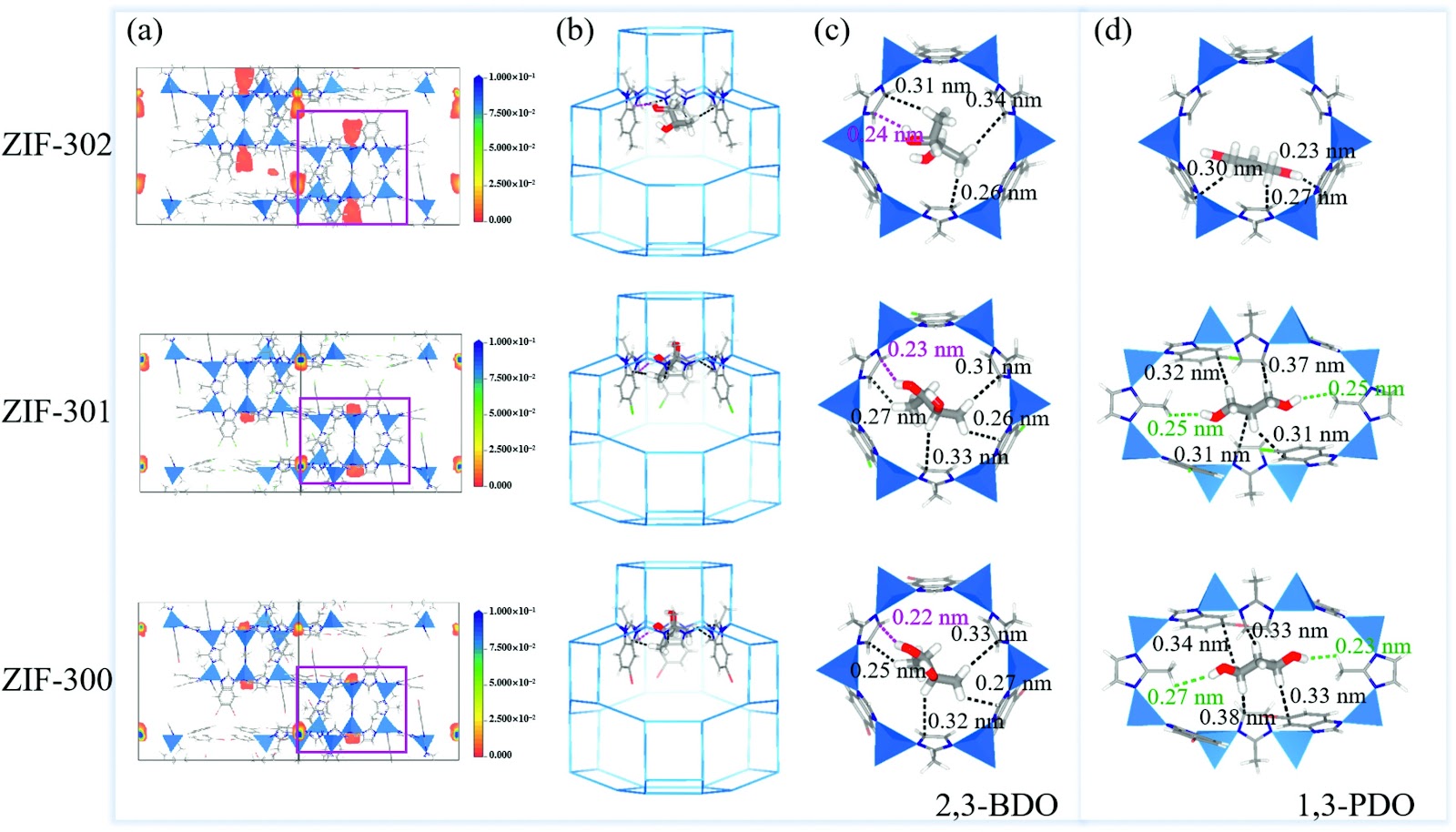
The adsorption and separation of diols from dilute aqueous solution using hydrophobic materials is very challenging due to the strong diol–water hydrogen-bonding interactions. Herein, we screened hydrophobic zeolitic imidazolate frameworks (ZIFs) with chabazite (CHA) topology for separation of 2,3-butanediol (2,3-BDO) and 1,3-propanediol (1,3-PDO), which had junctional and hydrophobic traps matching the two end methyl groups of the 2,3-BDO molecule. Based on CHA-ZIFs with the same small-sized ligand 2-methylimidazole (mIm) and different large-sized ligand benzimidazole derivatives (RbIm), CHA-ZIFs with larger surface areas were obtained by the addition of excess small-sized ligand mIm in the synthesis process. We showed that all of the hydrophobic CHA-ZIFs preferentially adsorbed 2,3-BDO over 1,3-PDO by static batch adsorption and dynamic column adsorption experiments. But ZIF-301 and ZIF-300 with halogen groups exhibited better adsorptive separation performance for 2,3-BDO/1,3-PDO than ZIF-302 with methyl groups. For a typical ZIF-301, its adsorption capacity for 2,3-BDO was 116.4 mg·g−1 and selectivity for 2,3-BDO/1,3-PDO was 3.8 in dynamic column adsorption of the binary-component system (2,3-BDO/1,3-PDO: 50 g·L−1/50 g·L−1). Computational simulations revealed that 2,3-BDO preferentially adsorbed in a trap at the junction between the cha and d6r cages of CHA-ZIFs, meaning the strong host–guest interactions. Therefore, the hydrophobic CHA-ZIFs with a junctional trap were promising candidate materials for adsorbing 2,3-BDO, which also provided a new perspective for separating diols in dilute aqueous solutions.
1. Introduction
Effective development and utilization of biomass is extremely important to the realization of China's “carbon peaking” and “carbon neutrality” goals. The 1,3-propanediol (1,3-PDO) and 2,3-butanediol (2,3-BDO) are vital bio-based platform compounds, which act as polymer monomers to synthesize high-performance polyester materials [1,2]. Typically, bio-based 1,3-PDO is produced through glycerol fermentation [3–5]. The corresponding fermentation broth is a low concentration and multi-component aqueous solution of 80%–90% water, 30–100 g·L−1 1,3-PDO and 10–70 g·L−1 2,3-BDO [6–9]. However, 1,3-PDO and 2,3-BDO are diols with strong hydrophilicities and high boiling points, which further complicates the separation and purification process.
At present, several technologies have been studied for the separation of 1,3-PDO and 2,3-BDO from the fermentation broth, such as distillation [10,11], extraction [12–14] and adsorption [15–22]. Compared to other separation methods, adsorption has advantages of low energy consumption, environmental protection and less investment in equipment. Several adsorbent materials have been studied to adsorb 1,3-PDO or 2,3-BDO, including zeolites [15–17], metal–organic frameworks (MOFs) [18,19] and resins [20–22]. Hydrophilic adsorbents preferentially adsorbed 1,3-PDO, whereas hydrophobic adsorbents preferentially adsorbed 2,3-BDO. Typically, Jin et al. [18] reported that hydrophilic SIM-1 was useful for enriching 1,3-PDO. Li et al. [16] showed that hydrophobic F-ZSM-5 was suitable for adsorbing 2,3-BDO, with the adsorption capacity of 59 mg·g−1. Our recent work demonstrated that introducing adsorption sites on hydrophobic ZIF-71 improved the adsorption capacity and mass transfer of 2,3-BDO [19]. Based on 2,3-BDO with methyl groups at both ends, we designed adsorbent materials with hydrophobic and confined pore structures, which facilitated the adsorptive separation of 2,3-BDO from dilute aqueous solutions.
Loading authentic research manuscript (Pages 1–5)...
Lifang Ge, Meizhen Gao, Xiaosheng Zhang, Jiang Wang, Qi Shi, Jinxiang Dong (2024). Hydrophobic CHA-ZIFs with a junctional trap between cha and d6r cages for adsorption of 2,3-butanediol in aqueous solution. Chinese Journal of Chemical Engineering. https://doi.org/10.1016/j_cjche_1448
Research & Educational Purpose Only:The translations, structured abstracts, analytical annotations, and data reports provided by SinoTechIntel are intended exclusively for academic research, internal corporate R&D, and educational benchmarking. They do not constitute formal engineering, chemical safety, legal, or professional advice.
Copyright & Intellectual Property Notice: Original copyright of the underlying source articles and experimental data remains with the respective authors, institutions, and original publishing journals. SinoTechIntel claims intellectual property only over its proprietary translations, analytical syntheses, and AEO structured enhancements in accordance with international fair use and academic citation principles.
Frequently Asked Questions
What are CHA-ZIFs and why are they used for diol separation?
CHA-ZIFs are zeolitic imidazolate frameworks with chabazite topology, featuring hydrophobic properties and confined traps. They are used for diol separation because their junctional traps between cha and d6r cages match the methyl groups of 2,3-butanediol, enabling selective adsorption from aqueous solutions.
Which CHA-ZIF variant showed the best performance for 2,3-BDO adsorption?
ZIF-301, which contains halogen groups, exhibited the best performance with an adsorption capacity of 116.4 mg·g−1 and a selectivity of 3.8 for 2,3-BDO/1,3-PDO in dynamic column adsorption.
How does the hydrophobic nature of CHA-ZIFs contribute to the separation?
The hydrophobic nature of CHA-ZIFs reduces competitive water adsorption, allowing preferential interaction with the hydrophobic methyl groups of 2,3-BDO, thus enhancing selectivity over more hydrophilic diols like 1,3-PDO.
What is the significance of the junctional trap in CHA-ZIFs?
The junctional trap between the cha and d6r cages provides a confined hydrophobic environment that strongly interacts with the two terminal methyl groups of 2,3-BDO, leading to high adsorption capacity and selectivity.
What are the practical implications of this study for bio-based chemical production?
The findings offer a promising adsorbent material for efficient separation of 2,3-butanediol from dilute fermentation broths, potentially reducing energy costs and improving the purification process in bio-based chemical production.
Related Technical Papers & Translations

Design and optimization of a high-efficiency distillation process for cellulosic fuel ethanol integrated with thermal coupling and molecular sieve adsorption
To address the challenges of high energy consumption and prominent costs in the traditional three-columns distillation process for cellulosic fuel ethanol, a distillation—molecular sieve coupling separation process is proposed. This process integrates a three-column (crude distillation column, first distillation column, second distillation column) system with a 3A molecular sieve adsorption deep dehydration unit. A thermal coupling network is constructed via differential pressure design (steam from medium/high-pressure columns as mutual heat sources, reboiler liquid waste heat for feed preheating), and molecular sieve adsorption conditions are optimized. The study first performs a thermodynamic consistency test on the ethanol—water system, determines optimal non-random two-liquid (NRTL) model binary interaction parameters via experimental data regression for Aspen Plus simulation. Aiming at minimum total annual cost (TAC), Aspen Plus is used to optimize process parameters (theoretical tray number, feed location, reflux ratio, side-draw position, etc.). Economic analysis shows this process reduces CO2 emission costs by 27.56%, TAC by 15.58% (to 5.123 × 10⁶ USD·a-1), and increases ethanol purity to >99.6%, providing an effective solution for green, efficient separation.

A cohesion loss model for determining residual strength of deep bedded sandstone
Rock residual strength, as an important input parameter, plays an indispensable role in proposing the reasonable and scientific scheme about stope design, underground tunnel excavation and stability evaluation of deep chambers. Therefore, previous residual strength models of rocks established were reviewed. And corresponding related problems were stated. Subsequently, starting from the effects of bedding and whole life-cycle evolution process, series of triaxial mechanical tests of deep bedded s

Federated model with contrastive learning and adaptive control variates for human activity recognition
Recent attention to privacy issues demands a communication-safe method for training human activity recognition (HAR) models on client activity data. Federated learning (FL) has become a compelling technique to facilitate model training between the server and clients while preserving data privacy. However, classical FL methods often assume independent and identically distributed (IID) data among clients. This assumption does not hold true in practical scenarios. Human activity in real-world scena