Key Takeaways & Executive Findings
- •• [EMIM][FeCl4] ionic liquid exhibits high selectivity for separating tetralin from dodecane and decalin, with selectivity values up to 110 and 19.5, respectively. • Density functional theory and energy decomposition analyses reveal that electrostatic and dispersion interactions dominate the extraction mechanism, with van der Waals forces playing a major role. • The selectivity of the ionic liquid increases with decreasing alkyl chain length, offering a tunable parameter for process optimization. • The regenerated [EMIM][FeCl4] can be reused multiple times, demonstrating good recyclability and potential for industrial application.
Abstract
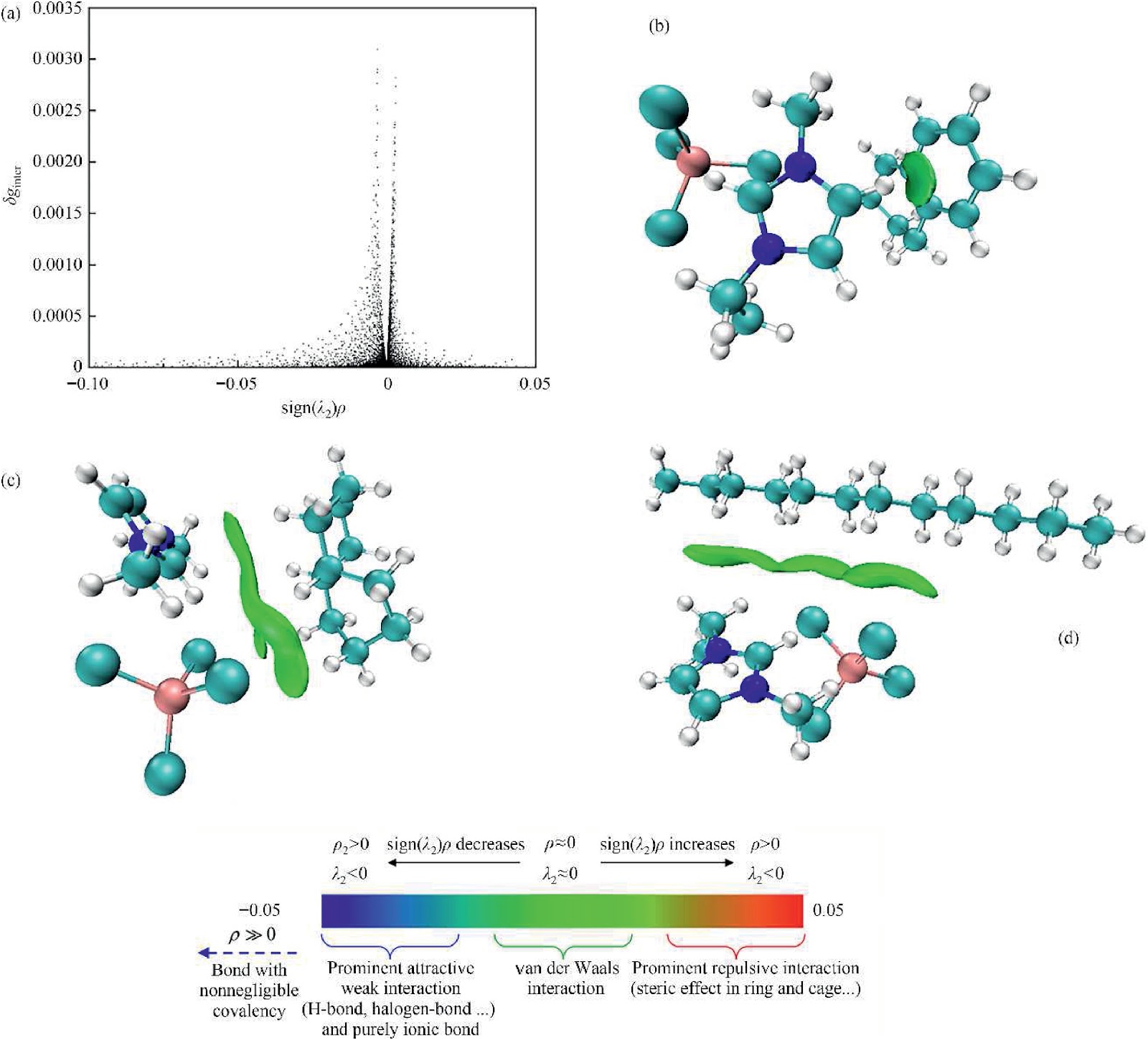
The separation of aromatics from aliphatics is essential for achieving maximum exploitation of oil resources in the petrochemical industry. In this study, a series of metal chloride-based ionic liquids were prepared and their performances in the separation of 1,2,3,4-tetrahydronaphthalene (tetralin)/dodecane and tetralin/decalin systems were studied. Among these ionic liquids, 1-ethyl-3-methylimidazolium tetrachloroferrate ([EMIM][FeCl4]) with the highest selectivity was used as the extractant. Density functional theory calculations showed that [EMIM][FeCl4] interacted more strongly with tetralin than with dodecane and decalin. Energy decomposition analysis of [EMIM][FeCl4]–tetralin indicated that electrostatics and dispersion played essential roles, and induction cannot be neglected. The van der Waals forces was a main effect in [EMIM][FeCl4]–tetralin by independent gradient model analysis. The tetralin distribution coefficient and selectivity were 0.8 and 110, respectively, with 10% (mol) tetralin in the initial tetralin/dodecane system, and 0.67 and 19.5, respectively, with 10% (mol) tetralin in the initial tetralin/decalin system. The selectivity increased with decreasing alkyl chain length of the extractant. The influence of the extraction temperature, extractant dosage, and initial concentrations of the system components on the separation performance were studied. Recycling experiments showed that the regenerated [EMIM][FeCl4] could be used repeatedly.
1. Introduction
Diesel, which is a mixture that includes polycyclic aromatic hydrocarbons [1], is an important raw material in the chemical industry. However, polycyclic aromatic hydrocarbons in vehicle diesel decrease the cetane number [2]. They can also produce oxycarbide and particulate matter [3], which cause severe environmental pollution. Diesel is rich in paraffins and cycloalkanes, and these are ideal raw materials for ethylene cracking and catalytic reforming, respectively [4]. It is untoward that the aromatics were removed from non-aromatics in diesel via traditional distillation owing to their fairly approximate boiling points [5]. The separation of aromatics from non-aromatic compounds is therefore a knotty work for the petrochemical industry [6].
The conventional methods used to separate aromatics from aliphatics are liquid–liquid extraction [7], extractive distillation [8], and azeotropic distillation [9]. Liquid–liquid extraction with low energy consumption and mild operating conditions is most commonly adopted. Classical organic solvents such as sulfolane, N-methylpyrrolidone (NMP), N-formylmorpholine, dimethyl sulfoxide, and tetraethylene glycol are used in this process [10]. Nevertheless, these solvents usually appearing with low selectivity are often evaporable [11]. An extractant with high selectivity and fine recyclable feature is favored in industrial processes.
Ionic liquids (ILs), which are usually regarded as organic salts comprising cations and organic or inorganic anions [12], have been receiving increasing attention in the recent decades [13] due to their strong dissolving capacities, low vapor pressures, and high thermal and chemical stabilities [14–16]. They are used in many fields by tuning the chemical structures of the cation and anion to prepare targeted ILs with specified properties [17]; therefore, ILs have potential applications in liquid–liquid extraction. Li et al. [18] studied the use of NMP, sulfolane, and N-formylmorpholine for separating 1-methylnaphthalene from dodecane, which suggested that 1-methylnaphthalene had the highest solubility in NMP and that sulfolane had the highest selectivity for 1-methylnaphthalene. Furthermore, it was indicated that the extractant-possessing planar construction was inclined to have higher solubility for 1-methylnaphthalene because of the smaller steric hindrance and the group with more electronegativity had higher selectivity for 1-methylnaphthalene. Finally, it was also found that the van der Waals (VDW) force made a major contribution between the three solvents and 1-methylnaphthalene by reduced density gradient and atoms in molecules analyses. Ge et al. [19] used a deep eutectic solvent containing tetrabutylphosphonium bromide and levulinic acid to separate 1,2,3,4-tetrahydronaphthalene (tetralin) from dodecane, indicating that the tetrabutylphosphonium cation could interact with tetralin through CH–π interaction by spatial distribution function with molecular dynamic simulation. It was suggested that π–π interaction was found between C=O bond of levulinic acid and tetralin, and no hydrogen bonds were detected between deep eutectic solvent (DES) and tetralin. Li et al. [20] used [Bz-DBU][NTf2] to separate t...
Loading authentic research manuscript (Pages 1–5)...
Hui Yu, Xiaojia Wu, Chuanqi Geng, Xinyu Li, Chencan Du, Zhiyong Zhou, Zhongqi Ren (2023). Highly selective extraction of aromatics from aliphatics by using metal chloride-based ionic liquids. Chinese Journal of Chemical Engineering. https://doi.org/10.1016/j_cjche_144877061
Research & Educational Purpose Only:The translations, structured abstracts, analytical annotations, and data reports provided by SinoTechIntel are intended exclusively for academic research, internal corporate R&D, and educational benchmarking. They do not constitute formal engineering, chemical safety, legal, or professional advice.
Copyright & Intellectual Property Notice: Original copyright of the underlying source articles and experimental data remains with the respective authors, institutions, and original publishing journals. SinoTechIntel claims intellectual property only over its proprietary translations, analytical syntheses, and AEO structured enhancements in accordance with international fair use and academic citation principles.
Frequently Asked Questions
What is the main objective of this study?
The main objective is to develop highly selective metal chloride-based ionic liquids for the separation of aromatics from aliphatics, specifically targeting tetralin/dodecane and tetralin/decalin systems, to improve efficiency in the petrochemical industry.
Which ionic liquid showed the highest selectivity?
1-ethyl-3-methylimidazolium tetrachloroferrate ([EMIM][FeCl4]) exhibited the highest selectivity among the tested metal chloride-based ionic liquids.
What are the key interaction mechanisms in the extraction process?
Density functional theory and energy decomposition analyses revealed that electrostatic and dispersion interactions are essential, with van der Waals forces playing a major role in the interaction between [EMIM][FeCl4] and tetralin.
How does the alkyl chain length of the extractant affect selectivity?
The selectivity increases with decreasing alkyl chain length of the extractant, indicating that shorter alkyl chains enhance the separation performance.
Can the ionic liquid be reused?
Yes, recycling experiments demonstrated that the regenerated [EMIM][FeCl4] can be used repeatedly without significant loss of performance, highlighting its potential for industrial applications.
Related Technical Papers & Translations

Design and optimization of a high-efficiency distillation process for cellulosic fuel ethanol integrated with thermal coupling and molecular sieve adsorption
To address the challenges of high energy consumption and prominent costs in the traditional three-columns distillation process for cellulosic fuel ethanol, a distillation—molecular sieve coupling separation process is proposed. This process integrates a three-column (crude distillation column, first distillation column, second distillation column) system with a 3A molecular sieve adsorption deep dehydration unit. A thermal coupling network is constructed via differential pressure design (steam from medium/high-pressure columns as mutual heat sources, reboiler liquid waste heat for feed preheating), and molecular sieve adsorption conditions are optimized. The study first performs a thermodynamic consistency test on the ethanol—water system, determines optimal non-random two-liquid (NRTL) model binary interaction parameters via experimental data regression for Aspen Plus simulation. Aiming at minimum total annual cost (TAC), Aspen Plus is used to optimize process parameters (theoretical tray number, feed location, reflux ratio, side-draw position, etc.). Economic analysis shows this process reduces CO2 emission costs by 27.56%, TAC by 15.58% (to 5.123 × 10⁶ USD·a-1), and increases ethanol purity to >99.6%, providing an effective solution for green, efficient separation.

A cohesion loss model for determining residual strength of deep bedded sandstone
Rock residual strength, as an important input parameter, plays an indispensable role in proposing the reasonable and scientific scheme about stope design, underground tunnel excavation and stability evaluation of deep chambers. Therefore, previous residual strength models of rocks established were reviewed. And corresponding related problems were stated. Subsequently, starting from the effects of bedding and whole life-cycle evolution process, series of triaxial mechanical tests of deep bedded s

Federated model with contrastive learning and adaptive control variates for human activity recognition
Recent attention to privacy issues demands a communication-safe method for training human activity recognition (HAR) models on client activity data. Federated learning (FL) has become a compelling technique to facilitate model training between the server and clients while preserving data privacy. However, classical FL methods often assume independent and identically distributed (IID) data among clients. This assumption does not hold true in practical scenarios. Human activity in real-world scena