Key Takeaways & Executive Findings
- •• A green, template-free synthesis of hierarchical ZSM-5 from silica fume yields a cost-effective and environmentally friendly catalyst. • Catalytic co-cracking of lignin and plastics over the synthesized ZSM-5 significantly enhances BTEX selectivity, with synergistic effects at specific feed ratios. • The highest BTEX selectivity reached 88.5%, outperforming individual cracking of LDPE and AL by 3.7% and 54.2%, respectively. • The synthesized ZSM-5 shows superior catalytic performance compared to commercial ZSM-5, highlighting its potential for industrial application.
Abstract
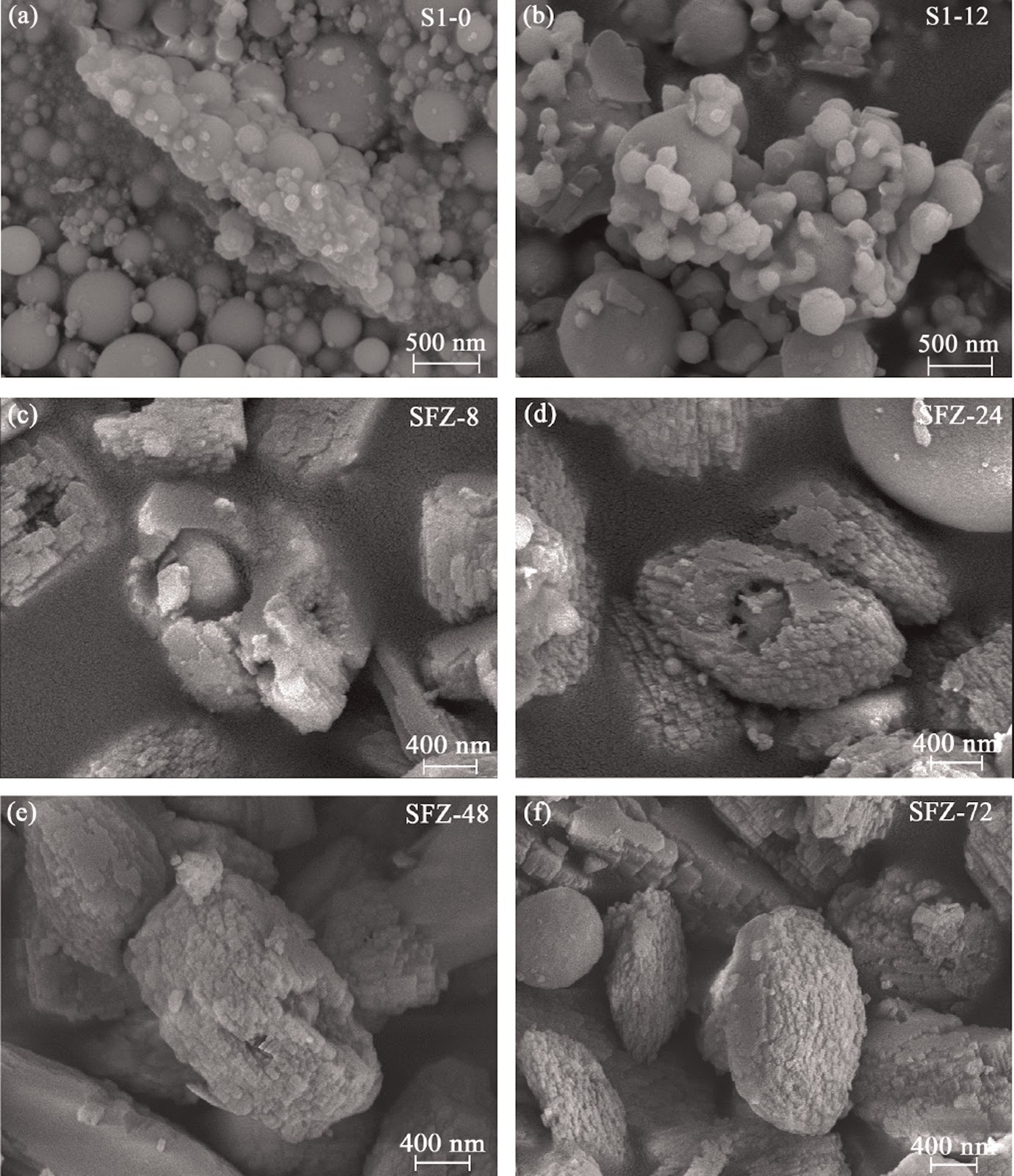
ZSM-5 with hierarchical pore structure was synthesized by a simple two-step hydrothermal crystallization from silica fume without using any organic ammonium templates. The synthesized ZSM-5 were oval shaped particles with a particle size about 2.0 lm and weak acid-dominated with proper Brønsted (B) and Lewis (L) acid sites. The ZSM-5 was used for catalytic co-cracking of n-octane and guaiacol, low-density polyethylene (LDPE) and alkali lignin (AL) to enhance the production of benzene, toluene, ethylbenzene and xylene (BTEX). The most significant synergistic effect occurred at n-octane/guaiacol at 1:1 and LDPE/AL at 1:3, under the condition, the achieved BTEX selectivity were 24% and 33% (mass) higher than the calculated values (weighted average). The highest BTEX selectivity reached 88.5%, which was 3.7% and 54.2% higher than those from individual cracking LDPE and AL. The synthesized ZSM-5 exhibited superior catalytic performance compared to the commercial ZSM-5, indicating potential application prospect.
1. Introduction
Monocyclic aromatic hydrocarbons (MAHs) such as benzene, toluene, ethylbenzene and xylene (BTEX) are important industrial chemicals, and are widely used in the production of chemical fiber, plastic and rubber [1,2]. By far, the production of BTEX mainly depends on petroleum resources via naphtha catalytic reforming and pyrolysis gasoline hydrogenation approaches [3,4]. However, the increasing shortage of oil resource and demand for BTEX necessitates developing an alternative source to produce BTEX. As the sole renewable carbon resource, biomass has attracted much attention of researchers [5,6]. Strenuous efforts have been made to produce BTEX via rapid pyrolysis and catalytic cracking of biomass [7,8]. Nevertheless, due to the complicated chemical structure and high oxygen content (35%–50% (mass)) in biomass, the rapid deactivation of catalysts due to coking and low selectivity of target products could be the bottleneck problem countered in the large-scale application. Catalytic cracking of biomass are prone to produce toxic polycyclic aromatic hydrocarbons (PAHs) and phenolics [9,10]. To resolve this issue, many studies carried out catalytic co-cracking of a co-feedstock of biomass and plastics (as a hydrogen-rich material), demonstrating a notable effect on enhancing BTEX production compared to the individual cracking of biomass [11,12].
It is well known that biomass consists of cellulose, hemicellulose and lignin. Every year about 50 million tons of lignin waste residue is produced from pulp engineering, which becomes a cheap under-utilized raw material [13]. Pyrolysis and co-pyrolysis are suitable for lignin conversion due to its highly complex and recalcitrant features. Even though pyrolysis of lignin is difficult (due to easily forming coke) but lignin has the highest theoretical value to obtain BTEX due to its rich phenyl in its chemical structure. Therefore, a lot of research work for improving BTEX production were conducted on catalytic co-cracking of lignin and plastics. Zhang et al. [14] conducted catalytic co-cracking of black-liquor lignin and different plastics, found that co-cracking with polystyrene produced the maximum aromatics yield (55.3%), while co-cracking with polyethylene produced the maximum olefin yield (13%). Bu et al. [15] reported that the addition of low-density polyethylene (LDPE) into the pyrolysis process of microwave-torrefied lignin enhanced aromatic hydrocarbon production (yield increased from 1.94% to 22.83%), promoted thermal degradation of lignin and improved the reaction rate. Development of novel catalysts and research on pyrolysis process for lignin are now in full swing.
ZSM-5 tends to be common catalyst used in the catalytic cracking of biomass due to its uniform micropores, tunable acidity and high hydrothermal stability [16]. However, ZSM-5 is generally prepared by pure chemicals, e.g. tetraethyl orthosilicate and sodium silicate as the silica sources, and aluminum sulfate and sodium aluminate as the alumina sources, as well as organic structuring agent (OSDA). This increases the manufacturing cost and causes environmental pollution (due to the released toxic waste during the removal process of templates). Hence, it is necessary to find a ZSM-5 synthesis method with low-cost materials and without using an organic template. New synthesis pathway of ZSM-5 have been developed using low-cost fly ash, kaolin and rice husk ash [17–19]. However, these methods could not avoid the use of the expensive OSDA.
Loading authentic research manuscript (Pages 1–5)...
Hongbing Fu, Yufei Gu, Tianhua Gao, Fuwei Li, Hengshuo Gu, Hucheng Ge, Yuke Liu, Zhixia Li, Hongfei Lin, Jiangfei Cao (2023). Green synthesis of ZSM-5 using silica fume and catalytic co-cracking of lignin and plastics for production of monocyclic aromatics. Chinese Journal of Chemical Engineering. https://doi.org/10.1016/j_cjche_144875065
Research & Educational Purpose Only:The translations, structured abstracts, analytical annotations, and data reports provided by SinoTechIntel are intended exclusively for academic research, internal corporate R&D, and educational benchmarking. They do not constitute formal engineering, chemical safety, legal, or professional advice.
Copyright & Intellectual Property Notice: Original copyright of the underlying source articles and experimental data remains with the respective authors, institutions, and original publishing journals. SinoTechIntel claims intellectual property only over its proprietary translations, analytical syntheses, and AEO structured enhancements in accordance with international fair use and academic citation principles.
Frequently Asked Questions
What is the main innovation of this study?
The study presents a green synthesis method for ZSM-5 using silica fume without organic templates, and demonstrates its effectiveness in catalytic co-cracking of lignin and plastics to enhance BTEX production.
How does the synthesized ZSM-5 compare to commercial ZSM-5?
The synthesized ZSM-5 exhibits superior catalytic performance compared to commercial ZSM-5, achieving higher BTEX selectivity in co-cracking reactions.
What are the optimal conditions for maximum BTEX yield?
The most significant synergistic effects were observed at n-octane/guaiacol ratio of 1:1 and LDPE/AL ratio of 1:3, leading to BTEX selectivity increases of 24% and 33% (mass) over calculated values.
Why is co-cracking of lignin and plastics beneficial?
Co-cracking of lignin (oxygen-rich) with plastics (hydrogen-rich) provides hydrogen transfer, reducing coke formation and enhancing the production of monocyclic aromatics like BTEX.
What is the significance of using silica fume as a silica source?
Silica fume is an industrial waste byproduct, making the synthesis cost-effective and environmentally friendly, while also providing a hierarchical pore structure beneficial for catalytic performance.
Related Technical Papers & Translations

Design and optimization of a high-efficiency distillation process for cellulosic fuel ethanol integrated with thermal coupling and molecular sieve adsorption
To address the challenges of high energy consumption and prominent costs in the traditional three-columns distillation process for cellulosic fuel ethanol, a distillation—molecular sieve coupling separation process is proposed. This process integrates a three-column (crude distillation column, first distillation column, second distillation column) system with a 3A molecular sieve adsorption deep dehydration unit. A thermal coupling network is constructed via differential pressure design (steam from medium/high-pressure columns as mutual heat sources, reboiler liquid waste heat for feed preheating), and molecular sieve adsorption conditions are optimized. The study first performs a thermodynamic consistency test on the ethanol—water system, determines optimal non-random two-liquid (NRTL) model binary interaction parameters via experimental data regression for Aspen Plus simulation. Aiming at minimum total annual cost (TAC), Aspen Plus is used to optimize process parameters (theoretical tray number, feed location, reflux ratio, side-draw position, etc.). Economic analysis shows this process reduces CO2 emission costs by 27.56%, TAC by 15.58% (to 5.123 × 10⁶ USD·a-1), and increases ethanol purity to >99.6%, providing an effective solution for green, efficient separation.

A cohesion loss model for determining residual strength of deep bedded sandstone
Rock residual strength, as an important input parameter, plays an indispensable role in proposing the reasonable and scientific scheme about stope design, underground tunnel excavation and stability evaluation of deep chambers. Therefore, previous residual strength models of rocks established were reviewed. And corresponding related problems were stated. Subsequently, starting from the effects of bedding and whole life-cycle evolution process, series of triaxial mechanical tests of deep bedded s

Federated model with contrastive learning and adaptive control variates for human activity recognition
Recent attention to privacy issues demands a communication-safe method for training human activity recognition (HAR) models on client activity data. Federated learning (FL) has become a compelling technique to facilitate model training between the server and clients while preserving data privacy. However, classical FL methods often assume independent and identically distributed (IID) data among clients. This assumption does not hold true in practical scenarios. Human activity in real-world scena