Key Takeaways & Executive Findings
- •• Optimal fluidized pre-heating and hydrogen pre-reduction parameters were established (700°C for 30 min pre-heating; 700°C for 30 min pre-reduction; 80% H2 concentration), achieving nickel metallization of 90.56% and iron metallization of 41.31%. • Hydrogen enables effective nickel reduction at relatively low temperatures, offering a green alternative to conventional carbon-based reductants. • Pre-heating treatment is beneficial as it opens the mineral structures of serpentine and limonite, enhancing the interaction between reducing gas and nickel during pre-reduction. • The study provides mechanistic insights into phase composition, magnetism, surface elemental valence states, and microstructure evolution during fluidized pre-heating and pre-reduction of saprolitic nickel laterite ore.
Abstract
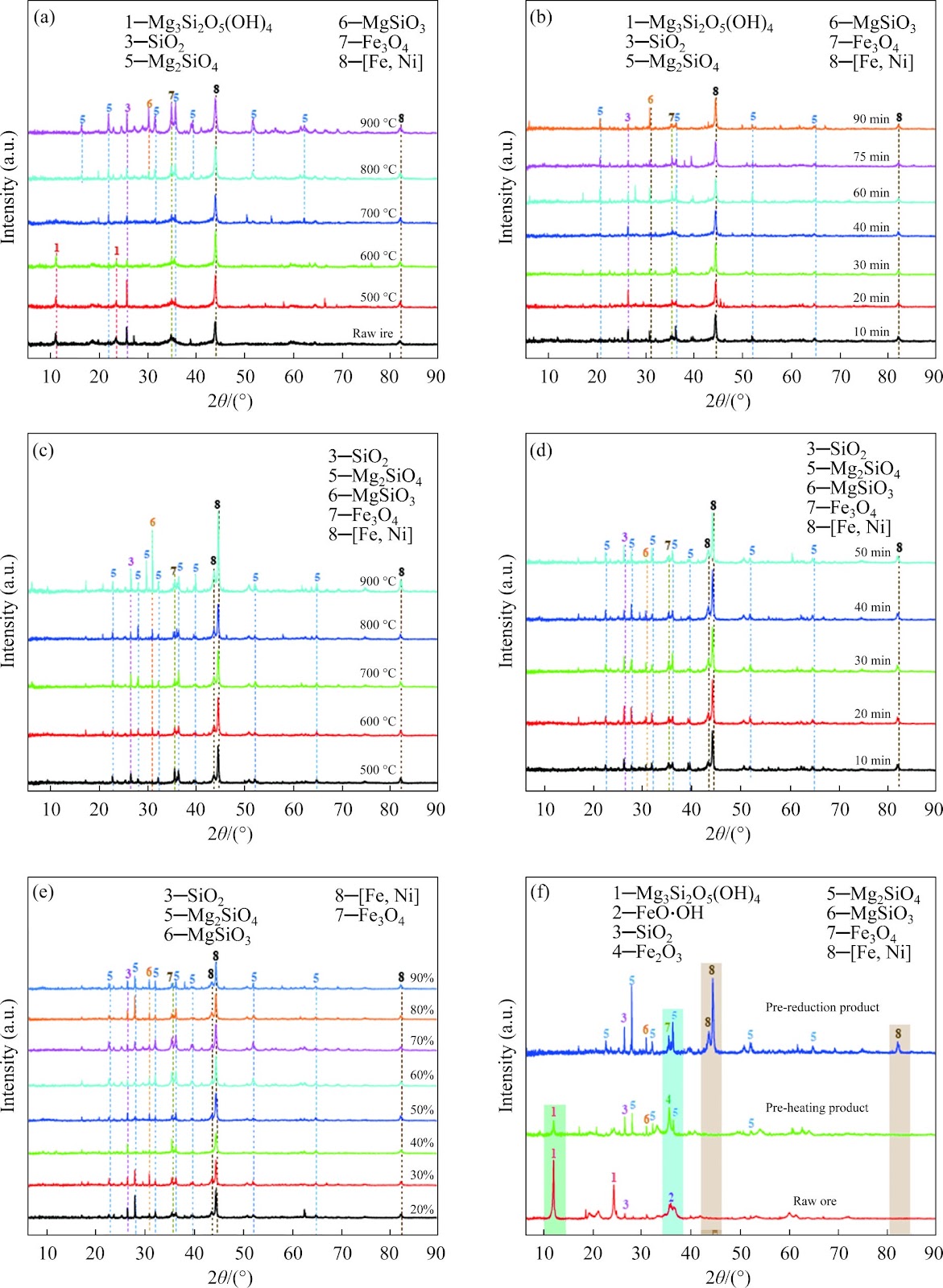
Nickel laterite ore is an important nickel-bearing mineral. Research on pre-heating and hydrogen pre-reduction in the pyrometallurgical process of nickel laterite ore is very limited, especially when using fluidized bed roasting. This study systematically explores the mechanisms of fluidized bed pre-heating treatment and hydrogen pre-reduction in the roasting process of saprolitic nickel laterite ore. According to single-factor experiment results, the appropriate pre-heating and pre-reduction conditions were a pre-heating temperature of 700 ℃, a pre-heating time of 30 min, a pre-reduction temperature of 700 ℃, a pre-reduction time of 30 min, and a hydrogen concentration of 80%. Then, the nickel metallization rate and iron metallization rate reached 90.56% and 41.31%, respectively. Various analytical and testing methods were employed to study the changes in phase composition, magnetism, surface element valence states, and microstructure of nickel laterite ore during fluidized pre-heating and pre-reduction. The study shows that hydrogen can achieve nickel reduction at relatively low temperatures. It was also found that pre-heating treatment of nickel laterite ore is beneficial. Pre-heating opens up the mineral structures of serpentine and limonite, allowing the reducing gas and nickel to interact quickly during the reduction process, enhancing the pre-reduction process.
1. Introduction
Nickel is one of the most important metals in the industry, with excellent physical and chemical properties, including high strength, high-temperature stability, corrosion resistance, antioxidation, ductility, electrical and thermal conductivity, and good catalytic performance. It is widely used in fields such as metallurgy, materials, aerospace, and new energy batteries [1, 2]. With the rise of the new energy battery industry and the continuous demand for nickel in stainless steel production [3], global demand for nickel is steadily increasing [4]. Land-based nickel is mainly found in nickel laterite ores and nickel sulfide ores [5].
Although nickel laterite ores have a low nickel grade, they are abundant in reserves. With the increasing years of nickel sulfide ore mining and the gradual depletion and impoverishment of resources, nickel laterite ores have gradually become the primary raw material for nickel production [6]. Nickel laterite ore typically has a low nickel grade, complex mineral composition, and often exhibits intergrown and symbiotic mineral phases without distinct nickel minerals. Nickel is mainly dispersed as isomorphic or adsorbed forms within limonite and silicate phases [7]. The formation process of nickel laterite ore is complex, with significant differences in elemental content and mineral composition across different ore layers [8]. It is generally divided into two types based on elemental content: limonite type and saprolite type [9].
Limonitic type nickel laterite ore is characterized by high Fe and Co content and low Ni content, with the main phase being limonite, and gangue minerals are primarily comprised of spinel, talc, and amphibole [10]. Due to its high iron-to-nickel ratio, it leads to non-selective reduction effects [11], resulting in low nickel grade in the final product. Therefore, hydrometallurgical processes such as high-pressure acid leaching, atmospheric acid leaching, bioleaching, and reduction roasting-ammonia leaching are commonly used to treat this type of ore [12−16]. Saprolitic nickel laterite ore, found in the lower layers of the ore body, is characterized by high Si, Mg, and Ni content and low Co content [9]. Pyrometallurgical processes are generally used for its treatment. Industrially, the Rotary Kiln-Electric Furnace (RK-EF) process, sulfide smelting, and sintering-blast furnace processes are commonly employed [17−21].
Loading authentic research manuscript (Pages 1–5)...
FAN Qing-long, YUAN Shuai, LI Yan-jun, HE Jia-hao, WU Zi-jian (2025). Green and efficient mineral phase transformation of saprolitic nickel laterite ore through fluidized pre-heating and hydrogen-based pre-reduction processes. Journal of Central South University. https://doi.org/10.1007/s11771-025-5989-0
Research & Educational Purpose Only:The translations, structured abstracts, analytical annotations, and data reports provided by SinoTechIntel are intended exclusively for academic research, internal corporate R&D, and educational benchmarking. They do not constitute formal engineering, chemical safety, legal, or professional advice.
Copyright & Intellectual Property Notice: Original copyright of the underlying source articles and experimental data remains with the respective authors, institutions, and original publishing journals. SinoTechIntel claims intellectual property only over its proprietary translations, analytical syntheses, and AEO structured enhancements in accordance with international fair use and academic citation principles.
Frequently Asked Questions
What are the optimal pre-heating and pre-reduction conditions for saprolitic nickel laterite ore?
The optimal conditions identified in the study are a pre-heating temperature of 700 °C for 30 minutes, a pre-reduction temperature of 700 °C for 30 minutes, and a hydrogen concentration of 80%. Under these conditions, nickel metallization rate reached 90.56% and iron metallization rate reached 41.31%.
How does hydrogen pre-reduction compare to conventional carbon-based reduction?
Hydrogen pre-reduction can achieve nickel reduction at relatively low temperatures, offering a green and efficient alternative to conventional carbon-based methods. It also reduces CO2 emissions and improves selectivity.
What is the role of fluidized pre-heating in the process?
Pre-heating treatment opens up the mineral structures of serpentine and limonite, allowing reducing gas and nickel to interact quickly during the reduction process. This enhances the pre-reduction efficiency and overall metallization rates.
Which analytical methods were used to study the phase transformations?
Various analytical and testing methods were employed to study changes in phase composition, magnetism, surface element valence states, and microstructure of nickel laterite ore during fluidized pre-heating and pre-reduction.
Why is saprolitic nickel laterite ore processed via pyrometallurgy?
Saprolitic nickel laterite ore is characterized by high Si, Mg, and Ni content and low Co content, making pyrometallurgical processes suitable. Common industrial routes include the Rotary Kiln-Electric Furnace (RK-EF) process, sulfide smelting, and sintering-blast furnace processes.
Related Technical Papers & Translations

Design and optimization of a high-efficiency distillation process for cellulosic fuel ethanol integrated with thermal coupling and molecular sieve adsorption
To address the challenges of high energy consumption and prominent costs in the traditional three-columns distillation process for cellulosic fuel ethanol, a distillation—molecular sieve coupling separation process is proposed. This process integrates a three-column (crude distillation column, first distillation column, second distillation column) system with a 3A molecular sieve adsorption deep dehydration unit. A thermal coupling network is constructed via differential pressure design (steam from medium/high-pressure columns as mutual heat sources, reboiler liquid waste heat for feed preheating), and molecular sieve adsorption conditions are optimized. The study first performs a thermodynamic consistency test on the ethanol—water system, determines optimal non-random two-liquid (NRTL) model binary interaction parameters via experimental data regression for Aspen Plus simulation. Aiming at minimum total annual cost (TAC), Aspen Plus is used to optimize process parameters (theoretical tray number, feed location, reflux ratio, side-draw position, etc.). Economic analysis shows this process reduces CO2 emission costs by 27.56%, TAC by 15.58% (to 5.123 × 10⁶ USD·a-1), and increases ethanol purity to >99.6%, providing an effective solution for green, efficient separation.

A cohesion loss model for determining residual strength of deep bedded sandstone
Rock residual strength, as an important input parameter, plays an indispensable role in proposing the reasonable and scientific scheme about stope design, underground tunnel excavation and stability evaluation of deep chambers. Therefore, previous residual strength models of rocks established were reviewed. And corresponding related problems were stated. Subsequently, starting from the effects of bedding and whole life-cycle evolution process, series of triaxial mechanical tests of deep bedded s

Federated model with contrastive learning and adaptive control variates for human activity recognition
Recent attention to privacy issues demands a communication-safe method for training human activity recognition (HAR) models on client activity data. Federated learning (FL) has become a compelling technique to facilitate model training between the server and clients while preserving data privacy. However, classical FL methods often assume independent and identically distributed (IID) data among clients. This assumption does not hold true in practical scenarios. Human activity in real-world scena