Key Takeaways & Executive Findings
- •• ACRs are a novel type of repeated rockbursts in deep tunnels under drilling and blasting within locked-in stress zones, potentially lasting 7–10 days and affecting areas over 20 m along the tunnel axis. • Locked-in stress zones arise from interactions among multiple structural planes in tectonically active regions; blasting disturbances trigger early slippage and fracturing, with MS events migrating ahead of the working face. • High-energy MS events dominate during ACR development and occurrence, extending 20–30 m (3–4 tunnel diameters) ahead of the working face, while tensile fracturing is the predominant failure mode. • Monitoring MS event locations ahead of the working face offers a reliable prewarning strategy for identifying potential ACR-prone zones and enhancing tunnel construction safety.
Abstract
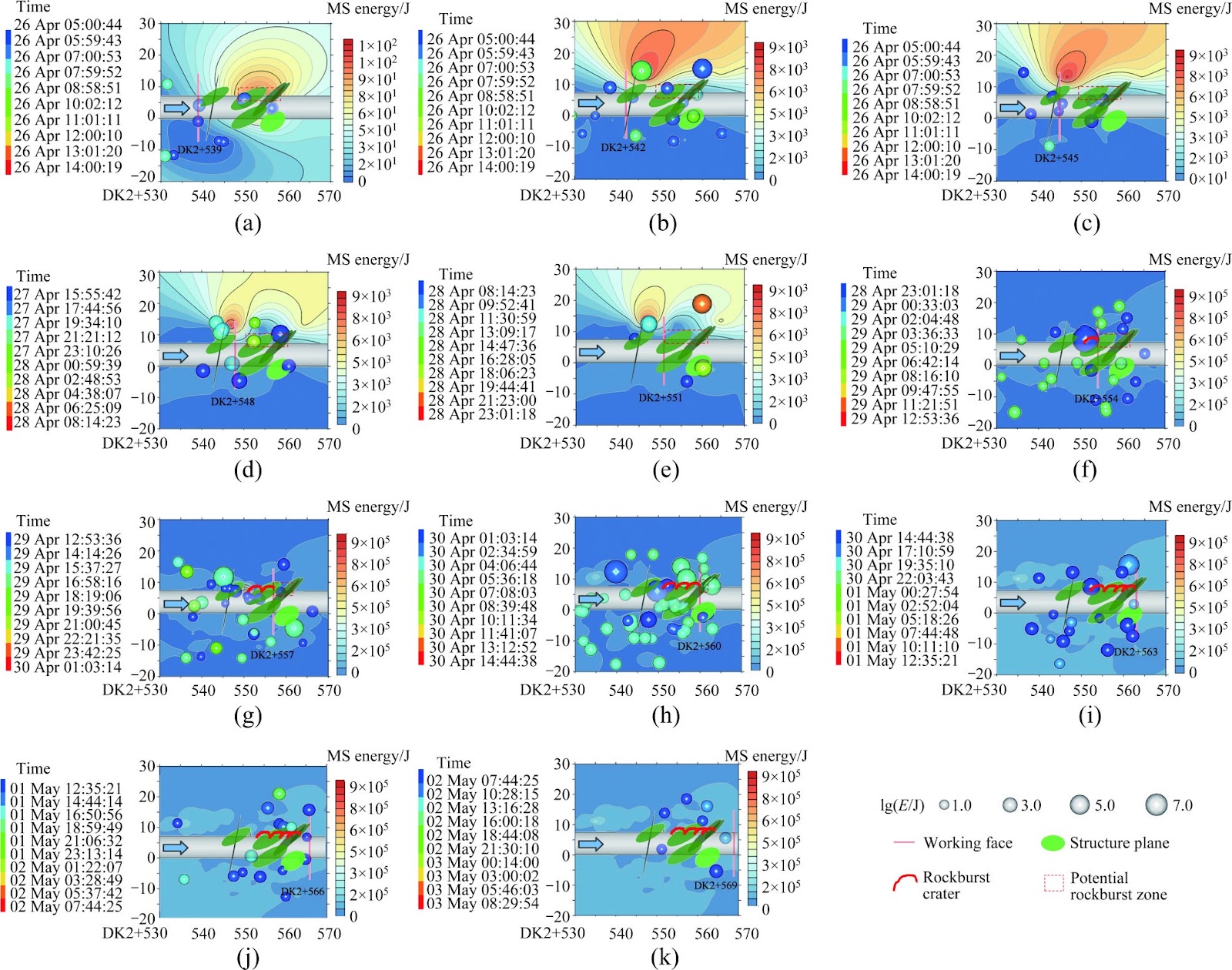
Axial chain rockbursts (ACRs) repeatedly occur in deep tunnels during drilling and blasting methodology (D&B) within locked-in stress zones, severely hindering construction progress. In extremely cases, ACRs can persist for 7−10 d and affect areas exceeding 20 m along tunnel axis. Through integrated geological investigations and microseismic (MS) monitoring, the geological characteristics, MS activity patterns, and formation mechanisms of ACRs were analyzed. In tectonically active regions, locked-in stress zones arise from interactions between multiple structural planes. Blasting dynamic disturbances during tunnel excavation in these zones trigger early slippage along structural planes and fractures in the surrounding rock, with MS events developing ahead of the working face. High-energy MS events dominate during the development and occurrence stages of ACRs, extending 20−30 m (3−4 tunnel diameters) ahead of the working face. Following the ACRs, low-energy MS events primarily occur behind the working face. Tensile fracturing is the predominant failure mode during ACRs. Shear and mixed fractures primarily occur within the ACRs zone during the intra-ACR phase. Monitoring MS event locations ahead of the working face provides a reliable approach for prewarning potential ACR-prone zones.
1. Introduction
Rockburst issues in deeply buried hard rock tunnels have been becoming increasingly prominent [1]. Rockburst generation is influenced by various factors, including in-situ stresses, geological conditions, and excavation methods, resulting in diverse characteristics [2-4]. Based on the mechanisms, timing, and spatial location of rockburst, rockbursts can be classified into strain rockburst, strain-structure slip rockburst, fault-slip rockburst, immediate rockburst, and time-delayed rockburst [5]. In the active tectonic regions of Southwest China, multiple rockbursts have been observed in the same area during the excavation of deeply buried tunnel. These repeated rockbursts severely impact safety and progress during tunnel excavation. This occurrence of repeated rockbursts in the same area has been classified as a new type of rockburst, referred to as “chain rockburst” [6]. Based on the spatial locations of multiple rockbursts, chain rockbursts are categorized further into axial chain rockbursts (ACRs) and radial chain rockbursts (RCRs). During the tunnel excavation process, a rockburst occurs with each blast, and the rockburst-induced crater boundaries of two adjacent rockbursts are connected. This series of rockbursts is defined as ACRs [7].
The geological environment of deep engineering projects is primarily influenced by the coupling of tectonic and sedimentary processes, resulting in exceptionally complex primary structures of the surrounding rock (as shown in Figure 1). During deep rock mass excavation, the mechanisms underlying numerous phenomena remain unclear, such as chain rockbursts, extremely intense rockbursts, and floor heave [8]. MÜLLER [9] first noted the overlooked issue of locked-in stress in rock mechanics research. During geological tectonic movements, the presence of multiple structural planes induces non-coordinated deformation in the rock, forming an uneven in-situ stress field. Within this field, some stresses remain constrained, forming a locked-in stress field [10, 11]. Tunneling through locked-in stress zones sharply increases rockburst probability.
Both laboratory physical simulations and documented field cases have revealed the characteristic phenomena of ACRs. For instance, large-scale physical model tests demonstrate that joints can induce significant compressive stress concentrations, leading to the occurrence of intensive rockbursts [12]. Similarly, tunnel excavations in discontinuous bedrock within the Himalayan tectonic active zone, such as at the Neelum-Jhelum Hydroelectric Project, freque
Loading authentic research manuscript (Pages 1–5)...
LI Hong-pu, HE Ben-guo, FENG Xia-ting, NIU Wen-jing, MA Tao (2025). Generation of axial chain rockbursts in deep tunnels with drilling and blasting methodology in locked-in stress zone. Journal of Central South University. https://doi.org/10.1007/s11771-025-6034-z
Research & Educational Purpose Only:The translations, structured abstracts, analytical annotations, and data reports provided by SinoTechIntel are intended exclusively for academic research, internal corporate R&D, and educational benchmarking. They do not constitute formal engineering, chemical safety, legal, or professional advice.
Copyright & Intellectual Property Notice: Original copyright of the underlying source articles and experimental data remains with the respective authors, institutions, and original publishing journals. SinoTechIntel claims intellectual property only over its proprietary translations, analytical syntheses, and AEO structured enhancements in accordance with international fair use and academic citation principles.
Frequently Asked Questions
What are axial chain rockbursts (ACRs)?
Axial chain rockbursts (ACRs) are a series of repeated rockbursts that occur along the tunnel axis during drilling and blasting excavation, where the rockburst-induced crater boundaries of adjacent events are connected.
How do locked-in stress zones influence rockburst occurrence?
Locked-in stress zones are formed by the interaction of multiple structural planes during tectonic movements, resulting in uneven in-situ stress fields. Tunneling through such zones sharply increases the probability of rockbursts because blasting disturbances trigger early slippage and fracturing.
What monitoring technique is used to predict ACRs?
Microseismic (MS) monitoring is used to track MS activity patterns. Events occurring ahead of the working face, especially high-energy events, can provide reliable prewarning for potential ACR-prone zones.
How far ahead of the working face do high-energy MS events extend?
High-energy MS events dominate during the development and occurrence stages of ACRs, extending 20–30 m (3–4 tunnel diameters) ahead of the working face.
What are the dominant failure modes during ACRs?
Tensile fracturing is the predominant failure mode during ACRs, while shear and mixed fractures primarily occur within the ACRs zone during the intra-ACR phase.
Related Technical Papers & Translations

Design and optimization of a high-efficiency distillation process for cellulosic fuel ethanol integrated with thermal coupling and molecular sieve adsorption
To address the challenges of high energy consumption and prominent costs in the traditional three-columns distillation process for cellulosic fuel ethanol, a distillation—molecular sieve coupling separation process is proposed. This process integrates a three-column (crude distillation column, first distillation column, second distillation column) system with a 3A molecular sieve adsorption deep dehydration unit. A thermal coupling network is constructed via differential pressure design (steam from medium/high-pressure columns as mutual heat sources, reboiler liquid waste heat for feed preheating), and molecular sieve adsorption conditions are optimized. The study first performs a thermodynamic consistency test on the ethanol—water system, determines optimal non-random two-liquid (NRTL) model binary interaction parameters via experimental data regression for Aspen Plus simulation. Aiming at minimum total annual cost (TAC), Aspen Plus is used to optimize process parameters (theoretical tray number, feed location, reflux ratio, side-draw position, etc.). Economic analysis shows this process reduces CO2 emission costs by 27.56%, TAC by 15.58% (to 5.123 × 10⁶ USD·a-1), and increases ethanol purity to >99.6%, providing an effective solution for green, efficient separation.

A cohesion loss model for determining residual strength of deep bedded sandstone
Rock residual strength, as an important input parameter, plays an indispensable role in proposing the reasonable and scientific scheme about stope design, underground tunnel excavation and stability evaluation of deep chambers. Therefore, previous residual strength models of rocks established were reviewed. And corresponding related problems were stated. Subsequently, starting from the effects of bedding and whole life-cycle evolution process, series of triaxial mechanical tests of deep bedded s

Federated model with contrastive learning and adaptive control variates for human activity recognition
Recent attention to privacy issues demands a communication-safe method for training human activity recognition (HAR) models on client activity data. Federated learning (FL) has become a compelling technique to facilitate model training between the server and clients while preserving data privacy. However, classical FL methods often assume independent and identically distributed (IID) data among clients. This assumption does not hold true in practical scenarios. Human activity in real-world scena