Key Takeaways & Executive Findings
- •• Sulfidation roasting with sulfur successfully converts stibiconite to stibnite (Sb2S3), achieving a flotation recovery of 90.3%. • The adsorption capacity of sodium butyl xanthate on the roasted products increases with higher S/Sb mole ratio, directly enhancing floatability. • XPS and EPMA analyses reveal that Sb2S3 forms predominantly on the particle surface while the interior remains antimony oxides, with sulfur inducing outward oxygen migration. • These findings provide theoretical support for the sustainable recovery of antimony from antimony oxide ores using xanthate flotation.
Abstract
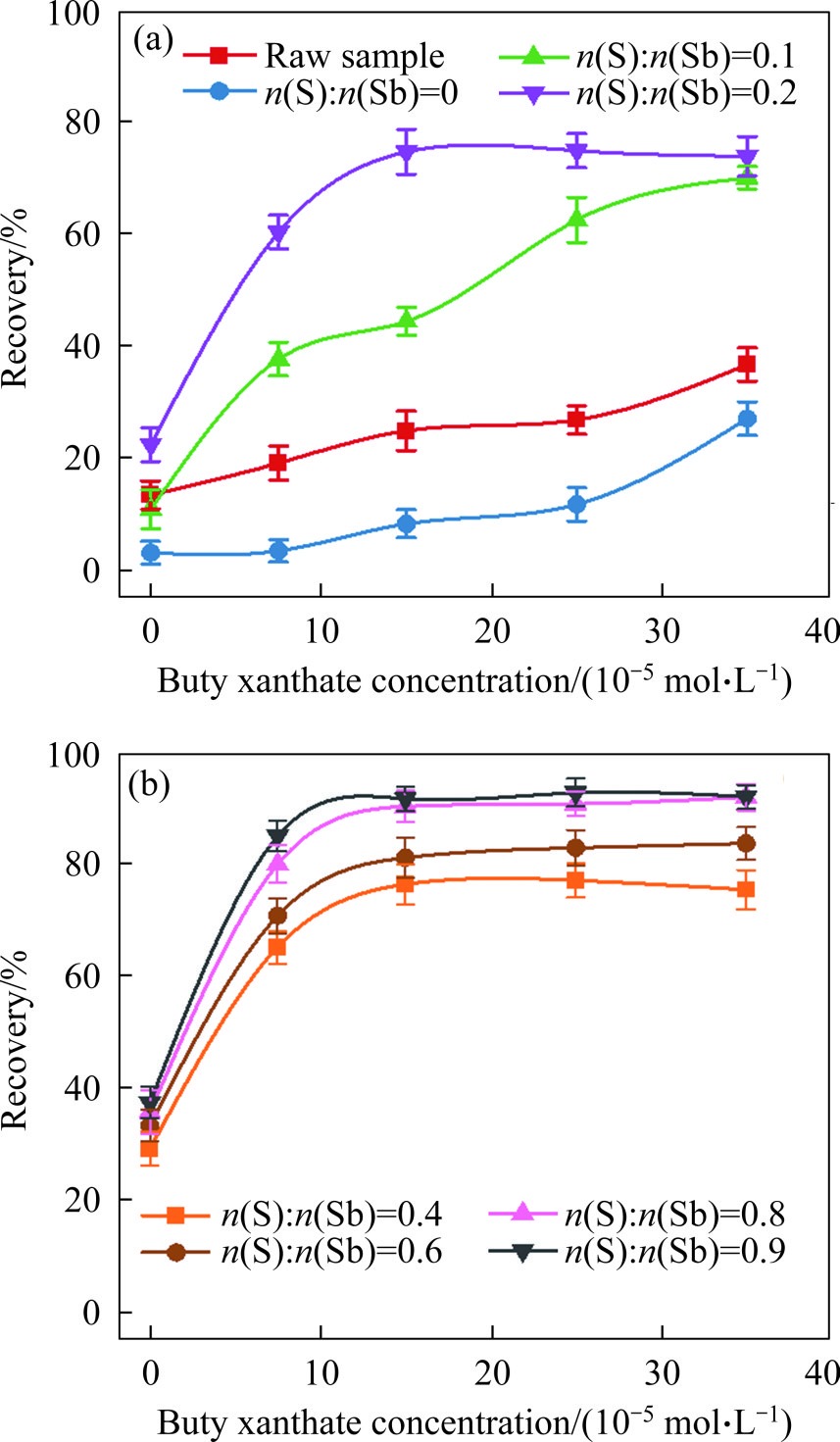
Flotation behavior of stibiconite after sulfidation roasting with sulfur at a high temperature and the sulfidation mechanisms were investigated by ultraviolet spectrophotometry, X-ray diffraction (XRD) combining with thermodynamic calculation, X-ray photoelectron spectroscopy (XPS) and electron probe microanalysis (EPMA). The XRD and thermodynamic analyses revealed that the Sb3O6(OH) was reduced into Sb2O4 and Sb2O3, and was transformed into Sb2S3 after introducing sulfur at high temperatures. Flotation test results show that flotation recovery of the stibiconite after sulfidation reaches 90.3%. Ultraviolet spectrophotometry tests confirm that adsorption capacity of sodium butyl xanthate (SBX) on surface of the roasted products has a positive relationship with S/Sb mole ratio. XPS analyses indicate that Sb-bearing species including mainly Sb2S3, Sb2O3 and Sb2(SO4)3 are formed at the surface of particle after sulfidation. The EPMA analyses verify that the Sb2S3 is generated at the outer layer of sample after sulfidation roasting, but the particle interior is mainly composed of antimony oxides. The sulfur atmosphere induces the outward migration of oxygen to form Sb2O4. Then, the Sb2O4 is transformed into Sb2O3 in two pathways, and the Sb2S3 is formed. These findings will provide theoretical support for recovering antimony from antimony oxide ores by xanthate-flotation methods.
1. Introduction
Antimony, as a non-renewable strategic metal, is widely used in military, pharmaceutical and chemical engineering, and semiconductor components [1−3]. Antimony resource reserves and production in China rank first in the world [4, 5]. There are over 100 kinds of antimony-bearing minerals, in which stibnite (Sb2S3) and jamesonite (Pb4FeSb6S14) are the most common raw material for antimony production [6−8]. Moreover, both the minerals have good floatability. With fast development of the antimony industry, antimony sulfide ore has not been able to meet the industrial demand for antimony. Therefore, the search for alternatives to the antimony sulfide ore has become a hotspot in exploitation of antimony resources. Antimony oxide mineral, as the second largest source of antimony, has gradually become the important mineral for extracting antimony. There are many types of antimony oxide minerals, such as stibiconite [Sb3O6(OH)], cervantite (Sb2O4) and senarmontite (Sb2O3) [9]. Nowadays, many technologies including gravity separation and flotation have been developed for the processing of antimony oxide ores.
Gravity separation is a typical method to recover antimony oxide minerals. Equipments such as shaking table, chute and jigging have been always applied in the industry. However, the antimony-bearing minerals are easy to be excessively ground before beneficiation due to the low hardness, resulting in a poor recovery of antimony. Thus, the gravity separation only has a perfect recovery on antimony oxide minerals at a coarse size fraction. To improve the recovery of antimony, especially for the minerals at a fine size fraction, some innovative equipments and processes have been developed. LIU et al [10] used a reflux classifier with closely spaced inclined channels as a pre-concentration facility to improve the separation efficiency of a tailing containing 0.8% Sb before a shaking table. The results showed that the grade and recovery of concentrate reached 2.31% and 83.17%, respectively. CHU et al [11] adopted an agitated reflux classifier to pre-concentrate a tailing. The results confirmed that 73.13% of the feeding was discarded into the tailing. In addition, flotation was reported for recovering the antimony oxide minerals. WANG et al [12] investi
Loading authentic research manuscript (Pages 1–5)...
HUANG Yu-song, ZHENG Yong-xing, DAI Zhe, ZHANG Song (2025). Flotation behavior and sulfidation mechanisms of stibiconite after sulfidation with sulfur. Journal of Central South University. https://doi.org/10.1007/s11771-025-6038-8
Research & Educational Purpose Only:The translations, structured abstracts, analytical annotations, and data reports provided by SinoTechIntel are intended exclusively for academic research, internal corporate R&D, and educational benchmarking. They do not constitute formal engineering, chemical safety, legal, or professional advice.
Copyright & Intellectual Property Notice: Original copyright of the underlying source articles and experimental data remains with the respective authors, institutions, and original publishing journals. SinoTechIntel claims intellectual property only over its proprietary translations, analytical syntheses, and AEO structured enhancements in accordance with international fair use and academic citation principles.
Frequently Asked Questions
What is the flotation recovery of stibiconite after sulfidation with sulfur?
The flotation recovery of stibiconite after sulfidation roasting with sulfur reaches 90.3%, indicating an effective approach for recovering antimony from oxide ores.
Which surface species are formed during sulfidation of stibiconite?
XPS analyses indicate that antimony-bearing species, mainly Sb2S3, Sb2O3, and Sb2(SO4)3, are formed on the particle surface after sulfidation.
How does the sulfur atmosphere affect the transformation of stibiconite?
The sulfur atmosphere induces outward migration of oxygen to form Sb2O4, which is then transformed into Sb2O3 in two pathways, and finally Sb2S3 is formed.
What analytical techniques were used to investigate the sulfidation mechanisms?
The study employed ultraviolet spectrophotometry, X-ray diffraction (XRD), thermodynamic calculation, X-ray photoelectron spectroscopy (XPS), and electron probe microanalysis (EPMA).
What is the practical significance of this research?
The findings provide theoretical support for recovering antimony from antimony oxide ores using xanthate flotation, offering a promising route to supplement diminishing sulfide ore resources.
Related Technical Papers & Translations

Design and optimization of a high-efficiency distillation process for cellulosic fuel ethanol integrated with thermal coupling and molecular sieve adsorption
To address the challenges of high energy consumption and prominent costs in the traditional three-columns distillation process for cellulosic fuel ethanol, a distillation—molecular sieve coupling separation process is proposed. This process integrates a three-column (crude distillation column, first distillation column, second distillation column) system with a 3A molecular sieve adsorption deep dehydration unit. A thermal coupling network is constructed via differential pressure design (steam from medium/high-pressure columns as mutual heat sources, reboiler liquid waste heat for feed preheating), and molecular sieve adsorption conditions are optimized. The study first performs a thermodynamic consistency test on the ethanol—water system, determines optimal non-random two-liquid (NRTL) model binary interaction parameters via experimental data regression for Aspen Plus simulation. Aiming at minimum total annual cost (TAC), Aspen Plus is used to optimize process parameters (theoretical tray number, feed location, reflux ratio, side-draw position, etc.). Economic analysis shows this process reduces CO2 emission costs by 27.56%, TAC by 15.58% (to 5.123 × 10⁶ USD·a-1), and increases ethanol purity to >99.6%, providing an effective solution for green, efficient separation.

A cohesion loss model for determining residual strength of deep bedded sandstone
Rock residual strength, as an important input parameter, plays an indispensable role in proposing the reasonable and scientific scheme about stope design, underground tunnel excavation and stability evaluation of deep chambers. Therefore, previous residual strength models of rocks established were reviewed. And corresponding related problems were stated. Subsequently, starting from the effects of bedding and whole life-cycle evolution process, series of triaxial mechanical tests of deep bedded s

Federated model with contrastive learning and adaptive control variates for human activity recognition
Recent attention to privacy issues demands a communication-safe method for training human activity recognition (HAR) models on client activity data. Federated learning (FL) has become a compelling technique to facilitate model training between the server and clients while preserving data privacy. However, classical FL methods often assume independent and identically distributed (IID) data among clients. This assumption does not hold true in practical scenarios. Human activity in real-world scena