Key Takeaways & Executive Findings
- •• Both KCsSiH6 and RbCsSiH6 crystallize in a stable cubic symmetry and exhibit both thermal and dynamical stability, confirming their structural integrity. • Gravimetric hydrogen storage capacities are 2.94 wt% for KCsSiH6 and 2.40 wt% for RbCsSiH6, indicating moderate storage potential for practical applications. • Indirect band gaps of 3.14 eV and 3.17 eV combined with pronounced ultraviolet optical activity make these hydrides promising for optoelectronic and UV-filtering devices. • Comprehensive thermodynamic analyses up to 800 K reveal favorable entropy, heat capacity, and Gibbs free energy changes, underscoring their thermal stability for energy applications.
Abstract
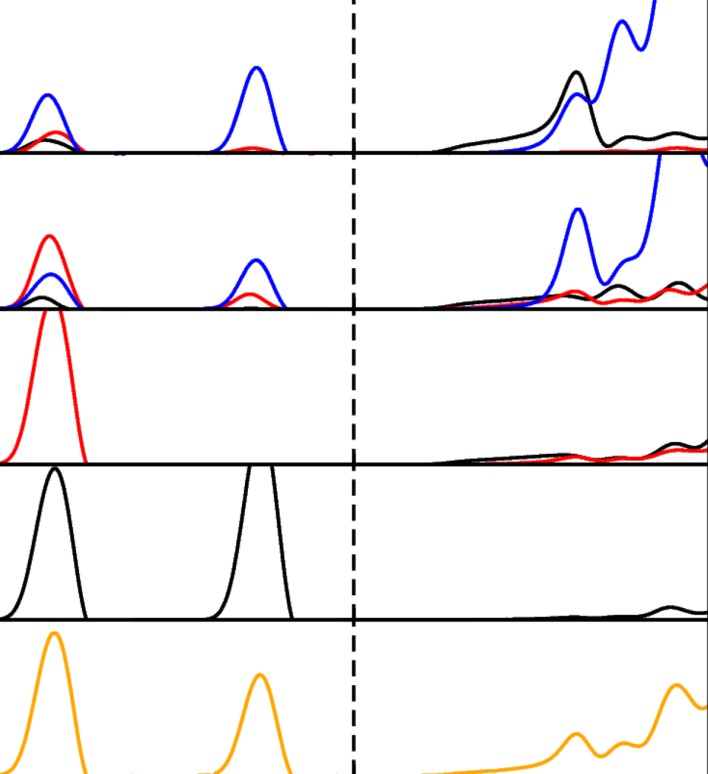
First-principles density functional theory (DFT) calculations are employed to investigate the structural, optoelectronic, mechanical, thermodynamic, and hydrogen storage properties of XCsSiH6 (X = K, Rb). The hydrogen atoms form discrete SiH6 octahedra stabilized by alkali metal cations, confirming a stable cubic symmetry upon structural optimization. Both compounds exhibit both thermal and dynamical stability. The calculated gravimetric hydrogen storage capacities are 2.94wt% for KCsSiH6 and 2.40wt% for RbCsSiH6. Electronic band structure analysis indicates indirect band gaps of 3.14 eV (KCsSiH6) and 3.17 eV (RbCsSiH6), with hydrogen contributing mainly to the valence band maximum (VBM) and Cs/Rb/K atoms to the conduction band minimum (CBM). Optical property analyses of the dielectric response, absorption, and reflectivity show pronounced ultraviolet activity, suggesting suitability for optoelectronic and UV-filtering applications. Both hydrides are found to be brittle yet elastically isotropic, with KCsSiH6 being slightly less stiff than RbCsSiH6. Comprehensive thermodynamic analysis demonstrates favorable variations in entropy, heat capacity, and Gibbs free energy up to 800 K, indicating the pronounced thermal stability of the investigated systems. Overall, XCsSiH6 hydrides appear to be stable semiconductors with moderate hydrogen storage capacity and desirable optical properties, suitable for various energy and electronic applications.
1. Introduction
The growing demand for clean, renewable, and sustainable energy worldwide has positioned hydrogen (H2) as one of the most promising energy carriers. Its appeal lies in several key advantages: clean combustion that produces only water, a high gravimetric energy density of 120 MJ/kg, and the potential for large-scale production from renewable sources such as solar and wind energy [1–2]. As global efforts intensify toward decarbonization and energy security, hydrogen is expected to play a pivotal role in future energy systems, particularly in transportation, industrial processes, and grid-scale storage [3–4]. Its versatility further enhances its value, as hydrogen can serve as a feedstock for the chemical industry, a fuel for fuel-cell vehicles (FCVs), and a medium for storing excess renewable electricity through power-to-gas technologies [5–6]. Moreover, hydrogen enables sector coupling by effectively linking heating, mobility, and electricity systems for more integrated and efficient energy use [7]. The International Energy Agency (IEA) projects that, with continued advances in electrolysis and storage technologies, hydrogen could supply up to 18% of global final energy demand by 2050 [4]. Reflecting this potential, many countries across the Middle East, Asia, and Europe are actively investing in green hydrogen production and developing hydrogen roadmaps.
Despite this encouraging outlook, large-scale adoption of hydrogen faces several challenges. High production costs, limited infrastructure, and—most critically—technological barriers in hydrogen storage and transportation remain major obstacles [8–9]. To address these limitations, extensive research has focused on materials-based storage methods, which provide portable, efficient, and safe alternatives suitable for both stationary and mobile applications [10–12].
Loading authentic research manuscript (Pages 1–5)...
Noorhan F. AlShaikh Mohammad, Ebrahim Nemati-Kande, Ahmad A. Mousa, Mohammed S. Abu-Jafar, Asif Hosen, N.S. Abd EL-Gawaad, Jihad Asad (2025). First-principles investigation of structural, optoelectronic, mechanical, thermodynamic and hydrogen storage properties of Si-based XCsSiH6 (X = K, Rb) hydrides. Journal of Mineral Metallurgy and Materials Science. https://doi.org/10.1007/s12613-026-3417-6
Research & Educational Purpose Only:The translations, structured abstracts, analytical annotations, and data reports provided by SinoTechIntel are intended exclusively for academic research, internal corporate R&D, and educational benchmarking. They do not constitute formal engineering, chemical safety, legal, or professional advice.
Copyright & Intellectual Property Notice: Original copyright of the underlying source articles and experimental data remains with the respective authors, institutions, and original publishing journals. SinoTechIntel claims intellectual property only over its proprietary translations, analytical syntheses, and AEO structured enhancements in accordance with international fair use and academic citation principles.
Frequently Asked Questions
What are the hydrogen storage capacities of KCsSiH6 and RbCsSiH6?
The gravimetric hydrogen storage capacities are 2.94 wt% for KCsSiH6 and 2.40 wt% for RbCsSiH6.
Are these hydrides stable at high temperatures?
Yes, thermodynamic analysis demonstrates favorable variations in entropy, heat capacity, and Gibbs free energy up to 800 K, indicating pronounced thermal stability.
What are the electronic band gaps of these materials?
Both compounds exhibit indirect band gaps: 3.14 eV for KCsSiH6 and 3.17 eV for RbCsSiH6.
How do the hydrogen atoms arrange in the crystal structure?
Hydrogen atoms form discrete SiH6 octahedra stabilized by alkali metal cations, confirming a stable cubic symmetry upon structural optimization.
What potential applications do these hydrides have?
Due to their ultraviolet activity and semiconducting nature, they are suitable for optoelectronic and UV-filtering applications, as well as hydrogen storage.
Related Technical Papers & Translations

Design and optimization of a high-efficiency distillation process for cellulosic fuel ethanol integrated with thermal coupling and molecular sieve adsorption
To address the challenges of high energy consumption and prominent costs in the traditional three-columns distillation process for cellulosic fuel ethanol, a distillation—molecular sieve coupling separation process is proposed. This process integrates a three-column (crude distillation column, first distillation column, second distillation column) system with a 3A molecular sieve adsorption deep dehydration unit. A thermal coupling network is constructed via differential pressure design (steam from medium/high-pressure columns as mutual heat sources, reboiler liquid waste heat for feed preheating), and molecular sieve adsorption conditions are optimized. The study first performs a thermodynamic consistency test on the ethanol—water system, determines optimal non-random two-liquid (NRTL) model binary interaction parameters via experimental data regression for Aspen Plus simulation. Aiming at minimum total annual cost (TAC), Aspen Plus is used to optimize process parameters (theoretical tray number, feed location, reflux ratio, side-draw position, etc.). Economic analysis shows this process reduces CO2 emission costs by 27.56%, TAC by 15.58% (to 5.123 × 10⁶ USD·a-1), and increases ethanol purity to >99.6%, providing an effective solution for green, efficient separation.

A cohesion loss model for determining residual strength of deep bedded sandstone
Rock residual strength, as an important input parameter, plays an indispensable role in proposing the reasonable and scientific scheme about stope design, underground tunnel excavation and stability evaluation of deep chambers. Therefore, previous residual strength models of rocks established were reviewed. And corresponding related problems were stated. Subsequently, starting from the effects of bedding and whole life-cycle evolution process, series of triaxial mechanical tests of deep bedded s

Federated model with contrastive learning and adaptive control variates for human activity recognition
Recent attention to privacy issues demands a communication-safe method for training human activity recognition (HAR) models on client activity data. Federated learning (FL) has become a compelling technique to facilitate model training between the server and clients while preserving data privacy. However, classical FL methods often assume independent and identically distributed (IID) data among clients. This assumption does not hold true in practical scenarios. Human activity in real-world scena