Key Takeaways & Executive Findings
- •• Accumulative roll bonding effectively disperses graphene oxide in Al 6061 matrix, mitigating agglomeration and enhancing interfacial bonding. • The Al 6061/GO composite exhibits a 338.37% increase in yield strength and 86.42% improvement in hardness compared to annealed Al 6061. • Raman spectroscopy and X-ray diffraction confirm strong GO-matrix interaction and increased dislocation density, explaining the mechanical enhancements. • Fracture surface analysis reveals a strength-ductility tradeoff with reduced elongation and deep dimples, underscoring the potential for lightweight structural applications.
Abstract
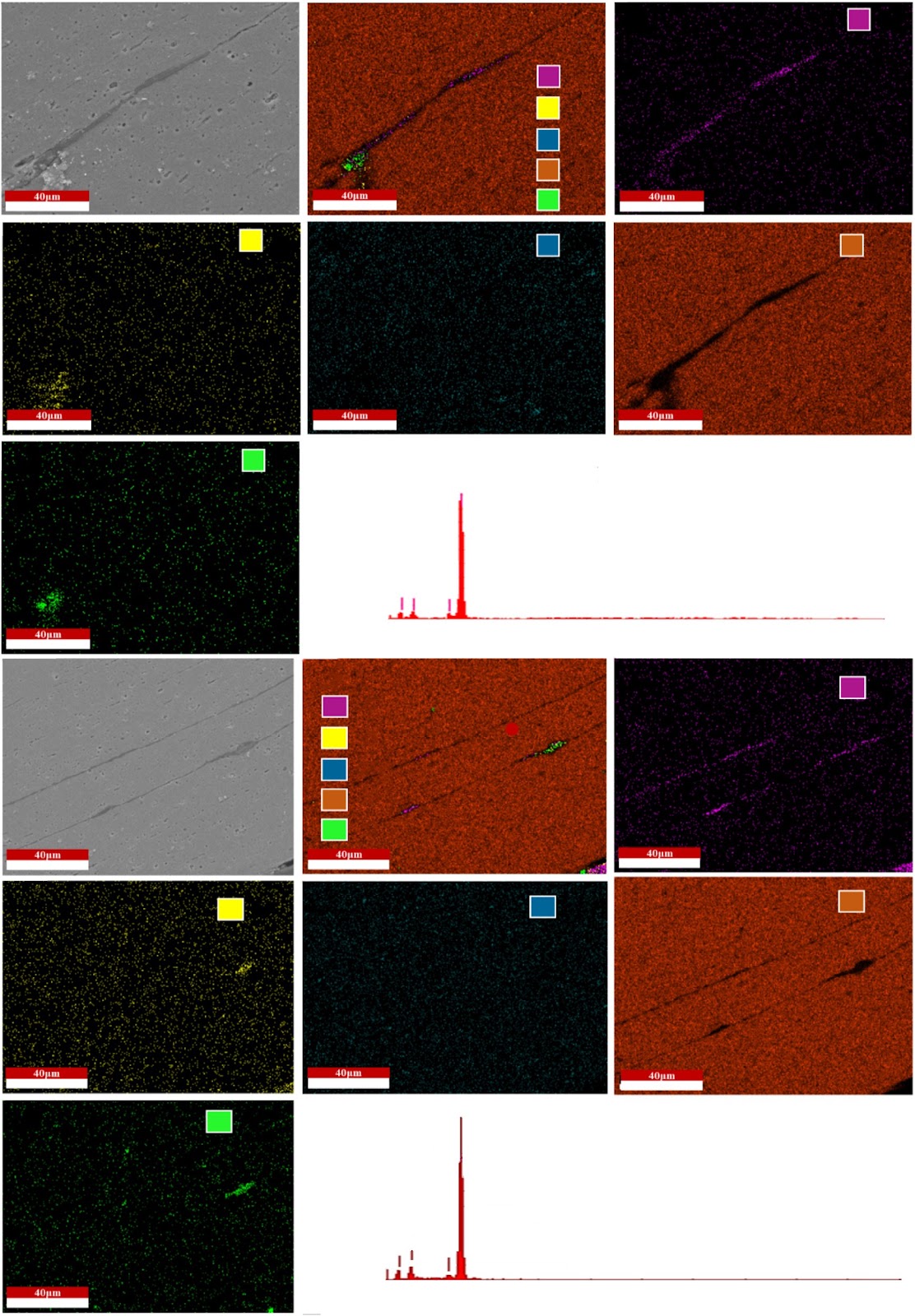
This study investigates the fabrication and characterization of Al alloy matrix composites reinforced with graphene oxide (GO) using accumulative roll bonding (ARB). The annealed Al 6061 sheets were processed through 5-pass ARB with GO reinforcement applied during the initial passes. Scanning electron microscopy revealed effective mitigation of GO agglomeration and improved interface bonding due to microscale material mixing. Raman spectroscopy confirmed the strong interaction between GO and the Al alloy matrix, as evidenced by the increased D band intensities and enhanced 2D band symmetry. Mechanical testing indicated an approximately 338.37% increase in yield strength (YS) and 86.42% improvement in hardness for the ARB-processed (ARBed) Al 6061/GO composite (0.2wt%) compared with annealed Al 6061 and an approximately 14.15% increase in YS and 17.23% improvement in hardness for the ARBed Al/GO composite (0.2wt%) compared with unreinforced ARBed Al 6061 specimens after five passes. X-ray diffraction analysis indicated an increased dislocation density, corroborating the observed enhancements in mechanical properties. Fracture surface analysis revealed reduced elongation with deep dimples, highlighting the tradeoff between strength and ductility. These results demonstrate the effectiveness of ARB for integrating GO into the Al 6061 matrix to improve the mechanical performance and interfacial bonding and underscore its potential for advanced composite materials.
1. Introduction
The broad spectrum of industrial applications of Al matrix composites is attributed to their exceptional specific properties, including light weight, elastic modulus, thermal conductivity, electrical conductivity, strength, low coefficient of thermal expansion, and wear and corrosion resistance [1–2]. Pure Al and Al alloys are among the most commonly used materials in multilayered composites because of their excellent properties, affordability, and widespread availability. In many applications, metals and their alloys cannot simultaneously satisfy strength and stiffness requirements. Therefore, metal–matrix composites (MMCs) must be prepared. MMCs made from light-metal alloys are known for their lightweight nature and exceptional mechanical properties, making them ideal for applications in the automotive, defense, and aerospace sectors [3–5]. MMCs derive their flexibility from the metal matrix and their rigidity from reinforcements that are commonly composed of particles, monofilaments, or ceramic fibers. Conventional methods for producing MMCs, such as casting and powder metallurgy, often have limitations, including high manufacturing costs and defects such as porosity and reinforcement clustering. These shortcomings reduce uniformity, impacting the mechanical and electrical performance of the composite [6–7].
To overcome such challenges, this study investigates an alternative approach known as accumulative roll bonding (ARB) [8]. In addition to producing the composite, ARB significantly reduces the size of the matrix grains, making it suitable for ultrafine-grain (UFG) materials [9]. Severe plastic deformation (SPD) techniques such as high-pressure torsion, equal-channel angular processing [10], and ARB [11–12] are utilized to manufacture MMCs. ARB is one of the most versatile techniques owing to its straightforward process. This involves repeated stacking, cutting, and rolling, which significantly increases the dislocation density [13]. Generally, cold-roll bonding is used to create composites strengthened with particles, whereas hot-roll bonding is more suitable for fabricating laminates of different metals and their alloys [14]. Hot ARB offers higher bonding strength because the materials are processed more easily at higher temperatures compared with cold ARB [15]. Furthermore, ARB’s lower processing temperature compared with casting helps avoid destructive interfacial reactions, porosity, and inclusions. The primary objective of ARB is to achieve a metal with UFGs and exceptional mechanical properties [16]. Fabrication of MMCs using ARB involves two distinct approaches. In one method, particles are used as reinforcement and added between metal layers at the beginning of the ARB cycles [17]. A uniform particle dispersion can be achieved after reaching a critical total strain or reduction [18–19]. Another approach combines ARB with a coating method [7,20]. In this technique, a coated strip is inserted between uncoated metal strips. As ARB progresses, the coated layer breaks and evenly disperses within the metal matrix owing to the different flow properties of the coated layer and matrix. Over the past decade, graphene has attracted considerable attention for the advancement of multifunctional MMCs owing to its unique combination of ther
Loading authentic research manuscript (Pages 1–5)...
Vijay Pratap Singh, Abhishek Sharma, Gaurav Kumar Gupta, Mohammad Ashiq, Sunil Patidar, Manoj Kumar, Srinibash Mishra (2025). Evolution of microstructure and mechanical properties of graphene oxide-reinforced aluminum alloy (6061) composite fabricated via accumulative roll bonding. Journal of Mineral Metallurgy and Materials Science. https://doi.org/10.1007/s12613-025-3194-7
Research & Educational Purpose Only:The translations, structured abstracts, analytical annotations, and data reports provided by SinoTechIntel are intended exclusively for academic research, internal corporate R&D, and educational benchmarking. They do not constitute formal engineering, chemical safety, legal, or professional advice.
Copyright & Intellectual Property Notice: Original copyright of the underlying source articles and experimental data remains with the respective authors, institutions, and original publishing journals. SinoTechIntel claims intellectual property only over its proprietary translations, analytical syntheses, and AEO structured enhancements in accordance with international fair use and academic citation principles.
Frequently Asked Questions
What is accumulative roll bonding (ARB)?
Accumulative roll bonding (ARB) is a severe plastic deformation technique that involves repeated stacking, cutting, and rolling of metal sheets to achieve ultrafine-grained microstructures and enhanced mechanical properties. In this study, ARB is used to fabricate aluminum matrix composites reinforced with graphene oxide.
How does graphene oxide improve the mechanical properties of Al 6061?
Graphene oxide acts as a reinforcement in the Al 6061 matrix, increasing yield strength and hardness through effective load transfer, grain refinement, and increased dislocation density. The study reports a 338% increase in yield strength and 86% improvement in hardness compared to annealed Al 6061.
What were the key results of this study?
The study demonstrated that ARB processing with graphene oxide reinforcement significantly improves the mechanical properties of Al 6061, achieving a 338.37% increase in yield strength and 86.42% improvement in hardness compared to annealed Al 6061, with effective dispersion and strong interfacial bonding.
What is the tradeoff between strength and ductility in the composite?
While the Al 6061/GO composite exhibits significantly enhanced strength and hardness, fracture surface analysis showed reduced elongation with deep dimples, indicating a tradeoff between strength and ductility. This is a common characteristic of reinforced composites.
What are the potential applications of Al/GO composites?
Aluminum matrix composites reinforced with graphene oxide are promising for lightweight structural applications in automotive, defense, and aerospace sectors, where high specific strength and stiffness are critical.
Related Technical Papers & Translations

Design and optimization of a high-efficiency distillation process for cellulosic fuel ethanol integrated with thermal coupling and molecular sieve adsorption
To address the challenges of high energy consumption and prominent costs in the traditional three-columns distillation process for cellulosic fuel ethanol, a distillation—molecular sieve coupling separation process is proposed. This process integrates a three-column (crude distillation column, first distillation column, second distillation column) system with a 3A molecular sieve adsorption deep dehydration unit. A thermal coupling network is constructed via differential pressure design (steam from medium/high-pressure columns as mutual heat sources, reboiler liquid waste heat for feed preheating), and molecular sieve adsorption conditions are optimized. The study first performs a thermodynamic consistency test on the ethanol—water system, determines optimal non-random two-liquid (NRTL) model binary interaction parameters via experimental data regression for Aspen Plus simulation. Aiming at minimum total annual cost (TAC), Aspen Plus is used to optimize process parameters (theoretical tray number, feed location, reflux ratio, side-draw position, etc.). Economic analysis shows this process reduces CO2 emission costs by 27.56%, TAC by 15.58% (to 5.123 × 10⁶ USD·a-1), and increases ethanol purity to >99.6%, providing an effective solution for green, efficient separation.

A cohesion loss model for determining residual strength of deep bedded sandstone
Rock residual strength, as an important input parameter, plays an indispensable role in proposing the reasonable and scientific scheme about stope design, underground tunnel excavation and stability evaluation of deep chambers. Therefore, previous residual strength models of rocks established were reviewed. And corresponding related problems were stated. Subsequently, starting from the effects of bedding and whole life-cycle evolution process, series of triaxial mechanical tests of deep bedded s

Federated model with contrastive learning and adaptive control variates for human activity recognition
Recent attention to privacy issues demands a communication-safe method for training human activity recognition (HAR) models on client activity data. Federated learning (FL) has become a compelling technique to facilitate model training between the server and clients while preserving data privacy. However, classical FL methods often assume independent and identically distributed (IID) data among clients. This assumption does not hold true in practical scenarios. Human activity in real-world scena