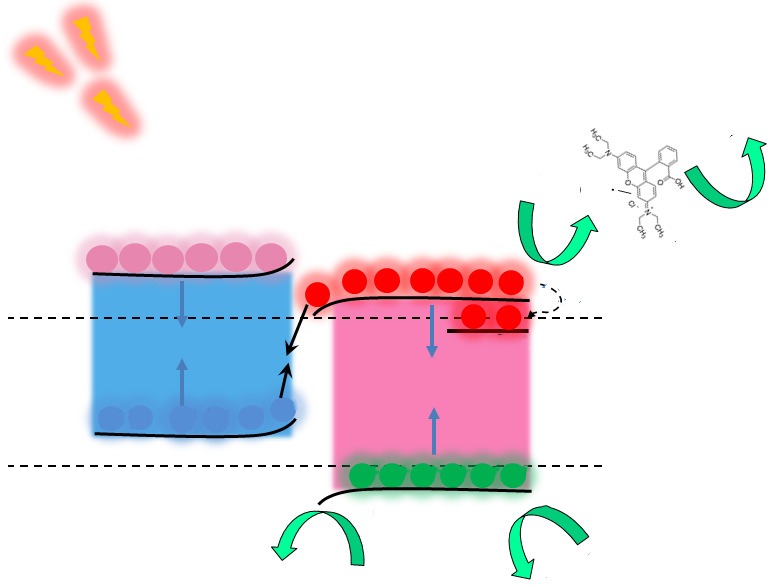
Key Takeaways & Executive Findings
- •• A TiO2–TiC shell–core S-scheme photocatalyst was synthesized via thermal treatment of TiC in carbon powder, forming a TiO2 shell with oxygen vacancies around TiC nanoparticles. • The optimized shell–core structure (cHT500) exhibits strong visible-light absorption (400–800 nm) and a RhB degradation rate constant of 0.0687 min⁻¹, 20.8 times higher than pristine TiO2 under visible light. • Cytocompatibility assays show cHT500 has favorable cell viability comparable to TiO2 NPs, overcoming the poor biocompatibility of TiC for biomedical use. • The work provides a strategy to engineer TiO2-based photocatalysts with enhanced visible light response and biocompatibility for photocatalytic and biomedical applications.
Abstract
To enhance the visible light response of titanium dioxide (TiO2), titanium carbide (TiC) nanoparticles (NPs) were thermally treated in carbon powder, effectively overcoming the challenges associated with conventional doping methods. During the treatment, a TiO2 thin shell with oxygen vacancies (OVs) formed around the TiC NPs, creating a shell–core structure S-scheme photocatalyst. Transmission electron microscopy (TEM) and ultraviolet–visible (UV–vis) spectroscopy confirmed the successful formation of the TiO2 shell. By optimizing the shell thickness, the TiO2–TiC shell–core structure achieved an ideal shell–core ratio, resulting in strong visible light absorption (400–800 nm), and the degradation rate constant of Rhodamine B (RhB) of sample cHT500 reached 0.0687 min−1, which is 20.8 times higher than that of pristine TiO2 (0.0033 min−1) under visible-light irradiation. In addition, cytocompatibility tests showed that sample cHT500 exhibits favorable cell viability, which is comparable to that of TiO2 nanoparticles, and thus remarkably mitigates the poor biocompatibility inherent to TiC, making them promising candidates for biomedical and photocatalytic applications.
1. Introduction
TiO2-based photocatalysis integrates physical chemistry into biomedicine, offering significant advantages over other inorganic materials due to its stability, low toxicity, and photon-responsive activity within the visible light or even near-infrared (NIR) spectrum [1–3]. Current research is focused on TiO2's potential as a biomedical tool, especially as an effective nanocarrier platform for various photosensitizers, owing to its unique optical and photocatalytic properties [4-5]. When light energy exceeds the band gap of TiO2, electron–hole pairs are generated, enabling strong oxidative reactions. This mechanism supports the use of TiO2 as an injectable agent to target and destroy cancer cells. However, TiO2 nanoparticles (NPs) accumulate in tumor tissues via the enhanced permeability and retention (EPR) effect [5]. Due to the wide band gap of TiO2 (anatase: 3.2 eV; rutile: 3.0 eV), it primarily responds only to ultraviolet (UV) light. This greatly limits its utility in emerging medical applications such as photodynamic therapy (PDT) and photothermal therapy (PTT), which require excitation by longer-wavelength light to achieve sufficient tissue penetration [6–9].
To develop catalysts responsive to visible light, various strategies have been applied to TiO2-based materials, including co-doping with non-metal and metal elements, inducing oxygen vacancies (OVs), and constructing core–shell structures with upconversion NPs (UCNPs) [10–13]. Studies by Sakthivel and Kisch have shown that incorporating transition metal chlorides either into the bulk or on the surface of TiO2 enables visible-light photocatalysis [14]. Although doping TiO2 with rare-earth and metallic elements can enhance visible-light absorption, these dopants may induce dark toxicity and persist in the body after treatment. Moreover, the doping process introduces impurities and defects into the TiO2 crystal lattice, which act as recombination centers for photogenerated carriers, thereby reducing catalytic efficiency [15]. Research by Wang et al. [16] has shown that OVs act as recombination centers for photoinduced electrons and holes, thus diminishing photocatalytic activity. Similarly, Lakshminarasimhan et al. [17] reported that with increased Pt loading, Pt clusters can act as recombination centers, negatively impacting charge transfer from TiO2 to Pt and/or from Pt to the electrolyte.
Loading authentic research manuscript (Pages 1–5)...
Yuanyuan Li, Sujun Guan, Yingda Qian, Liang Hao, Sheikh Mohamed Mohamed, Lijun Wang, Takaomi Itoi, Yun Lu, Xinwei Zhao (2025). Enhanced visible light response and cytocompatibility of TiO2–TiC shell–core structured S-scheme photocatalyst. Journal of Mineral Metallurgy and Materials Science. https://doi.org/10.1007/s12613-025-3304-6
Research & Educational Purpose Only:The translations, structured abstracts, analytical annotations, and data reports provided by SinoTechIntel are intended exclusively for academic research, internal corporate R&D, and educational benchmarking. They do not constitute formal engineering, chemical safety, legal, or professional advice.
Copyright & Intellectual Property Notice: Original copyright of the underlying source articles and experimental data remains with the respective authors, institutions, and original publishing journals. SinoTechIntel claims intellectual property only over its proprietary translations, analytical syntheses, and AEO structured enhancements in accordance with international fair use and academic citation principles.
Frequently Asked Questions
What is the TiO2–TiC shell–core S-scheme photocatalyst?
It is a photocatalyst formed by thermally treating titanium carbide nanoparticles in carbon powder, which creates a TiO2 thin shell with oxygen vacancies around the TiC core, resulting in a shell–core S-scheme heterojunction with enhanced visible light absorption.
How does the cHT500 sample compare to pristine TiO2 in photocatalytic activity?
Under visible-light irradiation, the cHT500 sample achieved a Rhodamine B degradation rate constant of 0.0687 min⁻¹, which is 20.8 times higher than that of pristine TiO2 (0.0033 min⁻¹).
Why is cytocompatibility important for this material?
Cytocompatibility tests showed that cHT500 exhibits favorable cell viability comparable to TiO2 nanoparticles, thereby mitigating the poor biocompatibility inherent to TiC and making the material promising for biomedical applications.
What are the main applications of the TiO2–TiC shell–core photocatalyst?
The material is promising for both photocatalytic degradation of organic pollutants and biomedical applications such as photodynamic therapy and photothermal therapy, owing to its visible light response and cytocompatibility.
How was the TiO2–TiC shell–core structure synthesized?
Titanium carbide nanoparticles were thermally treated in carbon powder, which promoted the formation of a TiO2 thin shell with oxygen vacancies around the TiC core, creating the shell–core S-scheme heterostructure.
Related Technical Papers & Translations

Design and optimization of a high-efficiency distillation process for cellulosic fuel ethanol integrated with thermal coupling and molecular sieve adsorption
To address the challenges of high energy consumption and prominent costs in the traditional three-columns distillation process for cellulosic fuel ethanol, a distillation—molecular sieve coupling separation process is proposed. This process integrates a three-column (crude distillation column, first distillation column, second distillation column) system with a 3A molecular sieve adsorption deep dehydration unit. A thermal coupling network is constructed via differential pressure design (steam from medium/high-pressure columns as mutual heat sources, reboiler liquid waste heat for feed preheating), and molecular sieve adsorption conditions are optimized. The study first performs a thermodynamic consistency test on the ethanol—water system, determines optimal non-random two-liquid (NRTL) model binary interaction parameters via experimental data regression for Aspen Plus simulation. Aiming at minimum total annual cost (TAC), Aspen Plus is used to optimize process parameters (theoretical tray number, feed location, reflux ratio, side-draw position, etc.). Economic analysis shows this process reduces CO2 emission costs by 27.56%, TAC by 15.58% (to 5.123 × 10⁶ USD·a-1), and increases ethanol purity to >99.6%, providing an effective solution for green, efficient separation.

A cohesion loss model for determining residual strength of deep bedded sandstone
Rock residual strength, as an important input parameter, plays an indispensable role in proposing the reasonable and scientific scheme about stope design, underground tunnel excavation and stability evaluation of deep chambers. Therefore, previous residual strength models of rocks established were reviewed. And corresponding related problems were stated. Subsequently, starting from the effects of bedding and whole life-cycle evolution process, series of triaxial mechanical tests of deep bedded s

Federated model with contrastive learning and adaptive control variates for human activity recognition
Recent attention to privacy issues demands a communication-safe method for training human activity recognition (HAR) models on client activity data. Federated learning (FL) has become a compelling technique to facilitate model training between the server and clients while preserving data privacy. However, classical FL methods often assume independent and identically distributed (IID) data among clients. This assumption does not hold true in practical scenarios. Human activity in real-world scena