Key Takeaways & Executive Findings
- •• A novel NDASC design uses functional optical coatings on the outer surface to control energy flow and suppress high-temperature thermal losses. • Optimal thermal performance is achieved at a nanofluid absorption coefficient of 80 m−1; a local Sn-In2O3 coating improves efficiency by 7.8% at 400 K. • Hybrid Sn-In2O3/WTi-Al2O3 coatings with optimized coverage angles increase thermal efficiency by 10.22%–17.9% over the uncoated NDASC. • The proposed strategy outperforms traditional surface-type collectors by 7.6%–19.5%, validating its effectiveness for next-generation solar harvesting.
Abstract
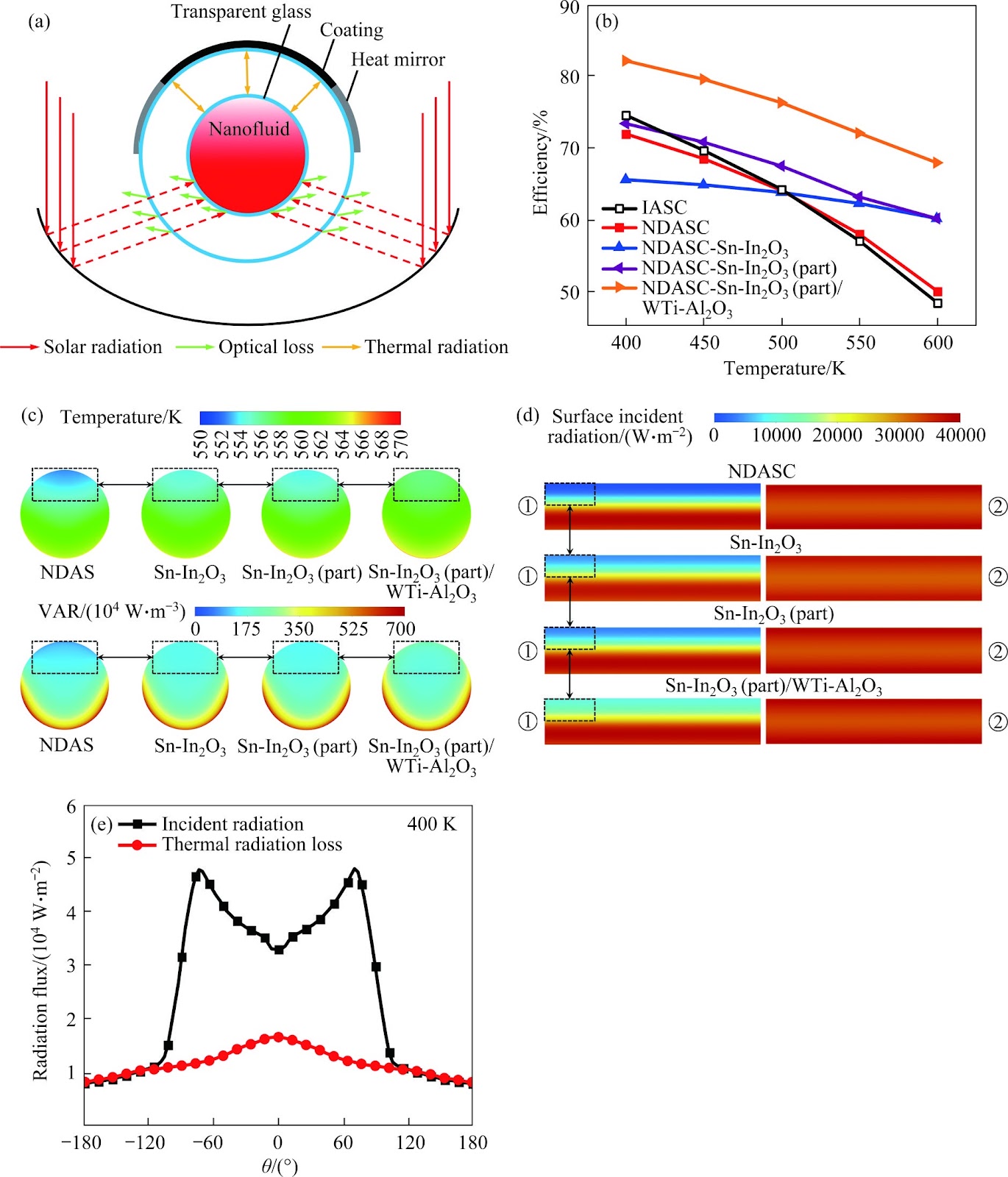
The nanofluid-based direct absorption solar collector (NDASC) ensures that solar radiation passing through the tube wall is directly absorbed by the nanofluid, reducing thermal resistance in the energy transfer process. However, further exploration is required to suppress the outward thermal losses from the nanofluid at high temperatures. Herein, this paper proposes a novel NDASC in which the outer surface of the collector tube is covered with functional coatings and a three-dimensional computational fluid dynamics model is established to study the energy flow distributions on the collector within the temperature range of 400−600 K. When the nanofluid’s absorption coefficient reaches 80 m−1, the NDASC shows the optimal thermal performance, and the NDASC with local Sn-In2O3 coating achieves a 7.8% improvement in thermal efficiency at 400 K compared to the original NDASC. Furthermore, hybrid coatings with Sn-In2O3/WTi-Al2O3 are explored, and the optimal coverage angles are determined. The NDASC with such coatings shows a 10.22%−17.9% increase in thermal efficiency compared to the original NDASC and a 7.6%−19.5% increase compared to the traditional surface-type solar collectors, demonstrating the effectiveness of the proposed energy flow control strategy for DASCs.
1. Introduction
Solar energy, which is renewable and abundant, offers a promising solution to clean and sustainable energy systems [1−3]. Various solar energy harvesting techniques, such as concentrated solar power (CSP) [4] and photovoltaic (PV) [5], have been explored extensively in recent years. Solar collectors have been widely used to harness solar thermal energy [6]. In traditional surface-type solar collectors [7], solar radiation is initially absorbed by the collector surface. After the surface temperature of the collector tube increases, the heat is then transferred to the working fluid inside the collector. Due to the thermal resistance between the collector surface and the working fluid, solar energy cannot be fully absorbed by the working fluid. However, direct absorption solar collectors (DASCs) enable solar radiation to pass through the collector wall and be directly absorbed by the working fluid, reducing the hindrance of heat conduction by the collector wall [8]. Therefore, DASCs are considered the next generation of high-performance collectors.
DASCs were introduced in the 1970s as a simplified design compared to traditional collectors, aiming to improve efficiency by directly absorbing solar radiation with the fluid [9]. MINARDI et al [10] first proposed a direct absorption solar collector that utilized a suspension of micro-sized carbon particles in “Indian ink” as the volumetric receiver. Over the past few decades, there has been a renewed interest in nanofluid-based direct absorption solar collectors due to the advancements in nanoparticle production and nanofluid preparation techniques [11, 12]. KHULLAR et al [13] first applied the aluminum nanofluid with a volume fraction of 0.05% in direct absorption parabolic trough solar collectors (DAPTSCs), reporting a 5%−10% higher thermal efficiency than traditional trough solar collectors. OTANICAR et al [14] numerically evaluated the thermal performance of nanofluids with various nanoparticles in low-temperature DASCs. They observed a 5% improvement in thermal efficiency by utilizing nanofluids as the absorption medium in solar collectors. In another study [15], the DAPTSC was constructed using Al2O3/H2O nanofluids. The results showed that the DAPTSC achieved the highest thermal efficiency at the minimum incidence angle, and the thermal efficiency increased with the volume fraction of nanofluids. In conclusion, DASCs with nanofluids as the solar absorption medium enable them to capture solar radiation better and prevent its escape through the working fluid, thus exhibiting higher thermal efficiency than traditional surface-type solar collectors.
Loading authentic research manuscript (Pages 1–5)...
Xu Bing, Zeng Rui-jing, Zheng Nian-ben, Sun Zhi-qiang (2025). Energy flow control of nanofluid-based direct absorption solar collectors with functional optical coatings for efficient solar harvesting. Journal of Central South University. https://doi.org/10.1007/s11771-025-5969-4
Research & Educational Purpose Only:The translations, structured abstracts, analytical annotations, and data reports provided by SinoTechIntel are intended exclusively for academic research, internal corporate R&D, and educational benchmarking. They do not constitute formal engineering, chemical safety, legal, or professional advice.
Copyright & Intellectual Property Notice: Original copyright of the underlying source articles and experimental data remains with the respective authors, institutions, and original publishing journals. SinoTechIntel claims intellectual property only over its proprietary translations, analytical syntheses, and AEO structured enhancements in accordance with international fair use and academic citation principles.
Frequently Asked Questions
What is a nanofluid-based direct absorption solar collector (NDASC)?
A NDASC is a solar collector in which solar radiation passes through the collector wall and is directly absorbed by a nanofluid (a fluid containing nanoparticles), eliminating the thermal resistance between the surface and the working fluid, thus improving energy transfer efficiency.
What is the main innovation of this paper?
The paper proposes a novel NDASC with functional optical coatings applied to the outer surface of the collector tube. This design controls the energy flow distribution and suppresses outward thermal losses at high temperatures, significantly enhancing thermal efficiency.
What thermal efficiency improvements are reported?
At 400 K, a local Sn-In2O3 coating achieves a 7.8% improvement over the uncoated NDASC. Hybrid coatings (Sn-In2O3/WTi-Al2O3) yield a 10.22%–17.9% increase over the original NDASC and a 7.6%–19.5% increase compared to traditional surface-type collectors.
What is the optimal absorption coefficient for the nanofluid?
The optimal absorption coefficient is 80 m−1, at which the NDASC exhibits the best thermal performance according to the three-dimensional computational fluid dynamics model.
How do hybrid coatings affect collector performance?
Hybrid coatings with Sn-In2O3 and WTi-Al2O3, when applied at optimal coverage angles, reduce radiative heat losses and improve solar absorption, leading to a substantial increase in thermal efficiency relative to uncoated and traditional collectors.
Related Technical Papers & Translations

Design and optimization of a high-efficiency distillation process for cellulosic fuel ethanol integrated with thermal coupling and molecular sieve adsorption
To address the challenges of high energy consumption and prominent costs in the traditional three-columns distillation process for cellulosic fuel ethanol, a distillation—molecular sieve coupling separation process is proposed. This process integrates a three-column (crude distillation column, first distillation column, second distillation column) system with a 3A molecular sieve adsorption deep dehydration unit. A thermal coupling network is constructed via differential pressure design (steam from medium/high-pressure columns as mutual heat sources, reboiler liquid waste heat for feed preheating), and molecular sieve adsorption conditions are optimized. The study first performs a thermodynamic consistency test on the ethanol—water system, determines optimal non-random two-liquid (NRTL) model binary interaction parameters via experimental data regression for Aspen Plus simulation. Aiming at minimum total annual cost (TAC), Aspen Plus is used to optimize process parameters (theoretical tray number, feed location, reflux ratio, side-draw position, etc.). Economic analysis shows this process reduces CO2 emission costs by 27.56%, TAC by 15.58% (to 5.123 × 10⁶ USD·a-1), and increases ethanol purity to >99.6%, providing an effective solution for green, efficient separation.

A cohesion loss model for determining residual strength of deep bedded sandstone
Rock residual strength, as an important input parameter, plays an indispensable role in proposing the reasonable and scientific scheme about stope design, underground tunnel excavation and stability evaluation of deep chambers. Therefore, previous residual strength models of rocks established were reviewed. And corresponding related problems were stated. Subsequently, starting from the effects of bedding and whole life-cycle evolution process, series of triaxial mechanical tests of deep bedded s

Federated model with contrastive learning and adaptive control variates for human activity recognition
Recent attention to privacy issues demands a communication-safe method for training human activity recognition (HAR) models on client activity data. Federated learning (FL) has become a compelling technique to facilitate model training between the server and clients while preserving data privacy. However, classical FL methods often assume independent and identically distributed (IID) data among clients. This assumption does not hold true in practical scenarios. Human activity in real-world scena