Key Takeaways & Executive Findings
- •• The energy self-inhibition model effectively characterizes energy accumulation and dissipation in freeze-thaw damaged sandstone under uniaxial compression, enhancing predictive capabilities for rock stability in cold regions. • Peak total input energy and energy storage limit follow an exponential freeze-thaw decay model, with decay constants ranging from 0.0021 to 0.1370 and 0.0018 to 0.1945, respectively, quantifying progressive deterioration. • A linear energy storage equation is proposed and validated, with storage coefficients between 0.823 and 0.992, showing a negative exponential relationship with initial uniaxial compressive strength, enabling strength-based energy predictions. • The study reveals from a thermodynamic perspective that freeze-thaw cycles weaken rock mechanical properties through distinct energy dissipation and accumulation stages, offering a robust framework for assessing frost damage in engineering geology.
Abstract
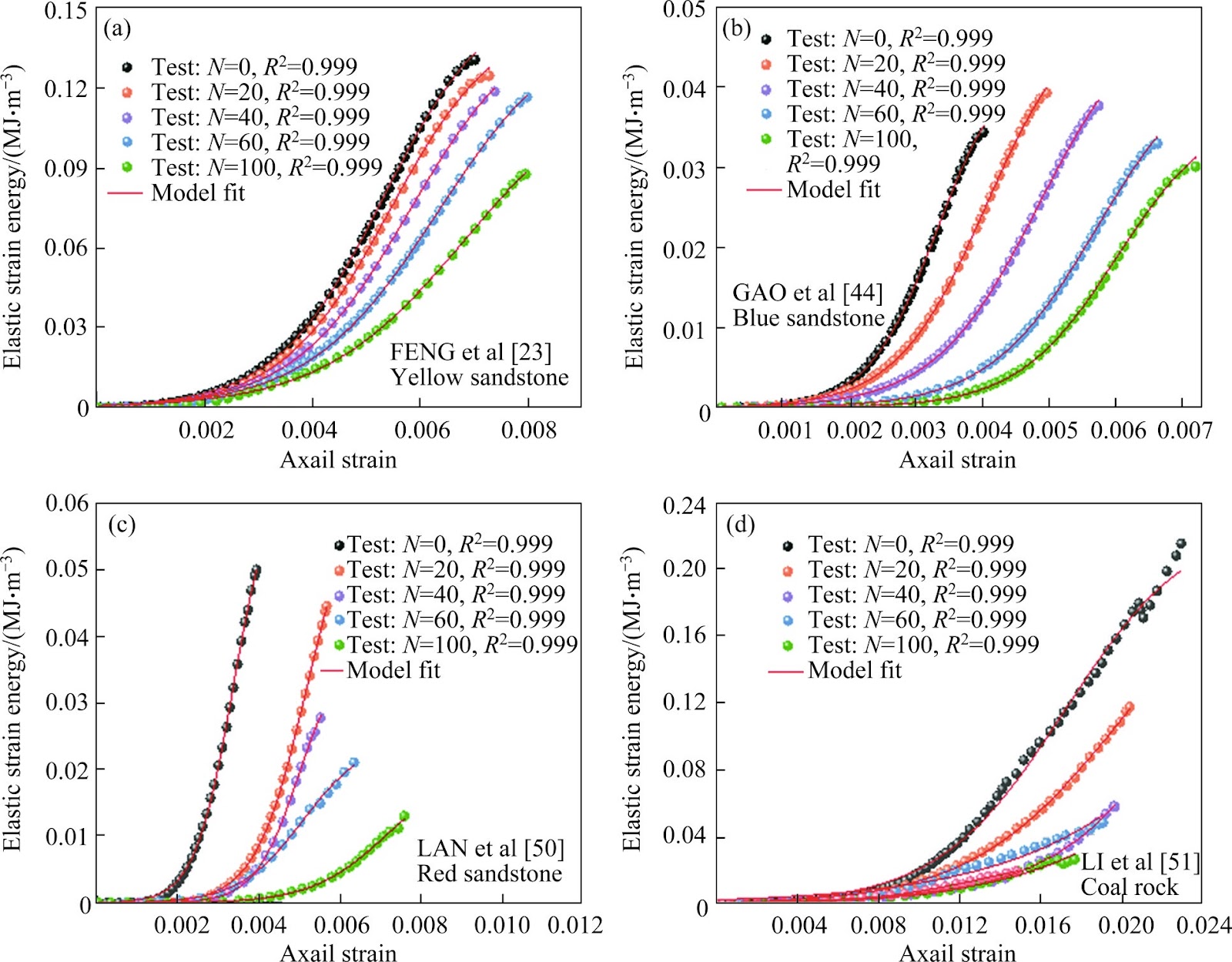
Rocks will suffer different degree of damage under freeze-thaw (FT) cycles, which seriously threatens the long-term stability of rock engineering in cold regions. In order to study the mechanism of rock FT damage, energy calculation method and energy self-inhibition model are introduced to explore their energy characteristics in this paper. The applicability of the energy self-inhibition model was verified by combining the data of FT cycles and uniaxial compression tests of intact and pre-cracked sandstone samples, as well as published reference data. In addition, the energy evolution characteristics of FT damaged rocks were discussed accordingly. The results indicate that the energy self-inhibition model perfectly characterizes the energy accumulation characteristics of FT damaged rocks under uniaxial compression before the peak strength and the energy dissipation characteristics before microcrack unstable growth stage. Taking the FT damaged cyan sandstone sample as an example, it has gone through two stages dominated by energy dissipation mechanism and energy accumulation mechanism, and the energy rate curve of the pre-cracked sample shows a fall-rise phenomenon when approaching failure. Based on the published reference data, it was found that the peak total input energy and energy storage limit conform to an exponential FT decay model, with corresponding decay constants ranging from 0.0021 to 0.1370 and 0.0018 to 0.1945, respectively. Finally, a linear energy storage equation for FT damaged rocks was proposed, and its high reliability and applicability were verified by combining published reference data, the energy storage coefficient of different types of rocks ranged from 0.823 to 0.992, showing a negative exponential relationship with the initial UCS (uniaxial compressive strength). In summary, the mechanism by which FT weakens the mechanical properties of rocks has been revealed from an energy perspective in this paper, which can provide reference for related issues in cold regions.
1. Introduction
Rocks are typical discontinuous media, and the unrecoverable freeze-thaw (FT) damage caused by complex climatic conditions and geological environment in cold regions seriously threatens their stability [1−4]. Therefore, the study of the FT damage characteristics can provide theoretical basis for the safety of rock mass engineering in cold regions and the analysis of FT disasters.
At present, FT damage characteristics are a hot topic in the field of rock mechanics. A large number of researchers have discussed this issue and found that FT cycles lead to varying degrees of deterioration in the compressive strength [5−13], elastic modulus [12−16], and P-wave velocity [17−20] of rocks. In addition, the repeated frost heave force also causes the initiation and growth of microcracks and pores, leading to a continuous increase in the porosity of the rock [21−25]. Through the study of the intrinsic mechanism of rock mechanical property degradation under FT weathering, it was found that the FT degradation effect of rocks is closely related to their initial strength and internal structure. PARK et al [26] pointed out that the FT damage characteristics of rocks are related to their compressive strength and density, and compact rock masses with high compressive strength are less affected by FT degradation. SARICI et al [27] found that the degree of FT degradation of Schmidt strength and point load strength of sedimentary rocks is related to initial porosity, water absorption capacity, and mineral content.
The above-mentioned achievements reveal the FT degradation characteristics of rock mechanical properties. However, from a thermodynamic perspective, the deformation and failure of rocks are a process of energy accumulation, dissipation, and release [28, 29]. As shown in Figure 1, when external energy is transferred to the interior of the rock, a portion of the energy is stored through elastic deformation. Due to the compaction of primary cracks and the initiation and growth of microcracks, energy dissipation also occurs, which is fundamental to understanding the coupled mechanical and energy responses of FT-damaged rocks.
Loading authentic research manuscript (Pages 1–5)...
ZHANG Chun-yang, TAN Tao, ZHAO Er-cheng (2025). Energy evolution model and energy response characteristics of freeze-thaw damaged sandstone under uniaxial compression. Journal of Central South University. https://doi.org/10.1007/s11771-024-5734-0
Research & Educational Purpose Only:The translations, structured abstracts, analytical annotations, and data reports provided by SinoTechIntel are intended exclusively for academic research, internal corporate R&D, and educational benchmarking. They do not constitute formal engineering, chemical safety, legal, or professional advice.
Copyright & Intellectual Property Notice: Original copyright of the underlying source articles and experimental data remains with the respective authors, institutions, and original publishing journals. SinoTechIntel claims intellectual property only over its proprietary translations, analytical syntheses, and AEO structured enhancements in accordance with international fair use and academic citation principles.
Frequently Asked Questions
What is the energy self-inhibition model in freeze-thaw damaged rocks?
The energy self-inhibition model is a theoretical framework that characterizes the energy accumulation and dissipation processes in rocks subjected to freeze-thaw cycles. It accurately describes the energy storage before peak strength and energy dissipation before microcrack unstable growth, providing a quantitative tool for predicting rock failure under uniaxial compression.
How do freeze-thaw cycles affect the energy storage limit of sandstone?
Freeze-thaw cycles cause an exponential decay in both the peak total input energy and the energy storage limit of sandstone. The decay constants range from 0.0021 to 0.1370 for total input energy and 0.0018 to 0.1945 for energy storage limit, indicating progressive degradation of the rock's capacity to store elastic energy.
What is the linear energy storage equation proposed in this study?
The linear energy storage equation relates the energy storage capacity of freeze-thaw damaged rocks to their mechanical properties. It uses an energy storage coefficient (ranging from 0.823 to 0.992 for different rock types) that shows a negative exponential relationship with initial uniaxial compressive strength, allowing estimation of energy storage from strength data.
Why is energy analysis important for understanding freeze-thaw rock damage?
Energy analysis provides a thermodynamic perspective on rock deformation and failure. It reveals how freeze-thaw cycles alter the balance between energy accumulation and dissipation, which directly controls the initiation and propagation of cracks. This approach offers deeper mechanistic insights than purely mechanical strength-based evaluations.
Which types of rocks were included in the validation of the energy model?
The study primarily used intact and pre-cracked sandstone samples, along with published reference data from various rock types. The energy storage coefficient was verified across different lithologies, confirming the broad applicability of the proposed linear energy storage equation for freeze-thaw damaged rocks.
Related Technical Papers & Translations

Design and optimization of a high-efficiency distillation process for cellulosic fuel ethanol integrated with thermal coupling and molecular sieve adsorption
To address the challenges of high energy consumption and prominent costs in the traditional three-columns distillation process for cellulosic fuel ethanol, a distillation—molecular sieve coupling separation process is proposed. This process integrates a three-column (crude distillation column, first distillation column, second distillation column) system with a 3A molecular sieve adsorption deep dehydration unit. A thermal coupling network is constructed via differential pressure design (steam from medium/high-pressure columns as mutual heat sources, reboiler liquid waste heat for feed preheating), and molecular sieve adsorption conditions are optimized. The study first performs a thermodynamic consistency test on the ethanol—water system, determines optimal non-random two-liquid (NRTL) model binary interaction parameters via experimental data regression for Aspen Plus simulation. Aiming at minimum total annual cost (TAC), Aspen Plus is used to optimize process parameters (theoretical tray number, feed location, reflux ratio, side-draw position, etc.). Economic analysis shows this process reduces CO2 emission costs by 27.56%, TAC by 15.58% (to 5.123 × 10⁶ USD·a-1), and increases ethanol purity to >99.6%, providing an effective solution for green, efficient separation.

A cohesion loss model for determining residual strength of deep bedded sandstone
Rock residual strength, as an important input parameter, plays an indispensable role in proposing the reasonable and scientific scheme about stope design, underground tunnel excavation and stability evaluation of deep chambers. Therefore, previous residual strength models of rocks established were reviewed. And corresponding related problems were stated. Subsequently, starting from the effects of bedding and whole life-cycle evolution process, series of triaxial mechanical tests of deep bedded s

Federated model with contrastive learning and adaptive control variates for human activity recognition
Recent attention to privacy issues demands a communication-safe method for training human activity recognition (HAR) models on client activity data. Federated learning (FL) has become a compelling technique to facilitate model training between the server and clients while preserving data privacy. However, classical FL methods often assume independent and identically distributed (IID) data among clients. This assumption does not hold true in practical scenarios. Human activity in real-world scena