Key Takeaways & Executive Findings
- •• Surface modification of PZT with polydopamine (PZT@PDA) enhances interfacial interaction with PVDF, promoting the formation of the piezoelectric β phase. • The β phase content increases with PZT@PDA loading, reaching a maximum of 28.09% at 5 wt.% PZT@PDA. • PZT@PDA acts as a nucleating agent but also reduces overall crystallinity, while increasing interfacial polarization sites. • The 5 wt.% PZT@PDA composite film exhibits superior electrical properties, with a dielectric constant of 8.61 and residual polarization of 0.6803 μC/cm².
Abstract
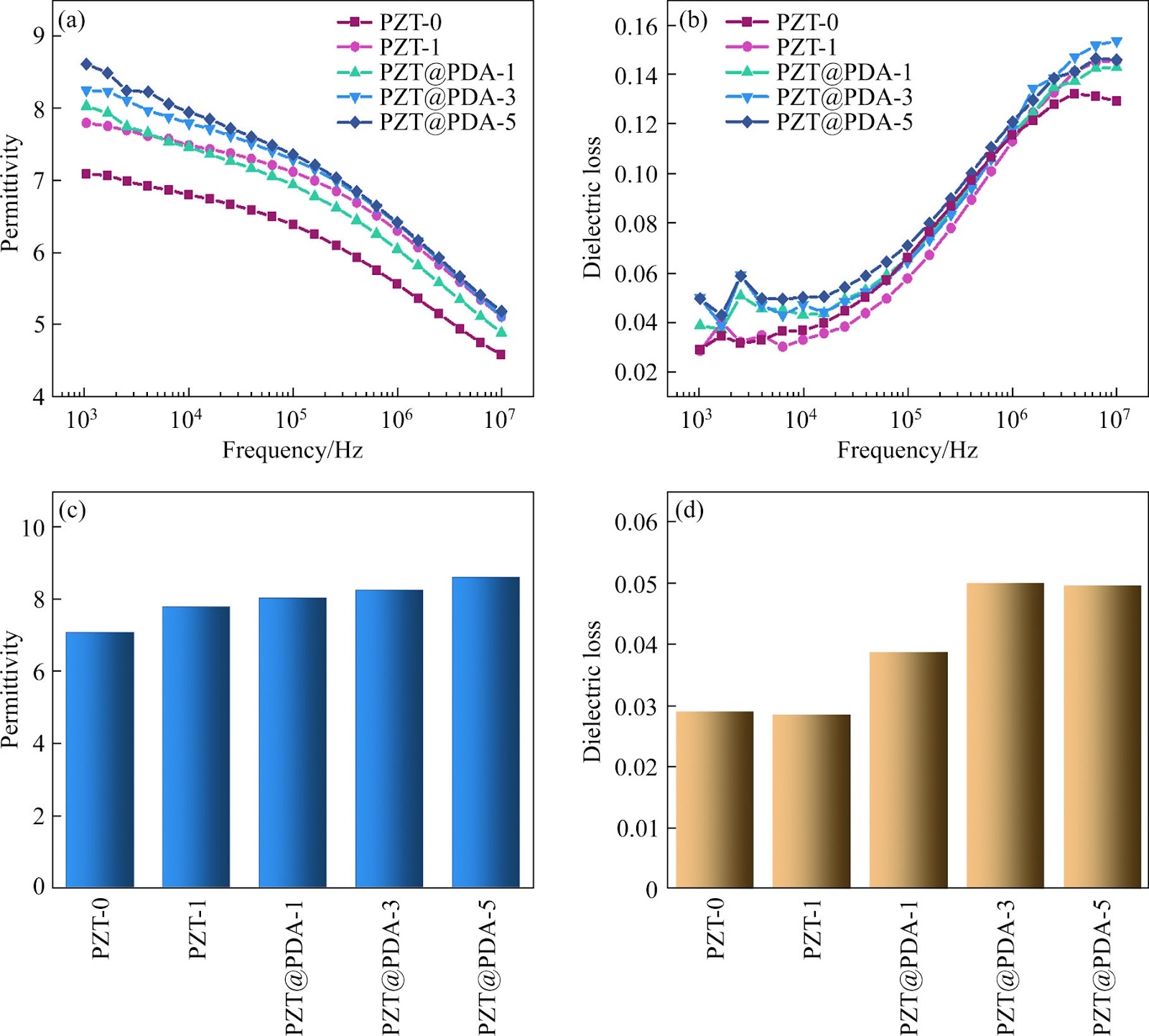
Polyvinylidene fluoride/lead zirconate titanate (PVDF/PZT) composite films have been prepared by direct ink writing and the effect of PZT content on crystallization behavior and electrical properties of film were systematically investigated. The composite films were characterized by scanning electron microscope (SEM), X-ray diffractometer (XRD), Flourier transform infrared spectroscope (FTIR) and differential scanning calorimeter (DSC). The results show that, surface modified PZT powder (PZT@PDA) is successfully coated by polydopamine (PDA), resulting in a large number of polar groups that interact with the —CF2— groups in PVDF, inducing the generation of polar β phase due to hydrogen bonding formed in the interaction. The β phase content in composite film increases with increasing PZT@PDA content, up to 28.09% as with 5 wt.% PZT@PDA. PZT@PDA plays a role of nucleating agent to promote the generation of polar phases in the film and also acts as an impurity hindering the growth of nuclei to reduce crystallinity. Moreover, the presence of PZT@PDA in interfaces provides more sites for the occurrence of interfacial polarization and thus improving the electrical properties of films. The composite film with 5 wt.% PZT@PDA possesses the highest dielectric constant (8.61) and residual polarization value (0.6803 μC/cm2).
1. Introduction
Piezoelectric materials have been developed for more than 140 years since 1880. The existence of piezoelectric effect provides a variety of scenarios for piezoelectric material applications. The use of piezoelectric materials for the preparation of microelectromechanical devices, the development of miniature resonators, sensors and micro-energy-supply chips, and transducers have been realized. Commonly used piezoelectric materials can be broadly categorized into two types, ceramics with very high electromechanical coupling coefficients, and polymers that can compensate for their lower piezoelectric properties with their high machinability. Piezoelectric polymers have more significant bending and tensile properties compared to piezoelectric ceramic materials. Piezoelectric polymer materials are dominated by carbon chains and are more flexible than single crystals and ceramics. This high flexibility allows them to withstand greater strains, making them more suitable for application scenarios with large bending and twisting requirements, especially in sensing applications. Flexible sensors with good flexibility, ductility can flexibly change their morphological structure according to the demands of the detection environment. Therefore, it can be adapted to complex and diverse non-smooth surfaces, the application range of the sensor is nearly expanded. With the rapid development of wearable devices, the good flexibility and excellent biocompatibility of piezoelectric polymers fulfill the requirements for wearable electronic components. Polymers with piezoelectric properties are nylon-11, poly(lactic acid) (PLLA), poly(lactic-co-glycolic acid) and poly(vinylidene fluoride) (PVDF). PVDF, poly(vinylidene fluoride)-trifluoroethylene (PVDF-TrFE), poly(lactic acid) (PLA) and polyamide (PA) have been widely used in pressure sensors, shock sensors, audio sensors, chemical sensors, ultrasonic sensors and medical sensors.
PVDF has a high piezoelectric coefficient among the known piezoelectric polymers and it has excellent chemical stability and flexibility. However, at present, improving the piezoelectric properties of piezoelectric polymers in practical applications is still a challenging task due to their own low piezoelectric strain constant (dij) and conversion efficiency. In order to make piezoelectric materials better meet the modern development trend, researchers have carried out research and validation work on graft modification of piezoelectric polymers, composite of piezoelectric ceramics and polymers through different processes, and structural design.
The preparation of composites using PVDF as a matrix with the introduction of suitable fillers is a simple and effective way to increase the content of polar phases in PVDF.
Loading authentic research manuscript (Pages 1–5)...
ZHOU Run-kai, YANG Hong, PENG Chao-qun, WANG Ri-chu, ZHANG Dou, FANG Guang-qiang, WANG Xiao-feng (2025). Electrical properties of PVDF/PZT composite films prepared by direct ink writing. Journal of Central South University. https://doi.org/10.1007/s11771-025-5854-1
Research & Educational Purpose Only:The translations, structured abstracts, analytical annotations, and data reports provided by SinoTechIntel are intended exclusively for academic research, internal corporate R&D, and educational benchmarking. They do not constitute formal engineering, chemical safety, legal, or professional advice.
Copyright & Intellectual Property Notice: Original copyright of the underlying source articles and experimental data remains with the respective authors, institutions, and original publishing journals. SinoTechIntel claims intellectual property only over its proprietary translations, analytical syntheses, and AEO structured enhancements in accordance with international fair use and academic citation principles.
Frequently Asked Questions
What is the effect of polydopamine coating on PVDF/PZT composite films?
The polydopamine coating (PZT@PDA) introduces polar groups that interact with the —CF2— groups in PVDF, inducing the formation of polar β phase through hydrogen bonding, which enhances the electrical properties.
How does PZT@PDA content affect the β phase content in the films?
The β phase content increases with increasing PZT@PDA content, reaching up to 28.09% at 5 wt.% PZT@PDA.
What are the highest dielectric constant and residual polarization values obtained?
The composite film with 5 wt.% PZT@PDA exhibits the highest dielectric constant of 8.61 and residual polarization of 0.6803 μC/cm².
What is the role of PZT@PDA in the crystallization behavior of PVDF?
PZT@PDA acts as a nucleating agent to promote the generation of polar phases, while also acting as an impurity that reduces overall crystallinity by hindering nuclei growth.
How were the PVDF/PZT composite films prepared?
The films were prepared using direct ink writing, a 3D printing technique that allows controlled deposition of the composite material.
Related Technical Papers & Translations

Design and optimization of a high-efficiency distillation process for cellulosic fuel ethanol integrated with thermal coupling and molecular sieve adsorption
To address the challenges of high energy consumption and prominent costs in the traditional three-columns distillation process for cellulosic fuel ethanol, a distillation—molecular sieve coupling separation process is proposed. This process integrates a three-column (crude distillation column, first distillation column, second distillation column) system with a 3A molecular sieve adsorption deep dehydration unit. A thermal coupling network is constructed via differential pressure design (steam from medium/high-pressure columns as mutual heat sources, reboiler liquid waste heat for feed preheating), and molecular sieve adsorption conditions are optimized. The study first performs a thermodynamic consistency test on the ethanol—water system, determines optimal non-random two-liquid (NRTL) model binary interaction parameters via experimental data regression for Aspen Plus simulation. Aiming at minimum total annual cost (TAC), Aspen Plus is used to optimize process parameters (theoretical tray number, feed location, reflux ratio, side-draw position, etc.). Economic analysis shows this process reduces CO2 emission costs by 27.56%, TAC by 15.58% (to 5.123 × 10⁶ USD·a-1), and increases ethanol purity to >99.6%, providing an effective solution for green, efficient separation.

A cohesion loss model for determining residual strength of deep bedded sandstone
Rock residual strength, as an important input parameter, plays an indispensable role in proposing the reasonable and scientific scheme about stope design, underground tunnel excavation and stability evaluation of deep chambers. Therefore, previous residual strength models of rocks established were reviewed. And corresponding related problems were stated. Subsequently, starting from the effects of bedding and whole life-cycle evolution process, series of triaxial mechanical tests of deep bedded s

Federated model with contrastive learning and adaptive control variates for human activity recognition
Recent attention to privacy issues demands a communication-safe method for training human activity recognition (HAR) models on client activity data. Federated learning (FL) has become a compelling technique to facilitate model training between the server and clients while preserving data privacy. However, classical FL methods often assume independent and identically distributed (IID) data among clients. This assumption does not hold true in practical scenarios. Human activity in real-world scena