Key Takeaways & Executive Findings
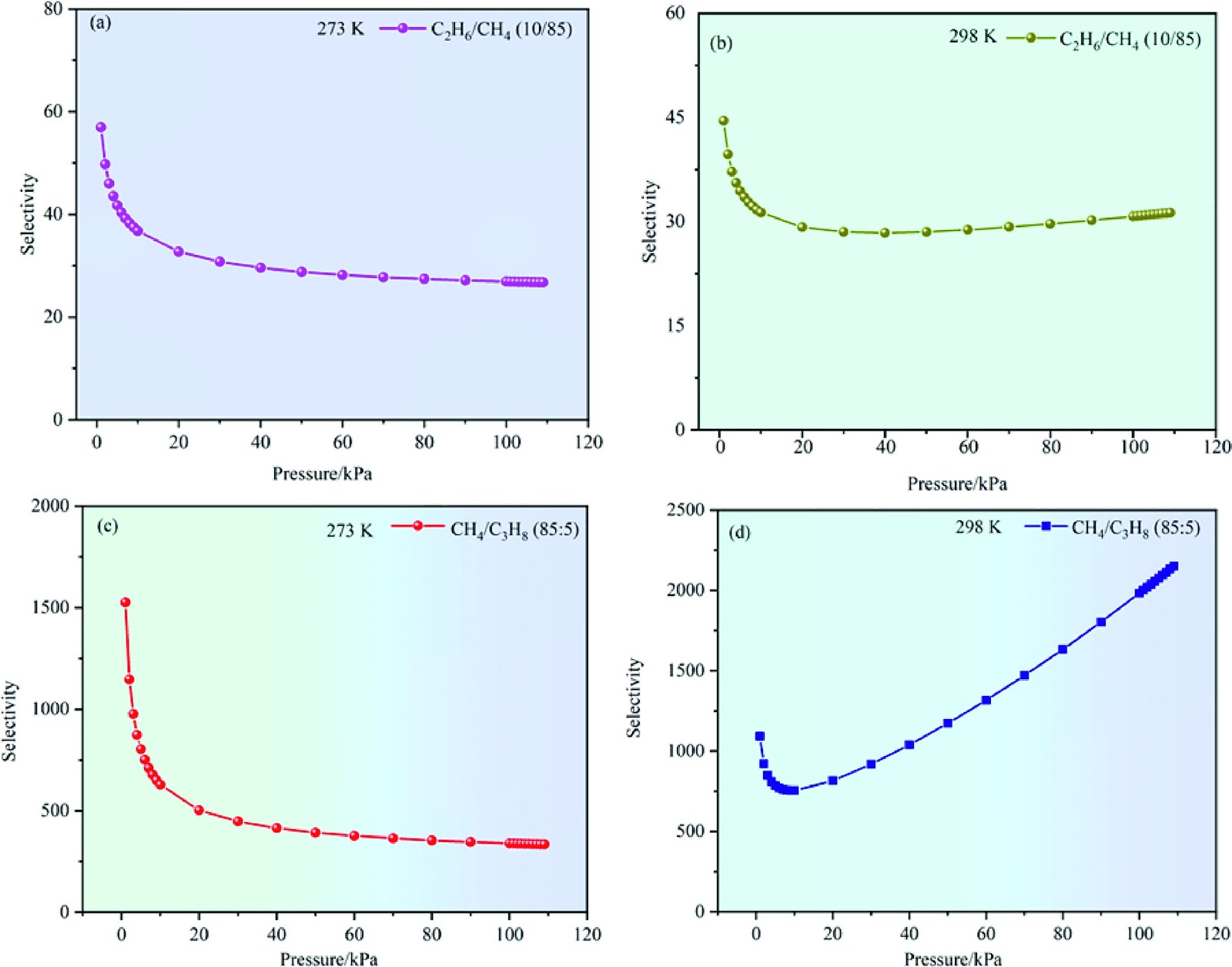
- •• A novel Co-MOF with open metal sites exhibits superior adsorption capacity for C2-C3 hydrocarbons over CH4, enabling efficient separation. • Ideal adsorbed solution theory calculations show remarkable equilibrium separation selectivity for C2H6/CH4 and C3H8/CH4 at 273/298 K and 0.1 MPa. • Dynamic breakthrough experiments confirm the practical ability of Co-MOF to purify methane from C2-C3 hydrocarbon mixtures. • Molecular simulations reveal that anionic SBUs preferentially interact with C2-C3 hydrocarbons, providing a design paradigm for porous MOF adsorbents.
Abstract
Methane (CH4) as a substitute for other mineral fuels plays a crucial role in reducing energy consumption and preventing environmental pollution. The present study employs a solvothermal method to fabricate a porous framework Co-metal-organic framework (Co-MOF) containing two distinct secondary building units (SBUs): an anionic [Co2(μ2-OH)(COO)4(H2O)] and a neutral [CoN2(COO)2]. Notably, within the anionic SBUs, the coordinated water molecules induce the generation of divergent unsaturated Co(II) centers in the unidirectional porous channels, thereby creating open metal sites. The adsorption performance of Co-MOF towards pure component gases was systematically investigated. The results demonstrated that Co-MOF exhibits superior adsorption capacity for C2-C3 hydrocarbons compared to CH4, which offers the potential for efficient adsorption and separation of CH4 from C2-C3 hydrocarbons. The gas selectivity separation ratios of Co-MOF for C2H6/CH4 and C3H8/CH4 were calculated using the ideal adsorbed solution theory method at 273/298 K and 0.1 MPa. The results revealed that Co-MOF achieved remarkable equilibrium separation selectivity for CH4 and C2-C3 hydrocarbon gases among non-modified MOFs, signifying the potential of the synthesized Co-MOF for efficient recovery and purification of CH4 from C2-C3 hydrocarbons. Breakthrough experiments further demonstrate the ability of Co-MOF to purify methane from C2-C3 hydrocarbons in practical gas separation scenarios. Additionally, molecular simulation calculations further substantiate the propensity of anionic SBUs to interact with C2-C3 hydrocarbon compounds. This study provides a novel paradigm for the development of porous MOF materials in the application of gas mixture separation.
1. Introduction
Mineral fuels, formed through complex transformations of ancient organisms' remains, hold significant importance in achieving industrialization through their efficient development and application. Unfortunately, the combustion of fossil fuels emits copious amounts of greenhouse gases, intensifying the greenhouse effect and they are non-renewable resources. Therefore, clean methane gas (CH4) serves as a promising alternative to fossil fuels, effectively reducing energy consumption and mitigating environmental pollution. Moreover, due to the persistent growth in global energy demand, natural gas (NG) has emerged as a strategic energy resource [1,2]. Primarily consisting of CH4, natural gas also contains trace amounts of ethane (C2H6) and propane (C3H8) etc. which must be eliminated to enhance its quality [3]. Moreover, pyrolysis gas (PG), a significant source of light hydrocarbons, comprises abundant methane along with varying quantities of C2-C3 hydrocarbon compounds, including C2H6, C2H4 and C3H8 etc. [4]. To be effectively utilized, all these hydrocarbon compounds must undergo separation from one another as basic raw materials. Consequently, the current research focuses on achieving efficient separation of CH4 and C2-C3 hydrocarbon compounds.
In addition, the low-temperature distillation process under high pressure remains the most advanced technology for separating light hydrocarbon mixtures, given the small differences in boiling points among gas components and their similar sizes. However, this energy-intensive process leads to increased costs and energy consumption during separation. To address these challenges, traditional porous materials like activated carbon, zeolite, and silica have been extensively investigated for their selective adsorption properties in hydrocarbon separation [5,6]. Nonetheless, the practical application of zeolite materials is limited due to their structural drawbacks, including low specific surface area and a lack of active sites seen in activated carbon materials [7].
Metal-organic framework (MOF) materials, as a class of emerging crystalline organic-inorganic hybrid materials, have potential applications in various fields such as catalysis [8], gas separation [9], fuel storage [10], carbon capture [11], and energy devices [12]. In the past decades, research on the separation of hydrocarbon compounds using porous MOFs has gained increasing attention.
Loading authentic research manuscript (Pages 1–5)...
Jie Zhang, Xingzhe Guo, Bing Lin, Guangzu Xiong, Hanshuang Wang, Min Zhang, Liwen Fan, Bingwen Li, Shuisheng Chen (2024). Efficient adsorption separation of methane from C2-C3 hydrocarbons in a Co(II)-nodes metal-organic framework. Chinese Journal of Chemical Engineering. https://doi.org/10.1016/j_cjche_1448
Research & Educational Purpose Only:The translations, structured abstracts, analytical annotations, and data reports provided by SinoTechIntel are intended exclusively for academic research, internal corporate R&D, and educational benchmarking. They do not constitute formal engineering, chemical safety, legal, or professional advice.
Copyright & Intellectual Property Notice: Original copyright of the underlying source articles and experimental data remains with the respective authors, institutions, and original publishing journals. SinoTechIntel claims intellectual property only over its proprietary translations, analytical syntheses, and AEO structured enhancements in accordance with international fair use and academic citation principles.
Frequently Asked Questions
What is the main objective of this study?
The study aims to develop a Co-based metal-organic framework (Co-MOF) with open metal sites for efficient adsorption and separation of methane (CH4) from C2-C3 hydrocarbons (ethane, propane, etc.) in natural gas and pyrolysis gas.
How does the Co-MOF achieve high separation selectivity?
The Co-MOF contains anionic secondary building units with coordinated water molecules that generate unsaturated Co(II) centers, creating open metal sites. These sites preferentially interact with C2-C3 hydrocarbons over CH4, leading to superior adsorption capacity and high separation selectivity.
What methods were used to evaluate the separation performance?
The separation performance was evaluated using pure component adsorption isotherms, ideal adsorbed solution theory (IAST) calculations for selectivity, dynamic breakthrough experiments, and molecular simulations to understand the adsorption mechanisms.
What are the practical implications of this research?
The Co-MOF demonstrates potential for efficient recovery and purification of methane from C2-C3 hydrocarbon mixtures, offering a more energy-efficient alternative to cryogenic distillation for natural gas processing and pyrolysis gas utilization.
What makes this Co-MOF unique compared to other MOFs?
The Co-MOF features two distinct secondary building units, including an anionic SBU with open metal sites, which provides strong interactions with C2-C3 hydrocarbons. It achieves remarkable equilibrium separation selectivity among non-modified MOFs, as confirmed by IAST calculations and breakthrough experiments.
Related Technical Papers & Translations

Design and optimization of a high-efficiency distillation process for cellulosic fuel ethanol integrated with thermal coupling and molecular sieve adsorption
To address the challenges of high energy consumption and prominent costs in the traditional three-columns distillation process for cellulosic fuel ethanol, a distillation—molecular sieve coupling separation process is proposed. This process integrates a three-column (crude distillation column, first distillation column, second distillation column) system with a 3A molecular sieve adsorption deep dehydration unit. A thermal coupling network is constructed via differential pressure design (steam from medium/high-pressure columns as mutual heat sources, reboiler liquid waste heat for feed preheating), and molecular sieve adsorption conditions are optimized. The study first performs a thermodynamic consistency test on the ethanol—water system, determines optimal non-random two-liquid (NRTL) model binary interaction parameters via experimental data regression for Aspen Plus simulation. Aiming at minimum total annual cost (TAC), Aspen Plus is used to optimize process parameters (theoretical tray number, feed location, reflux ratio, side-draw position, etc.). Economic analysis shows this process reduces CO2 emission costs by 27.56%, TAC by 15.58% (to 5.123 × 10⁶ USD·a-1), and increases ethanol purity to >99.6%, providing an effective solution for green, efficient separation.

A cohesion loss model for determining residual strength of deep bedded sandstone
Rock residual strength, as an important input parameter, plays an indispensable role in proposing the reasonable and scientific scheme about stope design, underground tunnel excavation and stability evaluation of deep chambers. Therefore, previous residual strength models of rocks established were reviewed. And corresponding related problems were stated. Subsequently, starting from the effects of bedding and whole life-cycle evolution process, series of triaxial mechanical tests of deep bedded s

Federated model with contrastive learning and adaptive control variates for human activity recognition
Recent attention to privacy issues demands a communication-safe method for training human activity recognition (HAR) models on client activity data. Federated learning (FL) has become a compelling technique to facilitate model training between the server and clients while preserving data privacy. However, classical FL methods often assume independent and identically distributed (IID) data among clients. This assumption does not hold true in practical scenarios. Human activity in real-world scena