Key Takeaways & Executive Findings
- •• Ionic liquids (ILs) effectively enhance the relative volatility of 1,3,5-trioxane (TOX) to water, enabling the destruction of the azeotrope at an IL mole fraction of about 0.10. • The addition of ILs increases TOX volatility while decreasing water volatility, with the effect intensifying at higher IL dosages. • The NRTL model successfully correlates experimental VLE data, revealing strong IL–water interactions that drive the separation enhancement. • ILs with strong polarity and hydrophilicity are identified as promising additives for improving TOX concentration in the vapor phase, offering potential energy savings in industrial separation.
Abstract
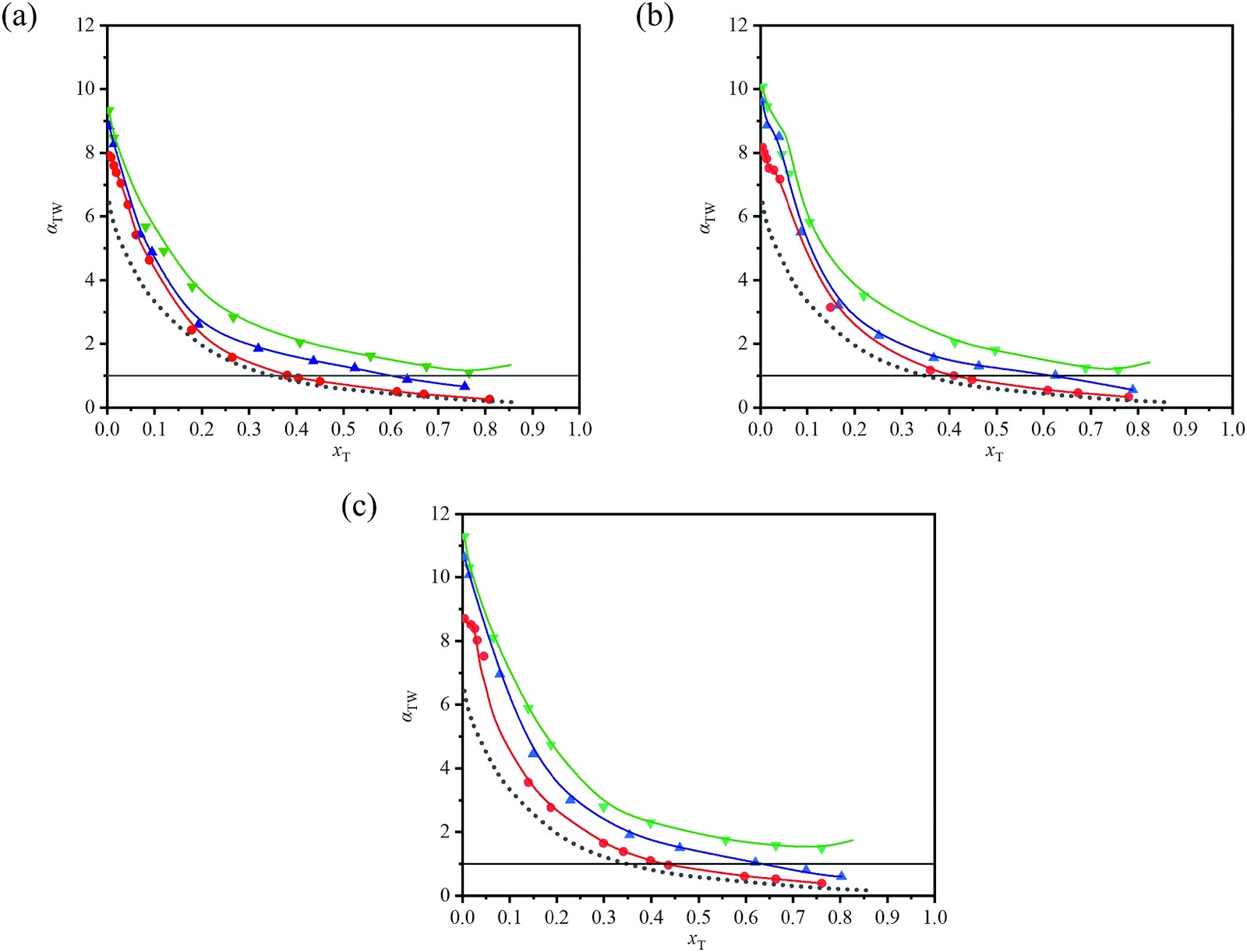
Increasing the 1,3,5-trioxane (TOX) concentration in the equilibrated vapor phase of TOX–H2O system has been recognized as a challenge for the azeotrope. Ionic liquids (ILs) were used to improve the relative volatility of TOX to H2O and destroy the azeotrope in the TOX–H2O system. The vapor–liquid equilibrium of TOX–H2O system at 101.3 kPa was studied with the addition of 1-butyl-3-methylimidazolium hydrogen sulfate, 1-hexyl-3-methylimidazolium hydrogen sulfate and 1-butyl-3-methylimidazolium nitrate, respectively. The results showed that the volatility of TOX increased with the increase in IL dosage. And the volatility of water decreased with the increase in IL dosage. The relative volatility of TOX to H2O was improved with the increase in ILs dosage. The azeotrope could be destroyed with an IL mole fraction of about 0.10. A non-random two-liquid (NRTL) model was successfully used to correlate the experimental data. The interaction parameters were obtained by fitting the experimental data with the model. The results indicated that a strong interaction existed between ILs and water. The strong interaction improved the volatility of TOX and inhibited the volatility of water, and then intensified the relative volatility of TOX to H2O. The results showed that an ILs with strong polarity and hydrophilicity may be a potential additive to improve the TOX concentration in the equilibrated vapor phase.
1. Introduction
1,3,5-Trioxane (TOX) is a cyclic trimer of formaldehyde (FA) [1]. On the merits of superior water solubility and biological activity [2], it is widely used in the production of pesticides, molding materials, antibacterial agents and adhesives. For example, TOX is the feed to synthesize polyformaldehyde (POM) [3], which is one of the top five engineering plastics having excellent mechanical properties, insulation and chemical stability [4,5]. TOX is also used to produce anhydrous formaldehyde by depolymerization [6,7]. Furthermore, TOX can also be used to synthesize paraformaldehyde dimethyl ether (PODEn), which is a potential diesel additive [8]. The researches related to the production technology of 1,3,5-trioxane have received extensive attention.
Currently, the primary commercial process of TOX production is the liquid phase route with H2SO4 as catalyst [9]. In aqueous solution of FA, FA reacts with water to form a series of n-formaldehyde hydrides (HO-(CH2O)nH, n ≥ 1). It indicates that HO-(CH2O)nH is the main presentence form of FA and the content of free FA is very low. The low FA concentration decreases the concentration of produced TOX for the limitation of reaction equilibrium [10]. After reaction, the produced TOX is usually separated by distillation. However, the separation of TOX from TOX–H2O system and the TOX–FA–H2O system is difficult because of the low concentration of TOX in the liquid phase and the small separation factor at the operation conditions. In the TOX–H2O system and TOX–FA–H2O system, a binary azeotropic system and a ternary azeotropic system may be formed respectively at specific operation conditions [10]. In the reactor, a large amount of FA and water enter the vapor phase accompanied by TOX. The equilibrium molar concentration of TOX in the vapor product is only about 2% [11]. Subsequent separation is necessary and a large energy consumption is needed.
Loading authentic research manuscript (Pages 1–5)...
Fei Li, Tao Zhang, Li Lv, Wenxiang Tang, Yan Wang, Shengwei Tang (2025). Effects of ionic liquids on the vapor–liquid equilibrium of 1,3,5-trioxane–water system at 101.3 kPa. Chinese Journal of Chemical Engineering. https://doi.org/10.1016/j_cjche_144878716
Research & Educational Purpose Only:The translations, structured abstracts, analytical annotations, and data reports provided by SinoTechIntel are intended exclusively for academic research, internal corporate R&D, and educational benchmarking. They do not constitute formal engineering, chemical safety, legal, or professional advice.
Copyright & Intellectual Property Notice: Original copyright of the underlying source articles and experimental data remains with the respective authors, institutions, and original publishing journals. SinoTechIntel claims intellectual property only over its proprietary translations, analytical syntheses, and AEO structured enhancements in accordance with international fair use and academic citation principles.
Frequently Asked Questions
What is the main challenge in the TOX–water system addressed by this study?
The main challenge is the low concentration of 1,3,5-trioxane (TOX) in the equilibrated vapor phase due to the formation of an azeotrope, which makes separation difficult and energy-intensive.
How do ionic liquids (ILs) affect the vapor-liquid equilibrium of the TOX-water system?
Ionic liquids increase the volatility of TOX and decrease the volatility of water, thereby improving the relative volatility of TOX to water. At an IL mole fraction of about 0.10, the azeotrope can be destroyed.
Which ionic liquids were tested in this study?
The study tested 1-butyl-3-methylimidazolium hydrogen sulfate, 1-hexyl-3-methylimidazolium hydrogen sulfate, and 1-butyl-3-methylimidazolium nitrate.
What model was used to correlate the experimental data?
The non-random two-liquid (NRTL) model was successfully used to correlate the experimental data, and interaction parameters were obtained by fitting.
What are the practical implications of this research?
The findings suggest that ionic liquids with strong polarity and hydrophilicity can serve as effective additives to enhance TOX concentration in the vapor phase, potentially reducing energy consumption in industrial separation processes.
Related Technical Papers & Translations

Design and optimization of a high-efficiency distillation process for cellulosic fuel ethanol integrated with thermal coupling and molecular sieve adsorption
To address the challenges of high energy consumption and prominent costs in the traditional three-columns distillation process for cellulosic fuel ethanol, a distillation—molecular sieve coupling separation process is proposed. This process integrates a three-column (crude distillation column, first distillation column, second distillation column) system with a 3A molecular sieve adsorption deep dehydration unit. A thermal coupling network is constructed via differential pressure design (steam from medium/high-pressure columns as mutual heat sources, reboiler liquid waste heat for feed preheating), and molecular sieve adsorption conditions are optimized. The study first performs a thermodynamic consistency test on the ethanol—water system, determines optimal non-random two-liquid (NRTL) model binary interaction parameters via experimental data regression for Aspen Plus simulation. Aiming at minimum total annual cost (TAC), Aspen Plus is used to optimize process parameters (theoretical tray number, feed location, reflux ratio, side-draw position, etc.). Economic analysis shows this process reduces CO2 emission costs by 27.56%, TAC by 15.58% (to 5.123 × 10⁶ USD·a-1), and increases ethanol purity to >99.6%, providing an effective solution for green, efficient separation.

A cohesion loss model for determining residual strength of deep bedded sandstone
Rock residual strength, as an important input parameter, plays an indispensable role in proposing the reasonable and scientific scheme about stope design, underground tunnel excavation and stability evaluation of deep chambers. Therefore, previous residual strength models of rocks established were reviewed. And corresponding related problems were stated. Subsequently, starting from the effects of bedding and whole life-cycle evolution process, series of triaxial mechanical tests of deep bedded s

Federated model with contrastive learning and adaptive control variates for human activity recognition
Recent attention to privacy issues demands a communication-safe method for training human activity recognition (HAR) models on client activity data. Federated learning (FL) has become a compelling technique to facilitate model training between the server and clients while preserving data privacy. However, classical FL methods often assume independent and identically distributed (IID) data among clients. This assumption does not hold true in practical scenarios. Human activity in real-world scena