Key Takeaways & Executive Findings
- •• Mn content critically modifies the microstructure and texture of hot-extruded Mg–2Nd–1Gd, with 0.5wt% Mn yielding the optimal combination of strength and ductility. • The Mg–2Nd–1Gd–0.5Mn alloy achieves a yield strength of 138.0 MPa, ultimate tensile strength of 231.1 MPa, and elongation of 38.8%. • Solid-solution Mn atoms reduce Nd/Gd segregation and weaken solute drag, while α-Mn particles pin grain boundaries and delay recrystallization. • Grain boundary and dislocation strengthening dominate the yield strength of the 0.5Mn alloy, contributing 44% and 24.1%, respectively.
Abstract
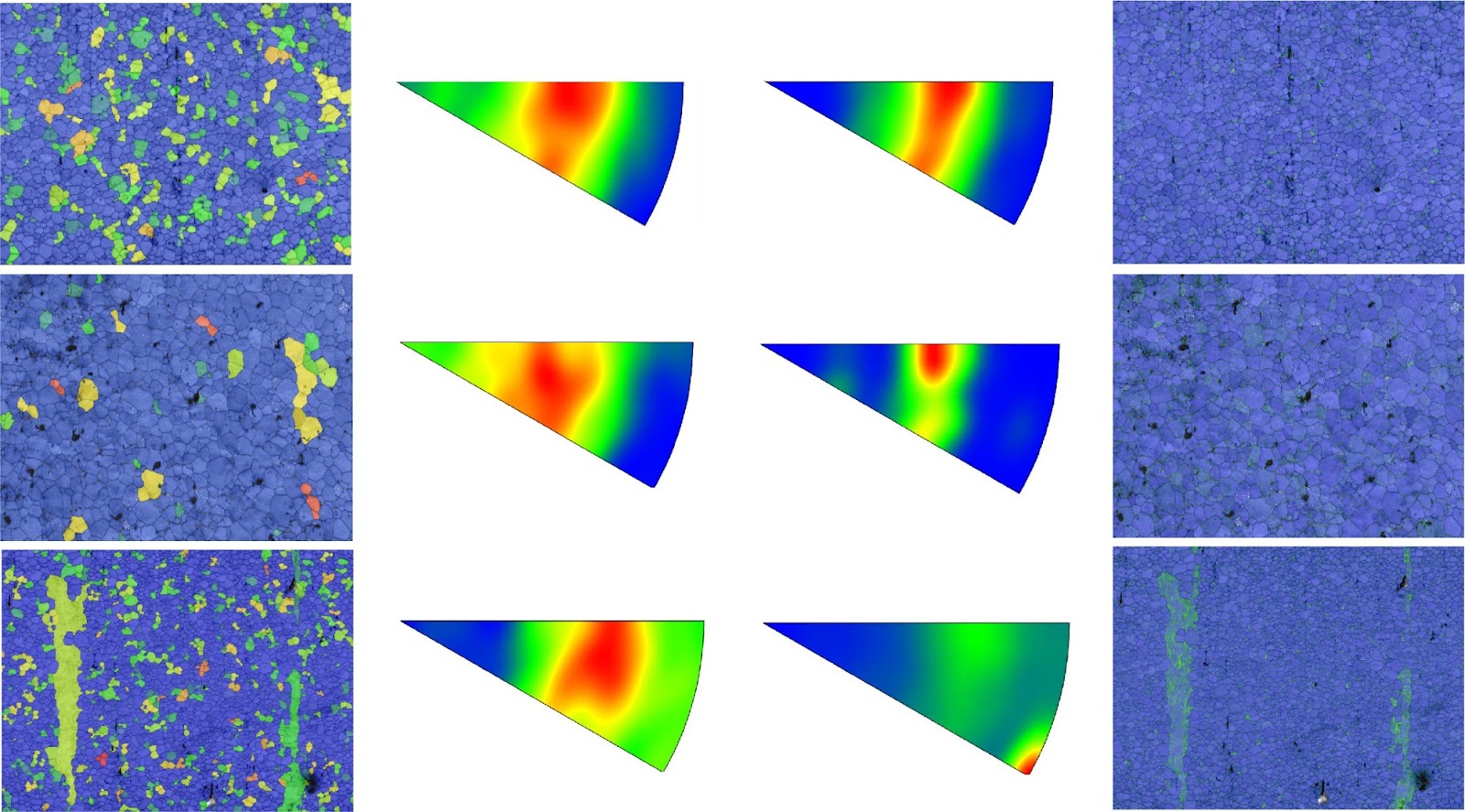
The effect of Mn content on the microstructure, texture, and room-temperature mechanical properties of hot-extruded Mg–2Nd–1Gd alloy was investigated. The microstructure of hot-extruded Mg–2Nd–1Gd–xMn (x = 0, 0.25wt%, and 0.5wt%) alloys consisted primarily of a fine-grained α-Mg matrix phase and point-like, streamline-distributed Mg41(Nd,Gd)5 phase along the extrusion direction. In the extruded Mg–2Nd–1Gd–0.25Mn and Mg–2Nd–1Gd–0.5Mn alloys, Mn was mainly present as solid–solution Mn atoms and α-Mn particles, respectively. With increasing Mn content, the recrystallization fraction of the Mg–2Nd–1Gd–xMn alloys increased from 79% to 94.3%, and then decreased to 77.8%. Meanwhile, the average grain size first increased from 7.9 to 11.9 μm and then decreased to 7.5 μm. Microstructural characterization revealed that the solid–solution Mn atoms in the extruded Mg–2Nd–1Gd–0.25Mn alloy reduced the segregation of Nd and Gd, thereby weakening the solute drag effect. In contrast, α-Mn particles pinned the grain boundaries and delayed the recrystallization process in the extruded Mg–2Nd–1Gd–0.5Mn alloy. The extruded Mg–2Nd–1Gd and Mg–2Nd–1Gd–0.25Mn alloys exhibited a typical rare-earth texture, whereas the extruded Mg–2Nd–1Gd–0.5Mn alloy displayed a basal texture combined with a rare-earth texture due to the presence of deformed grains. Among the extruded Mg–2Nd–1Gd–xMn alloys, the Mg–2Nd–1Gd–0.5Mn variant exhibited the best room-temperature mechanical properties, with a yield strength of 138.0 MPa, an ultimate tensile strength of 231.1 MPa, and an elongation of 38.8%. Quantitative analysis indicated that grain boundary and dislocation strengthening were the main contributors to the yield strength of the extruded Mg–2Nd–1Gd–0.5Mn alloy, accounting for 44% and 24.1%, respectively.
1. Introduction
Magnesium (Mg) alloys, the lightest metallic structural materials among existing engineering alloys, have significant application potential in the aerospace and automotive industries, where lightweight materials are urgently required [1–3]. Mg rare-earth (RE)-based casting alloys are considered promising due to their strong solid–solution strengthening and age-hardening effects [4–6]. Among them, Mg–Nd–Gd alloys have attracted increasing attention from researchers because of their relatively low cost [7–12]. In general, cast Mg alloys contain casting defects such as porosity, which reduce their mechanical properties [13]. Hot-extrusion deformation can effectively eliminate such defects and refine the grain structure, making it an effective method for developing high-strength and plastic Mg alloys [14–15]. However, the room-temperature strength of extruded Mg–Nd–Gd-based alloys remains relatively low, which limits their broader application. For example, the room-temperature strength of the commercial extruded EV31A alloy (Mg–3Nd–1.5Gd–0.3Zn–0.5Zr) is lower than that of the extruded ZK60 alloy [16–20], preventing optimal strength–ductility matching from being realized. In addition, the excellent high-temperature properties of Mg–RE alloys are their greatest advantage; however, it is necessary to improve their room-temperature mechanical properties. Moreover, the ZK60 alloy has a severe hot-cracking tendency and poor casting properties [21], and its plasticity is much lower than that of Mg–Nd–Gd-based alloys. Therefore, the modification of Mg–Nd–Gd-based alloys is a subject worthy of investigation.
Mn is a common alloying element in Mg–RE-based wrought alloys and offers the advantages of low cost, refined grains, and improved formability [22]. It has proven effective in enhancing the mechanical properties of Mg alloys [23–30]. A series of studies has been conducted on the effects of Mn addition. Fang et al. [23] showed that the grains were significantly refined from 18 to 11 μm after 0.8wt% Mn addition in extruded Mg–10Gd alloy, which was attributed to the inhibition of recrystallization grain growth by fine α-Mn particles. Zhou et al. [24] demonstrated that the addition of 2wt% Mn to extruded Mg–9Gd–4Y–1Zn alloy improved the grain refinement effect, promoted the phase transformation of block-shaped long period stacking ordered phase (LPSO) to lamellar LPSO, and increased the dislocation density. Zhao et al. [25] found that the extrusion direction (ED)-split texture of Mg–1Gd–0.5Zn–xMn sheets was gradually weakened with increasing Mn content, which related to restrained grain growth by fine α-Mn particles. Reportedly, the extruded Mg–3Gd–1Zn alloy with adding 1wt% Mn showed an increase in hardness, shear yield stress, and ultimate shear strength from HV 61, 102 MPa, and 142.8 MPa to HV 66, 128.5 MPa, and 152.4 MPa, respectively [26]. The extruded Mg–1Gd–0.7Mn alloy showed better tensile properties than the Mg–1Gd alloy, with a tensile yield strength of 105 MPa, ultimate tensile strength of 253 MPa, and elongation of 30.2% [27]. However, there are few studies on the effect of Mn on Mg–RE
Loading authentic research manuscript (Pages 1–5)...
Juan Wang, Guangyu Yang, Chenjin Zhang, Yaozhong Zhou, Zhiyong Kan, Chunhui Wang, Wanqi Jie (2025). Effect of Mn content on microstructure, texture and room-temperature mechanical properties of hot-extruded Mg–2Nd–1Gd alloy. Journal of Mineral Metallurgy and Materials Science. https://doi.org/10.1007/s12613-025-3243-2
Research & Educational Purpose Only:The translations, structured abstracts, analytical annotations, and data reports provided by SinoTechIntel are intended exclusively for academic research, internal corporate R&D, and educational benchmarking. They do not constitute formal engineering, chemical safety, legal, or professional advice.
Copyright & Intellectual Property Notice: Original copyright of the underlying source articles and experimental data remains with the respective authors, institutions, and original publishing journals. SinoTechIntel claims intellectual property only over its proprietary translations, analytical syntheses, and AEO structured enhancements in accordance with international fair use and academic citation principles.
Frequently Asked Questions
How does Mn content affect the microstructure of hot-extruded Mg-2Nd-1Gd alloy?
Increasing Mn content up to 0.5wt% initially raises the recrystallization fraction and grain size (from 79% and 7.9 μm to 94.3% and 11.9 μm at 0.25Mn), then decreases them (to 77.8% and 7.5 μm at 0.5Mn). At 0.25Mn, Mn dissolves as solid-solution atoms, reducing Nd/Gd segregation; at 0.5Mn, α-Mn particles form and pin grain boundaries, delaying recrystallization.
Which Mn addition provides the best mechanical properties in extruded Mg-2Nd-1Gd?
The Mg-2Nd-1Gd-0.5Mn alloy exhibits the best room-temperature mechanical properties, with a yield strength of 138.0 MPa, ultimate tensile strength of 231.1 MPa, and elongation of 38.8%.
What are the main strengthening mechanisms in the Mg-2Nd-1Gd-0.5Mn alloy?
Quantitative analysis shows that grain boundary strengthening and dislocation strengthening are the dominant contributors, accounting for 44% and 24.1% of the yield strength, respectively.
How does Mn influence texture evolution in Mg-2Nd-1Gd alloys?
The extruded Mg-2Nd-1Gd and 0.25Mn alloys show a typical rare-earth texture, while the 0.5Mn alloy displays a basal texture combined with a rare-earth texture due to the presence of deformed grains.
Related Technical Papers & Translations

Design and optimization of a high-efficiency distillation process for cellulosic fuel ethanol integrated with thermal coupling and molecular sieve adsorption
To address the challenges of high energy consumption and prominent costs in the traditional three-columns distillation process for cellulosic fuel ethanol, a distillation—molecular sieve coupling separation process is proposed. This process integrates a three-column (crude distillation column, first distillation column, second distillation column) system with a 3A molecular sieve adsorption deep dehydration unit. A thermal coupling network is constructed via differential pressure design (steam from medium/high-pressure columns as mutual heat sources, reboiler liquid waste heat for feed preheating), and molecular sieve adsorption conditions are optimized. The study first performs a thermodynamic consistency test on the ethanol—water system, determines optimal non-random two-liquid (NRTL) model binary interaction parameters via experimental data regression for Aspen Plus simulation. Aiming at minimum total annual cost (TAC), Aspen Plus is used to optimize process parameters (theoretical tray number, feed location, reflux ratio, side-draw position, etc.). Economic analysis shows this process reduces CO2 emission costs by 27.56%, TAC by 15.58% (to 5.123 × 10⁶ USD·a-1), and increases ethanol purity to >99.6%, providing an effective solution for green, efficient separation.

A cohesion loss model for determining residual strength of deep bedded sandstone
Rock residual strength, as an important input parameter, plays an indispensable role in proposing the reasonable and scientific scheme about stope design, underground tunnel excavation and stability evaluation of deep chambers. Therefore, previous residual strength models of rocks established were reviewed. And corresponding related problems were stated. Subsequently, starting from the effects of bedding and whole life-cycle evolution process, series of triaxial mechanical tests of deep bedded s

Federated model with contrastive learning and adaptive control variates for human activity recognition
Recent attention to privacy issues demands a communication-safe method for training human activity recognition (HAR) models on client activity data. Federated learning (FL) has become a compelling technique to facilitate model training between the server and clients while preserving data privacy. However, classical FL methods often assume independent and identically distributed (IID) data among clients. This assumption does not hold true in practical scenarios. Human activity in real-world scena