Key Takeaways & Executive Findings
- •• Elliptical stirred vessels significantly improve mixing performance in unbaffled stirred tanks, reducing mixing time to 45.3% of that in circular tanks at an aspect ratio of 2.00. • Increasing aspect ratio strengthens secondary flow and enlarges the vortex core region, enhancing fluid circulation and mixing. • Axial velocity is more sensitive to aspect ratio changes than circumferential or radial velocity, indicating improved axial mixing. • Elliptical geometry alters turbulent kinetic energy transfer, offering a novel approach to optimize mixing without baffles.
Abstract
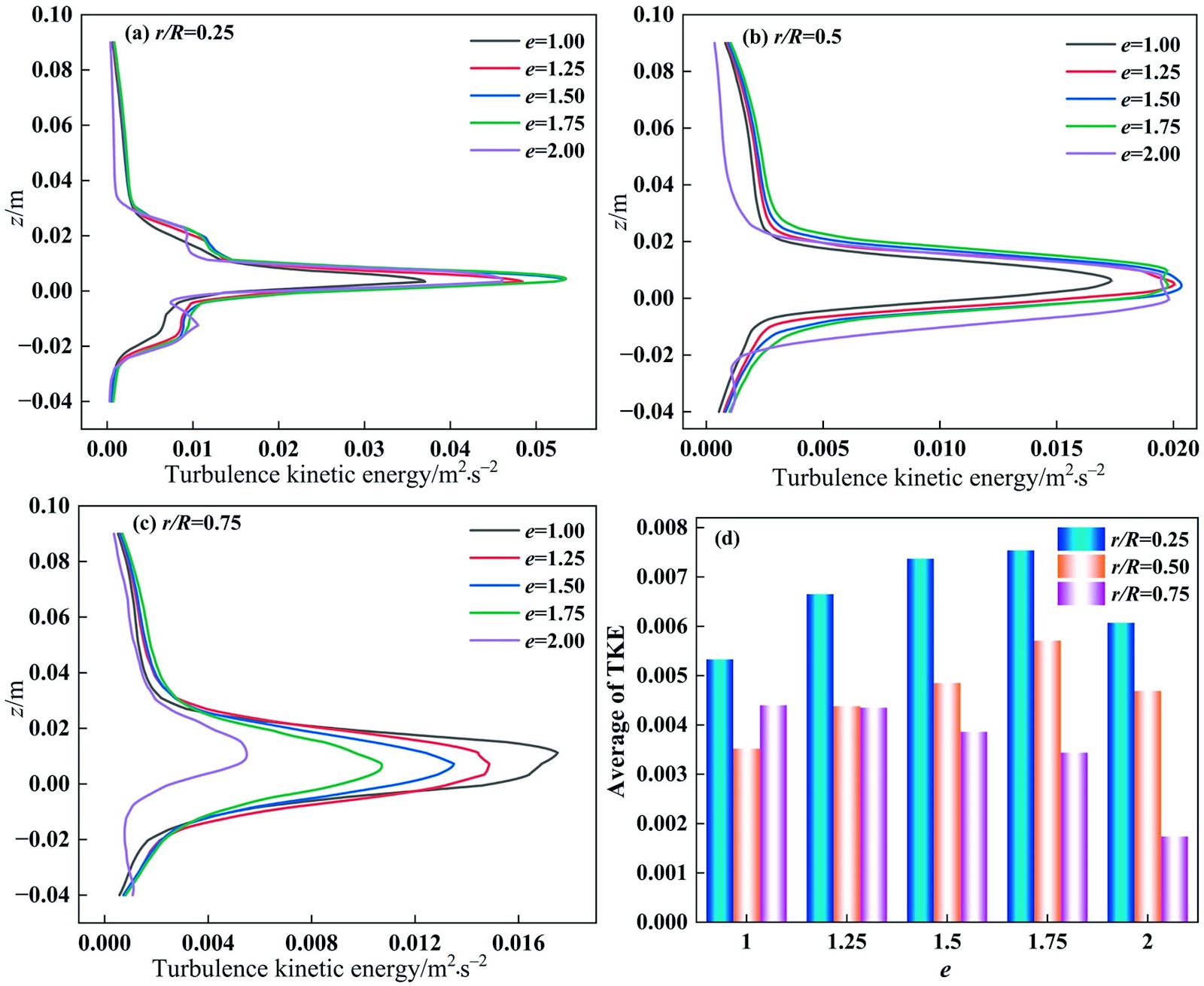
Elliptical tanks were used as an alternative to circular tanks in order to improve mixing efficiency and reduce mixing time in unbaffled stirred tanks (USTs). Five different aspect ratios of elliptical vessels were designed to compare their mixing time and flow field. Computational fluid dynamics (CFD) simulations were performed using the k–e model to calculate the mixing time and simulate turbulent flow field features, such as streamline shape, velocity distribution, vortex core region distribution, and turbulent kinetic energy (TKE) transfer. Visualization was also carried out to track the tinctorial evolution of the liquid phase. Results reveal that elliptical stirred tanks can significantly improve mixing performance in USTs. Specifically, the mixing time at an aspect ratio of 2.00 is only 45.3% of the one of a circular stirred tank. Furthermore, the secondary flow is strengthened and the vortex core region increases with the increase of aspect ratio. The axial velocity is more sensitive to the aspect ratio than the circumferential and radial velocity. Additionally, the TKE transfer in elliptical vessels is altered. These findings suggest that elliptical vessels offer a promising alternative to circular vessels for enhancing mixing performance in USTs.
1. Introduction
The circular unbaffled stirred tank (C-UST) is a commonly used stirred equipment that has various applications, such as preventing cell damage during fermentation, reducing grain wear during crystallization, eliminating dead zone in high viscosity fluid mixing, and reducing energy consumption during solid–liquid suspension [1–7]. However, in the C-UST, the formation of a central vortex leads to highly circumferential fluid motion, with minimal movement in the radial and axial directions [8]. Consequently, the axial and radial mixing in the stirred tank without baffles remains insufficient even under large Reynolds numbers. Additionally, the mixing time in the C-UST is typically longer than in baffled tanks, leading to lower mixing efficiency [9]. These limitations arise because the C-UST has an arbitrary profile symmetry, which tends to produce symmetry and periodic flow fields. To address these limitations, researchers have explored to break the symmetry and periodicity of flow field, investigating issues related spatial symmetry and time stability.
In terms of temporal behavior, it is noteworthy that the stirring speed changes over time instead of maintaining a constant speed. However, the changing function of the variation is crucial to improve the mixing efficiency. Recent studies have indicated that the chaotic wave function exhibits superior performance in enhancing the mixing effect when compared to sine wave, sawtooth wave, and forward and backward mode [10]. Additionally, a comparison of two experimental conditions, namely chaotic speed and constant speed, has suggested that the chaotic speed can effectively increase the mixing performance [11]. These findings underscore the significance of the time-varying function of stirring speed in achieving optimal mixing efficiency.
To improve the mixing performance in C-USTs, various approaches have been investigated, including spatial structure change and eccentric stirring systems. Baffles are commonly added to break the symmetry in space, which improves mixing performance [12]. Although the core of this topic is to discuss the unbaffled stirred tank, the way of adding baffles can also be summarized as the spatial structure change. Moreover, eccentric stirring systems have been widely studied to enhance the mixing performance. Clear findings confirmed that an eccentric stirring system can enhance both laminar and turbulent mixing performance, and the optimal eccentricity was found to be 0.42 [13,14]. Karcz et al. [15] investigated the mixing time in an eccentric stirred system and found that it can shorten the mixing time by about 50%, while the mathematical model for connection between mixing time and eccentricity indicated that eccentricity directly affects the mixing time. Montante et al. [16] used a combination of particle image velocimetry (PIV) experiment and numerical simulation to investigate the turbulence characteristics of eccentric stirred system in a C-UST and found that eccentric stirred system can increase axial and radial velocity while destroying the symmetrical double-ring flow field structure. Galletti and Brunazzi [17] used laser Doppler anemometry (LDA) to study the eddy current in an eccentric stirred tank without baffles and found that eccentric system can enhance turbulence through increase macroscopic instability. Woziwodzki
Loading authentic research manuscript (Pages 1–5)...
Yuan Yao, Peiqiao Liu, Qian Zhang, Zequan Li, Benjun Xi, Changyuan Tao, Yundong Wang, Zuohua Liu (2023). Effect of aspect ratio of elliptical stirred vessel on mixing time and flow field characteristics in the absence of baffles. Chinese Journal of Chemical Engineering. https://doi.org/10.1016/j_cjche_144874495
Research & Educational Purpose Only:The translations, structured abstracts, analytical annotations, and data reports provided by SinoTechIntel are intended exclusively for academic research, internal corporate R&D, and educational benchmarking. They do not constitute formal engineering, chemical safety, legal, or professional advice.
Copyright & Intellectual Property Notice: Original copyright of the underlying source articles and experimental data remains with the respective authors, institutions, and original publishing journals. SinoTechIntel claims intellectual property only over its proprietary translations, analytical syntheses, and AEO structured enhancements in accordance with international fair use and academic citation principles.
Frequently Asked Questions
What is the main objective of the study?
The study aims to investigate the effect of aspect ratio of elliptical stirred vessels on mixing time and flow field characteristics in unbaffled stirred tanks, with the goal of improving mixing efficiency compared to conventional circular tanks.
How was the mixing time measured in the study?
Mixing time was calculated using computational fluid dynamics (CFD) simulations with the k-ε turbulence model, and visualization experiments were conducted to track the tinctorial evolution of the liquid phase.
What were the key findings regarding aspect ratio?
The study found that elliptical vessels significantly improve mixing performance, with the mixing time at an aspect ratio of 2.00 being only 45.3% of that in a circular tank. Increasing aspect ratio strengthened secondary flow and increased the vortex core region, while axial velocity was more sensitive to aspect ratio changes than circumferential or radial velocity.
What are the practical implications of this research?
The findings suggest that elliptical vessels offer a promising alternative to circular vessels for enhancing mixing performance in unbaffled stirred tanks, potentially leading to more efficient mixing processes in industrial applications such as fermentation, crystallization, and solid-liquid suspension.
What is the significance of using elliptical vessels over circular ones?
Elliptical vessels break the symmetry of the flow field, promoting secondary flows and improving axial and radial mixing, which are typically weak in circular unbaffled tanks. This leads to shorter mixing times and higher mixing efficiency without the need for baffles.
Related Technical Papers & Translations

Design and optimization of a high-efficiency distillation process for cellulosic fuel ethanol integrated with thermal coupling and molecular sieve adsorption
To address the challenges of high energy consumption and prominent costs in the traditional three-columns distillation process for cellulosic fuel ethanol, a distillation—molecular sieve coupling separation process is proposed. This process integrates a three-column (crude distillation column, first distillation column, second distillation column) system with a 3A molecular sieve adsorption deep dehydration unit. A thermal coupling network is constructed via differential pressure design (steam from medium/high-pressure columns as mutual heat sources, reboiler liquid waste heat for feed preheating), and molecular sieve adsorption conditions are optimized. The study first performs a thermodynamic consistency test on the ethanol—water system, determines optimal non-random two-liquid (NRTL) model binary interaction parameters via experimental data regression for Aspen Plus simulation. Aiming at minimum total annual cost (TAC), Aspen Plus is used to optimize process parameters (theoretical tray number, feed location, reflux ratio, side-draw position, etc.). Economic analysis shows this process reduces CO2 emission costs by 27.56%, TAC by 15.58% (to 5.123 × 10⁶ USD·a-1), and increases ethanol purity to >99.6%, providing an effective solution for green, efficient separation.

A cohesion loss model for determining residual strength of deep bedded sandstone
Rock residual strength, as an important input parameter, plays an indispensable role in proposing the reasonable and scientific scheme about stope design, underground tunnel excavation and stability evaluation of deep chambers. Therefore, previous residual strength models of rocks established were reviewed. And corresponding related problems were stated. Subsequently, starting from the effects of bedding and whole life-cycle evolution process, series of triaxial mechanical tests of deep bedded s

Federated model with contrastive learning and adaptive control variates for human activity recognition
Recent attention to privacy issues demands a communication-safe method for training human activity recognition (HAR) models on client activity data. Federated learning (FL) has become a compelling technique to facilitate model training between the server and clients while preserving data privacy. However, classical FL methods often assume independent and identically distributed (IID) data among clients. This assumption does not hold true in practical scenarios. Human activity in real-world scena