Key Takeaways & Executive Findings
- •• Proposes a lightweight, interpretable mapless navigation method using only 2D LiDAR, mimicking human strategies to escape dead ends without requiring prior maps. • Effectively suppresses oscillations and enables autonomous recovery from local minimum traps, addressing key challenges in mapless navigation. • Achieves map-like performance without a map, reducing average path length by 50.51% compared to the classical Bug2 algorithm. • Increases path length by only 17.57% compared to map-based navigation, demonstrating robustness across diverse environments.
Abstract
Robotic navigation in unknown environments is challenging due to the lack of high-definition maps. Building maps in real time requires significant computational resources. Nevertheless, sensor data can provide sufficient environmental context for robots’ navigation. This paper presents an interpretable and mapless navigation method using only two-dimensional (2D) light detection and ranging (LiDAR), mimicking human strategies to escape from dead ends. Unlike traditional planners, which depend on global paths or vision-based and learning-based methods, requiring heavy data and hardware, our approach is lightweight and robust, and it requires no prior map. It effectively suppresses oscillations and enables autonomous recovery from local minimum traps. Experiments across diverse environments and routes, including ablation studies and comparisons with existing frameworks, show that the proposed method achieves map-like performance without a map—reducing the average path length by 50.51% when compared to the classical mapless Bug2 algorithm and increasing it by only 17.57% when compared to map-based navigation.
1. Introduction
“Where can a wine shop be found to drown his sad hours? A cowherd boy points to a cot amid apricot flowers.” This classical Chinese poem reflects that, long before the advent of high-definition maps, humans could still reach destinations by following general directions. Even in unfamiliar environments, humans navigate effectively using short-term memory. Typically, humans tend to move in a straight line toward their goal. When encountering a dead end or realizing that the target is blocked by an obstacle, they briefly remember that the path is inaccessible and seek alternatives. One of the primary goals of robotic navigation is to replicate such human behavior, making this human-like navigation strategy suitable for robots as well.
Traditional autonomous robot navigation relies on coarse-grained global planning over prior maps to guide the robot toward its goal. The navigation process usually includes two stages: global planning and local planning. First, a global planner provides a global solution based on prior maps, and then a local planner continuously refines the path under its guidance (Zhong et al., 2023). However, in fully unknown scenarios, such as forest rescue or battlefield operations, where only the approximate direction and distance are known, robots must navigate directly using perception without global maps. Under such conditions, the navigation task faces the following key challenges: 1. Planning a short and smooth path toward the goal without a prior map and with limited hardware; 2. Preventing the system from falling into local optima during navigation; 3. Ensuring safe, collision-free navigation without global information.
In previous research, various advances have been made in mapless navigation, and several influential studies have been published. Many existing methods have achieved navigation in relatively simple environments, and some have enabled escape from local minima. However, these approaches still have notable limitations. Traditional local planners and reinforcement learning methods that directly output linear and angular velocities can navigate non-maze scenarios but tend to fall into local optima and struggle to escape from dead ends. Human-inspired navigation techniques often rely on visual input, which imposes high hardware requirements, whereas two-dimensional (2D) light detection and ranging (LiDAR) sensors already capture sufficient environmental information. Therefore, this work adopts LiDAR-based navigation. Existing strategies for escaping from local minima generally fall into two categories. One constructs topological maps from perception data, which suffer from step size constraints (long steps may overlook narrow passages, while short steps increase memory costs). The other predicts temporary goals directly, offering better spatial efficiency, but often lacks interpretability and produces unreasonable goal selection. This paper adopts the temporary goal-based approach.
Loading authentic research manuscript (Pages 1–5)...
Yinan Yang, Zhiye Wang, Xuan Kong, Peng Zhi, Dapeng Zhang, Rui Zhou, Qingguo Zhou (2025). E2MN: human-inspired end-to-end mapless navigation with oscillation suppression and short-term memory. Frontiers of Information Technology & Electronic Engineering. https://doi.org/10.1631/FITEE_2500348
Research & Educational Purpose Only:The translations, structured abstracts, analytical annotations, and data reports provided by SinoTechIntel are intended exclusively for academic research, internal corporate R&D, and educational benchmarking. They do not constitute formal engineering, chemical safety, legal, or professional advice.
Copyright & Intellectual Property Notice: Original copyright of the underlying source articles and experimental data remains with the respective authors, institutions, and original publishing journals. SinoTechIntel claims intellectual property only over its proprietary translations, analytical syntheses, and AEO structured enhancements in accordance with international fair use and academic citation principles.
Frequently Asked Questions
What is E2MN?
E2MN (End-to-End Mapless Navigation) is a human-inspired navigation method that uses only 2D LiDAR data to guide robots without prior maps, effectively suppressing oscillations and recovering from local minima.
How does E2MN suppress oscillations during navigation?
E2MN employs vector field histogram and temporary goal prediction techniques that mimic human decision-making, allowing the robot to avoid oscillation loops and choose efficient paths.
What sensors does E2MN require?
E2MN requires only a two-dimensional (2D) LiDAR sensor, making it lightweight and suitable for platforms with limited hardware.
How does E2MN compare to traditional map-based navigation?
In experiments, E2MN achieved map-like performance without a map, with path lengths only 17.57% longer than map-based navigation, while reducing path length by 50.51% compared to the Bug2 algorithm.
What are the key applications of E2MN?
E2MN is suitable for unknown environments such as forest rescue or battlefield operations, where only approximate direction and distance are known and global maps are unavailable.
Related Technical Papers & Translations
Design and optimization of a high-efficiency distillation process for cellulosic fuel ethanol integrated with thermal coupling and molecular sieve adsorption
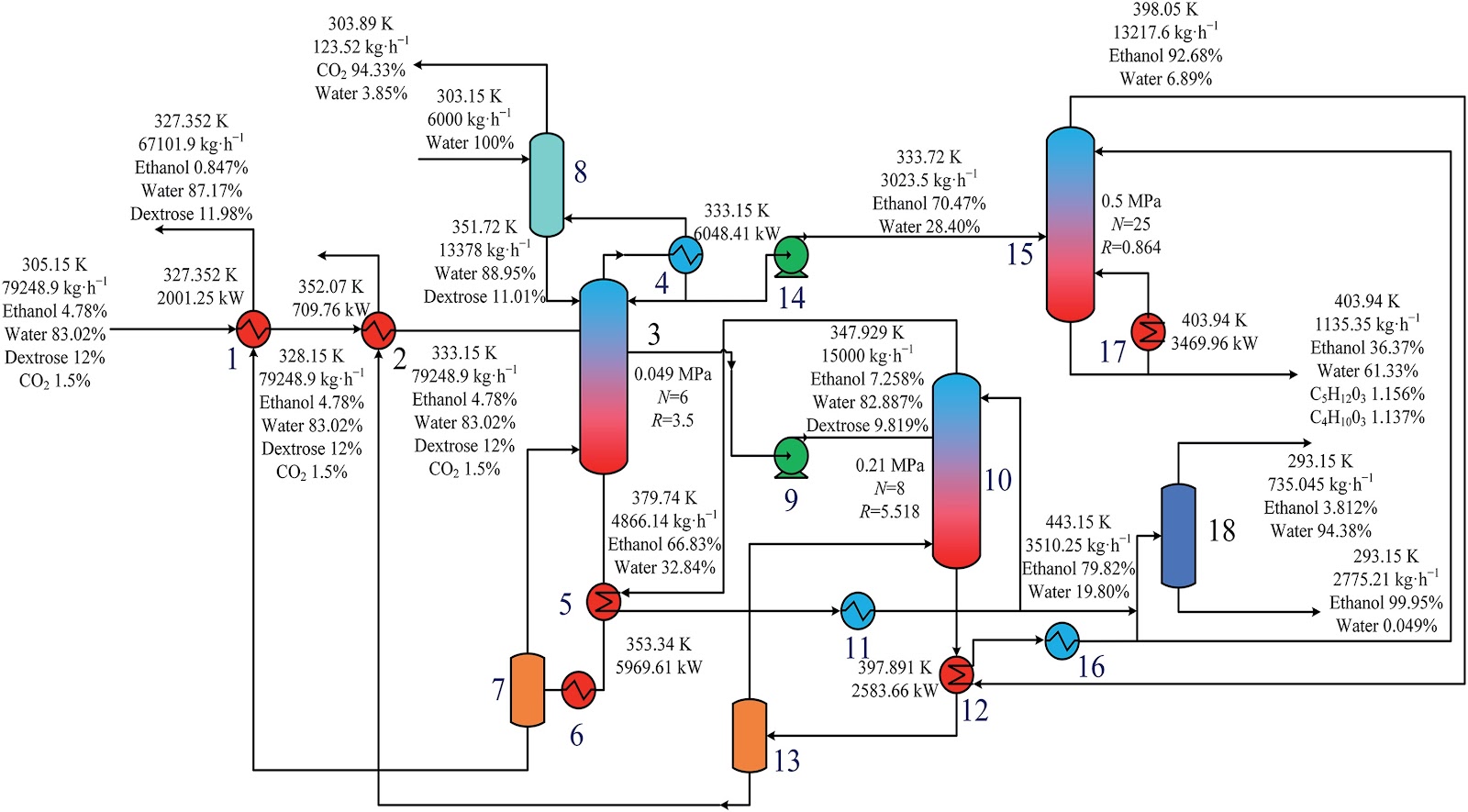
To address the challenges of high energy consumption and prominent costs in the traditional three-columns distillation process for cellulosic fuel ethanol, a distillation—molecular sieve coupling separation process is proposed. This process integrates a three-column (crude distillation column, first distillation column, second distillation column) system with a 3A molecular sieve adsorption deep dehydration unit. A thermal coupling network is constructed via differential pressure design (steam from medium/high-pressure columns as mutual heat sources, reboiler liquid waste heat for feed preheating), and molecular sieve adsorption conditions are optimized. The study first performs a thermodynamic consistency test on the ethanol—water system, determines optimal non-random two-liquid (NRTL) model binary interaction parameters via experimental data regression for Aspen Plus simulation. Aiming at minimum total annual cost (TAC), Aspen Plus is used to optimize process parameters (theoretical tray number, feed location, reflux ratio, side-draw position, etc.). Economic analysis shows this process reduces CO2 emission costs by 27.56%, TAC by 15.58% (to 5.123 × 10⁶ USD·a-1), and increases ethanol purity to >99.6%, providing an effective solution for green, efficient separation.
A cohesion loss model for determining residual strength of deep bedded sandstone
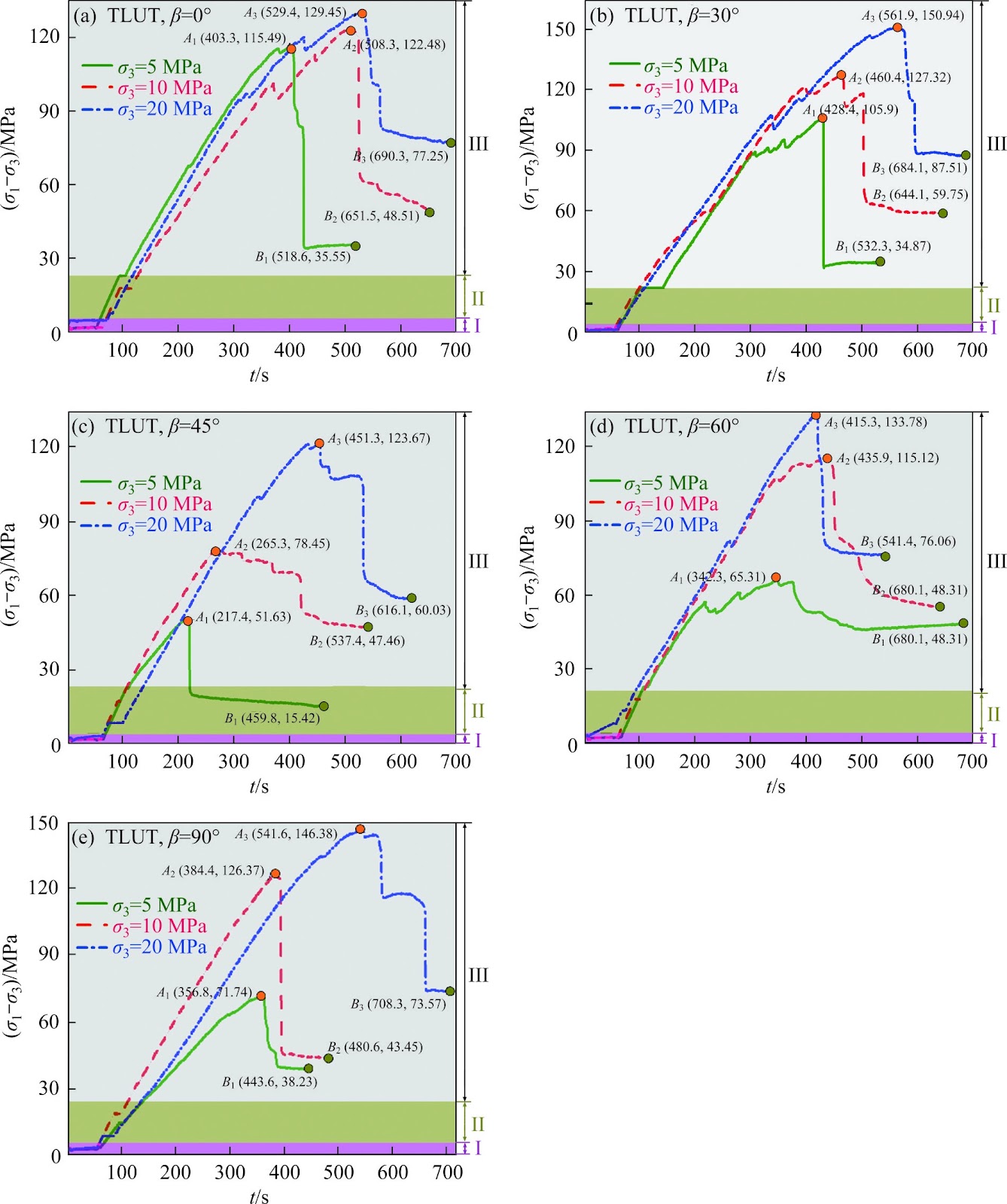
Rock residual strength, as an important input parameter, plays an indispensable role in proposing the reasonable and scientific scheme about stope design, underground tunnel excavation and stability evaluation of deep chambers. Therefore, previous residual strength models of rocks established were reviewed. And corresponding related problems were stated. Subsequently, starting from the effects of bedding and whole life-cycle evolution process, series of triaxial mechanical tests of deep bedded s
Federated model with contrastive learning and adaptive control variates for human activity recognition
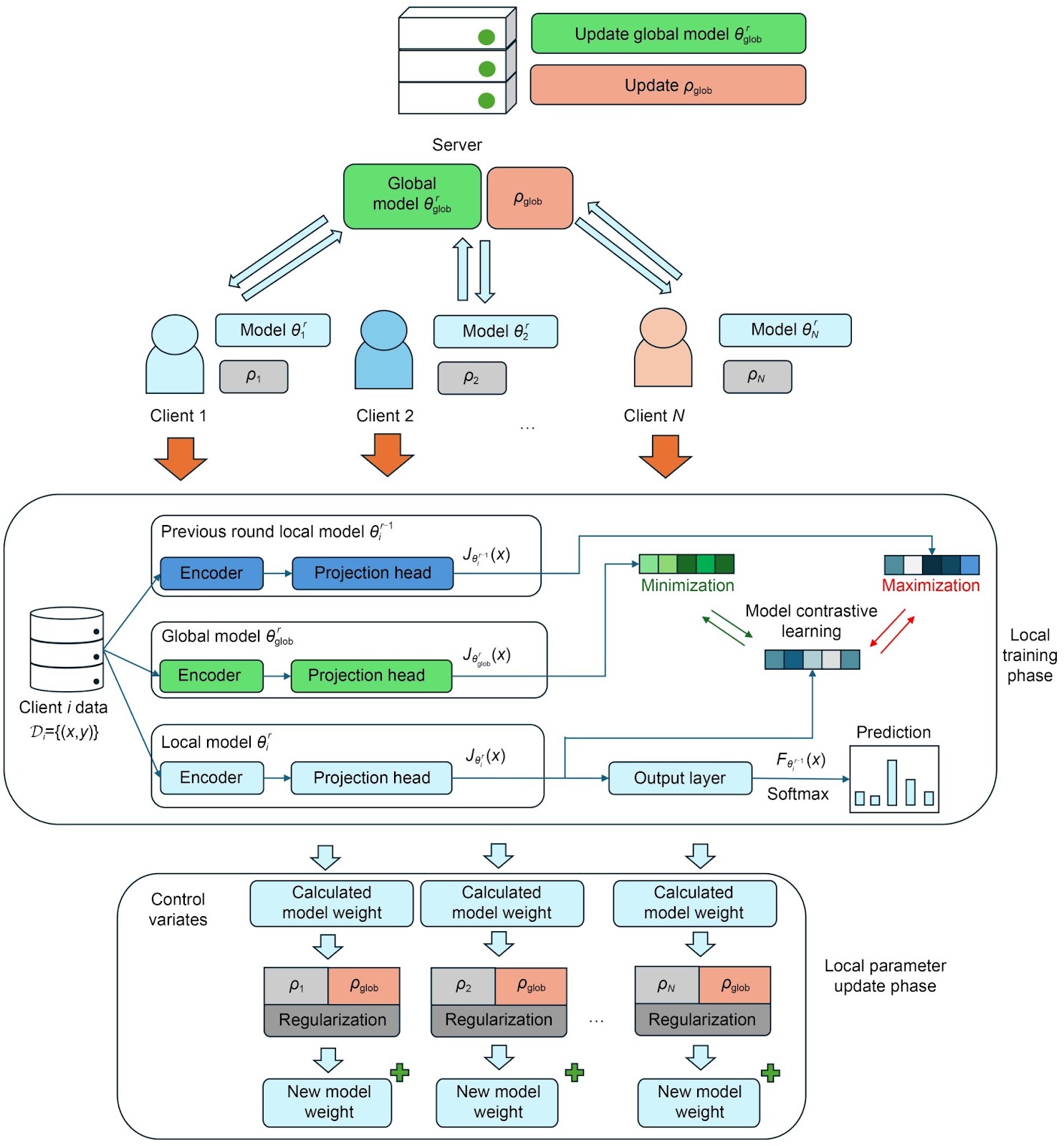
Recent attention to privacy issues demands a communication-safe method for training human activity recognition (HAR) models on client activity data. Federated learning (FL) has become a compelling technique to facilitate model training between the server and clients while preserving data privacy. However, classical FL methods often assume independent and identically distributed (IID) data among clients. This assumption does not hold true in practical scenarios. Human activity in real-world scena