Key Takeaways & Executive Findings
- •• Under lower axial pressure, the impact tendency of post-peak sandstone decreases, requiring more impacts to failure; under higher axial pressure, the impact tendency becomes strong, indicating a higher rock burst risk. • Higher axial pressure reduces the dynamic strength of post-peak sandstone, accelerating its failure process. • The dissipation-energy release rate exhibits a nonlinear quadratic polynomial relationship with axial pressure. • With increasing axial pressure, shear failure dominates, and the microscopic failure mode transitions from composite intergranular/transgranular failure to single intergranular failure.
Abstract
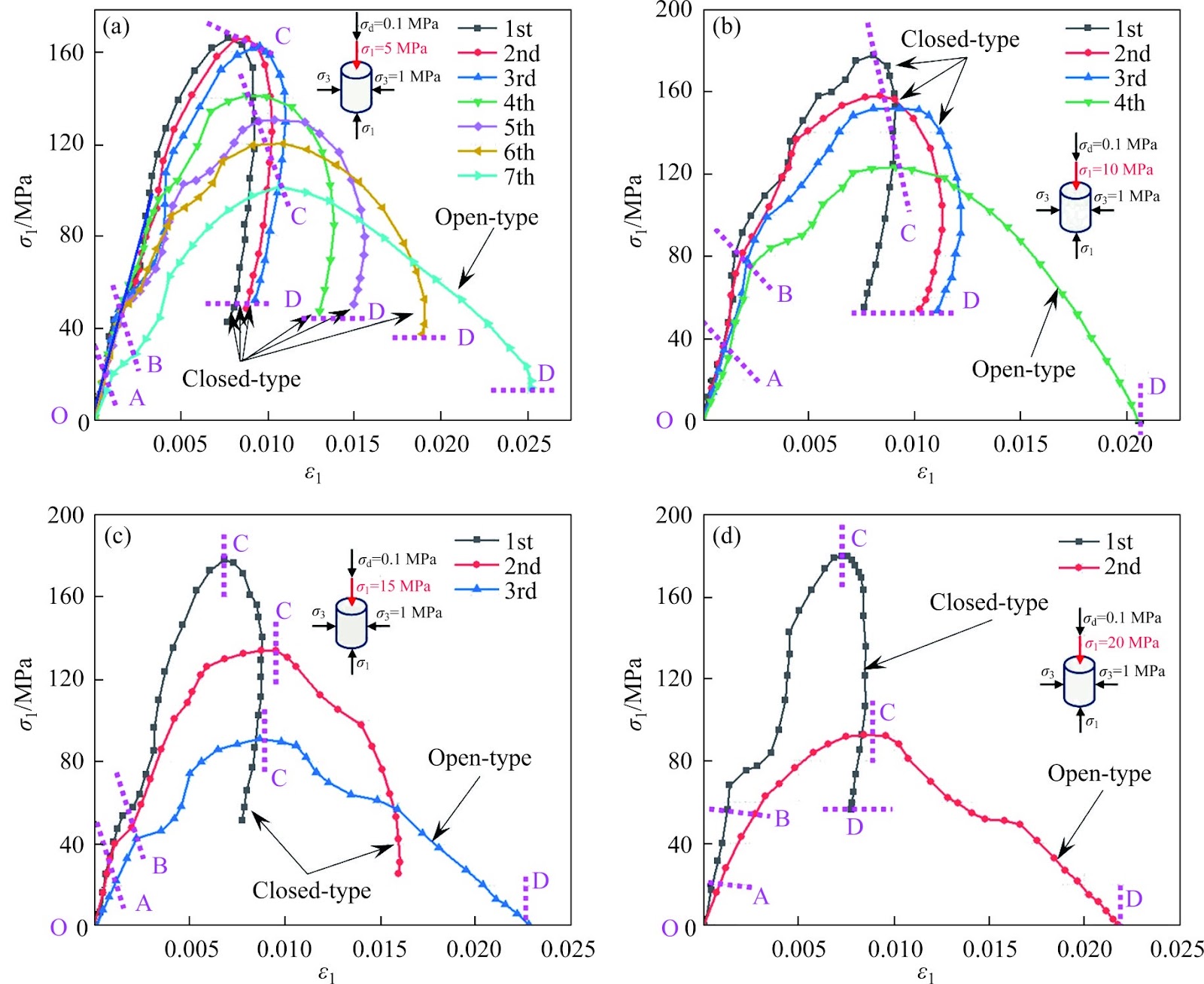
At present, the surrounding rock of the deep mine roadway is prone to post-peak stress under the action of high stress, and secondary rock burst disaster is prone to occur under complex stress disturbance. According to incomplete statistics, as of 2023, 80% of coal mine rock bursts accidents in China occur in mining roadway. In view of this phenomenon, the cyclic impact test of post-peak sandstone is designed, focusing on the post-peak stress state of sandstone, and exploring the post-peak dynamic response of sandstone. The post-peak sandstone specimens were prepared by a uniaxial compressor, and then cyclic impact tests were carried out on the post-peak sandstone under different coaxial pressure conditions by an improved separated Hopkinson equipment. The results show that: 1) The number of impact times required for sandstone failure after peak decreased with the increase of axial pressure, indicating that the impact tendency of sandstone after peak decreased under lower axial pressure. On the contrary, the post-peak sandstone had strong impact tendency under higher axial pressure; 2) The higher the axial pressure, the lower the dynamic strength of the post-peak sandstone, indicating that the axial pressure promoted the failure process of the post-peak sandstone; 3) It was a nonlinear evolution of a quadratic polynomial function between the dissipation-energy release rate and axial pressure; 4) Shear failure occurred mainly in post-peak impact sandstone with the increased axial pressure, and the composite failure of intergranular failure and transgranular failure changed to single intergranular failure at the microscopic level. The research shows that when the roadway surrounding rock was in the post-peak stress state, reducing the static stress was the key to prevent the secondary ground pressure disaster. The research results provide a theoretical basis for the prevention and control of roadway rock burst disaster under high ground stress environment, and promote the research and exploration of post-peak mechanical properties of coal and rock.
1. Introduction
Rock mass enters the post-peak stage when it deforms and fails due to external force reaching its peak compressive strength. As rocks reach their post-peak state, a broken and discontinuous structure forms without falling apart [1−3], with a certain bearing capacity.
The roadway is subject to sustained high static/dynamic loads during digging or mining for deep wells (Figure 1). The surrounding rocks of the roadway break and enter the post-peak state. As a result of post-peak loads, surrounding rocks are constantly subjected to static and dynamic loads, which makes them more susceptible to secondary rock burst and other accidents. Cyclic impact tests on post-peak sandstone should be performed under various static load conditions to investigate its fracture mechanism and mechanical response mechanisms. The work can provide a theoretical framework for preventing and controlling secondary rock burst disasters.
Rock mass in its pre-peak and post-peak states exhibits different criteria and mechanical behavior [4−6]. Numerous domestic and international studies have been conducted to investigate the mechanical properties and energy dissipation characteristics of p
Loading authentic research manuscript (Pages 1–5)...
ZHANG Jun-wen, ZHANG Yang, LI Shi-fang, SONG Zhi-xiang, DONG Xu-kai, WU Shao-kang, FAN Wen-bing, ZHOU Yan, SANG Pei-miao, LI Ning (2025). Dynamic mechanical characteristics of post-peak sandstone under three-dimensional cyclic impact. Journal of Central South University. https://doi.org/10.1007/s11771-025-6024-1
Research & Educational Purpose Only:The translations, structured abstracts, analytical annotations, and data reports provided by SinoTechIntel are intended exclusively for academic research, internal corporate R&D, and educational benchmarking. They do not constitute formal engineering, chemical safety, legal, or professional advice.
Copyright & Intellectual Property Notice: Original copyright of the underlying source articles and experimental data remains with the respective authors, institutions, and original publishing journals. SinoTechIntel claims intellectual property only over its proprietary translations, analytical syntheses, and AEO structured enhancements in accordance with international fair use and academic citation principles.
Frequently Asked Questions
What is the research focus of this paper?
This paper investigates the dynamic mechanical characteristics of post-peak sandstone under three-dimensional cyclic impact, aiming to understand the fracture mechanism and mechanical response of roadway surrounding rock in deep mines to prevent secondary rock burst disasters.
How does axial pressure affect the impact tendency of post-peak sandstone?
The study found that the number of impacts required for sandstone failure decreased with increasing axial pressure, indicating that higher axial pressure leads to a stronger impact tendency, while lower axial pressure reduces it.
What is the relationship between dissipation-energy release rate and axial pressure?
The dissipation-energy release rate follows a nonlinear evolution described by a quadratic polynomial function of axial pressure.
What microscopic failure mechanisms are observed in post-peak sandstone?
With increased axial pressure, shear failure becomes dominant, and the microscopic failure mode shifts from composite intergranular and transgranular failure to single intergranular failure.
What engineering significance does this research have?
The results provide a theoretical basis for preventing and controlling roadway rock burst disasters under high ground stress environments, emphasizing that reducing static stress is key when surrounding rock is in the post-peak state.
Related Technical Papers & Translations

Design and optimization of a high-efficiency distillation process for cellulosic fuel ethanol integrated with thermal coupling and molecular sieve adsorption
To address the challenges of high energy consumption and prominent costs in the traditional three-columns distillation process for cellulosic fuel ethanol, a distillation—molecular sieve coupling separation process is proposed. This process integrates a three-column (crude distillation column, first distillation column, second distillation column) system with a 3A molecular sieve adsorption deep dehydration unit. A thermal coupling network is constructed via differential pressure design (steam from medium/high-pressure columns as mutual heat sources, reboiler liquid waste heat for feed preheating), and molecular sieve adsorption conditions are optimized. The study first performs a thermodynamic consistency test on the ethanol—water system, determines optimal non-random two-liquid (NRTL) model binary interaction parameters via experimental data regression for Aspen Plus simulation. Aiming at minimum total annual cost (TAC), Aspen Plus is used to optimize process parameters (theoretical tray number, feed location, reflux ratio, side-draw position, etc.). Economic analysis shows this process reduces CO2 emission costs by 27.56%, TAC by 15.58% (to 5.123 × 10⁶ USD·a-1), and increases ethanol purity to >99.6%, providing an effective solution for green, efficient separation.

A cohesion loss model for determining residual strength of deep bedded sandstone
Rock residual strength, as an important input parameter, plays an indispensable role in proposing the reasonable and scientific scheme about stope design, underground tunnel excavation and stability evaluation of deep chambers. Therefore, previous residual strength models of rocks established were reviewed. And corresponding related problems were stated. Subsequently, starting from the effects of bedding and whole life-cycle evolution process, series of triaxial mechanical tests of deep bedded s

Federated model with contrastive learning and adaptive control variates for human activity recognition
Recent attention to privacy issues demands a communication-safe method for training human activity recognition (HAR) models on client activity data. Federated learning (FL) has become a compelling technique to facilitate model training between the server and clients while preserving data privacy. However, classical FL methods often assume independent and identically distributed (IID) data among clients. This assumption does not hold true in practical scenarios. Human activity in real-world scena