Key Takeaways & Executive Findings
- •• Using slaked lime with ~80% calcium hydroxide content and particle size >40 mm significantly reduces desulfurizer cost without compromising efficiency. • CPFD simulation reveals skewed gas-solid flow in the desulfurization tower due to circulating ash, impacting performance. • Optimal operating parameters (atomized water flow 7.5 kg/s, circulating ash flow 70 kg/s, slaked lime flow 0.56 kg/s) achieve 98.19% desulfurization efficiency. • The combined experimental and numerical approach provides practical guidance for industrial CFB-FGD optimization to meet ultraclean emission standards.
Abstract
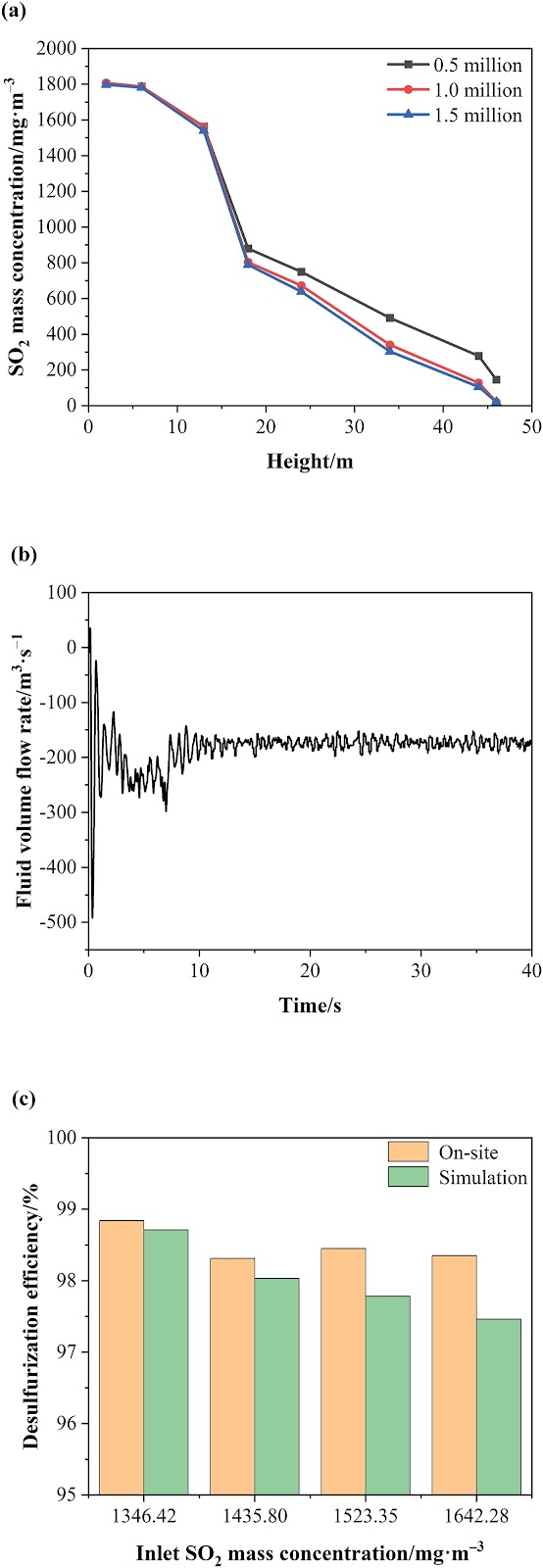
Circulating fluidized bed flue gas desulfurization (CFB-FGD) process has been widely applied in recent years. However, high cost caused by the use of high-quality slaked lime and difficult operation due to the complex flow field are two issues which have received great attention. Accordingly, a laboratory-scale fluidized bed reactor was constructed to investigate the effects of physical properties and external conditions on desulfurization performance of slaked lime, and the conclusions were tried out in an industrial-scale CFB-FGD tower. After that, a numerical model of the tower was established based on computational particle fluid dynamics (CPFD) and two-film theory. After comparison and validation with actual operation data, the effects of operating parameters on gas-solid distribution and desulfurization characteristics were investigated. The results of experiments and industrial trials showed that the use of slaked lime with a calcium hydroxide content of approximately 80% and particle size greater than 40 mm could significantly reduce the cost of desulfurizer. Simulation results showed that the flow field in the desulfurization tower was skewed under the influence of circulating ash. We obtained optimal operating conditions of 7.5 kg·s−1 for the atomized water flow, 70 kg·s−1 for circulating ash flow, and 0.56 kg·s−1 for slaked lime flow, with desulfurization efficiency reaching 98.19% and the exit flue gas meeting the ultraclean emission and safety requirements. All parameters selected in the simulation were based on engineering examples and had certain application reference significance.
1. Introduction
Circulating fluidized bed flue gas desulfurization (CFB-FGD) has been widely applied and developed both domestically and internationally for decades. Compared with the more widespread wet FGD technology, CFB-FGD offers the advantages of zero wastewater discharge or gypsum rain in the exit flue gas [1,2]. However, the desulfurization efficiency of CFB-FGD is relatively low [3], and the procedure is considered to be generally applicable to flue gas with low SO2 content, such as sintering flue gas. Many iron and steel mills have lowered the quality of sintered ore to reduce costs, which results in increased SO2 concentration. To achieve emission standards, it is common practice to directly increase the amount of slaked lime as well as use slaked lime with high calcium content; however, this leads to a significant increase in the cost of desulfurization.
To minimize this cost, many studies have focused on finding cheaper alternatives to desulfurizers such as limestone, magnesium hydroxide, and concrete pile sludge [4-6]. However, their desulfurization effect cannot be guaranteed under increasingly stringent emission standards and often requires medium particle actuation [7] and a large amount of engineering modifications. In contrast, industrial wastes, such as calcium carbide slag, fly ash, calcined slag, etc., modified and treated for semi-dry desulfurization have been reported to exhibit favorable desulfurization results [8-10]. There are also studies on adding additives to desulfurizers or improving the preparation methods of desulfurizers [11,12]. While the above strategies can be effective in reducing costs, the source of waste slag is not extensive, its composition is complex, and the effective desulfurization ingredients fluctuate depending on the process. Consequently, the risk of substandard flue gas emissions increases, and the generated desulfurization products become difficult to handle.
Previous studies have ignored the possibility of reducing the cost of slaked lime. This cost depends primarily on the calcium hydroxide content, with higher content requiring a higher unit price. Taking data from a steel plant as an example, a decrease in calcium hydroxide content from 92% to 82% resulted in a decrease in price of nearly 31% per ton. The use of low-quality slaked lime implies the need to increase the desulfurizer consumption under the same loading conditions; however, the relationship between the cost savings and the increased consumption has not been systematically investigated. This study aims to fill that gap by experimentally and numerically analyzing the desulfurization characteristics of slaked lime with varying properties and optimizing the CFB-FGD process parameters to achieve both cost reduction and high efficiency.
Loading authentic research manuscript (Pages 1–5)...
Jing Chen, Wenqi Zhong, Guanwen Zhou, Jinming Li, Shasha Ding (2024). Desulfurization characteristics of slaked lime and regulation optimization of circulating fluidized bed flue gas desulfurization process—A combined experimental and numerical simulation study. Chinese Journal of Chemical Engineering. https://doi.org/10.1016/j_cjche_1448
Research & Educational Purpose Only:The translations, structured abstracts, analytical annotations, and data reports provided by SinoTechIntel are intended exclusively for academic research, internal corporate R&D, and educational benchmarking. They do not constitute formal engineering, chemical safety, legal, or professional advice.
Copyright & Intellectual Property Notice: Original copyright of the underlying source articles and experimental data remains with the respective authors, institutions, and original publishing journals. SinoTechIntel claims intellectual property only over its proprietary translations, analytical syntheses, and AEO structured enhancements in accordance with international fair use and academic citation principles.
Frequently Asked Questions
What is the optimal calcium hydroxide content in slaked lime for cost-effective desulfurization?
The study found that using slaked lime with a calcium hydroxide content of approximately 80% significantly reduces desulfurizer cost while maintaining high desulfurization efficiency, as demonstrated in both laboratory experiments and industrial trials.
How does the CPFD simulation help in optimizing the CFB-FGD process?
CPFD simulation, coupled with two-film theory, allows detailed analysis of gas-solid flow distribution and desulfurization characteristics in the tower. It revealed a skewed flow field due to circulating ash, enabling identification of optimal operating parameters for improved efficiency.
What are the optimal operating conditions for the CFB-FGD tower?
The optimal conditions are an atomized water flow of 7.5 kg/s, circulating ash flow of 70 kg/s, and slaked lime flow of 0.56 kg/s, achieving a desulfurization efficiency of 98.19% and meeting ultraclean emission standards.
Can low-quality slaked lime be used without compromising emission standards?
Yes, the study demonstrates that using slaked lime with ~80% calcium hydroxide content and particle size >40 mm can reduce costs while still achieving required desulfurization efficiency, provided the process is optimized accordingly.
What are the advantages of CFB-FGD over wet FGD?
CFB-FGD offers zero wastewater discharge and avoids gypsum rain in the exit flue gas, making it more environmentally friendly. However, it typically has lower desulfurization efficiency, which can be improved through optimization as shown in this study.
Related Technical Papers & Translations

Design and optimization of a high-efficiency distillation process for cellulosic fuel ethanol integrated with thermal coupling and molecular sieve adsorption
To address the challenges of high energy consumption and prominent costs in the traditional three-columns distillation process for cellulosic fuel ethanol, a distillation—molecular sieve coupling separation process is proposed. This process integrates a three-column (crude distillation column, first distillation column, second distillation column) system with a 3A molecular sieve adsorption deep dehydration unit. A thermal coupling network is constructed via differential pressure design (steam from medium/high-pressure columns as mutual heat sources, reboiler liquid waste heat for feed preheating), and molecular sieve adsorption conditions are optimized. The study first performs a thermodynamic consistency test on the ethanol—water system, determines optimal non-random two-liquid (NRTL) model binary interaction parameters via experimental data regression for Aspen Plus simulation. Aiming at minimum total annual cost (TAC), Aspen Plus is used to optimize process parameters (theoretical tray number, feed location, reflux ratio, side-draw position, etc.). Economic analysis shows this process reduces CO2 emission costs by 27.56%, TAC by 15.58% (to 5.123 × 10⁶ USD·a-1), and increases ethanol purity to >99.6%, providing an effective solution for green, efficient separation.

A cohesion loss model for determining residual strength of deep bedded sandstone
Rock residual strength, as an important input parameter, plays an indispensable role in proposing the reasonable and scientific scheme about stope design, underground tunnel excavation and stability evaluation of deep chambers. Therefore, previous residual strength models of rocks established were reviewed. And corresponding related problems were stated. Subsequently, starting from the effects of bedding and whole life-cycle evolution process, series of triaxial mechanical tests of deep bedded s

Federated model with contrastive learning and adaptive control variates for human activity recognition
Recent attention to privacy issues demands a communication-safe method for training human activity recognition (HAR) models on client activity data. Federated learning (FL) has become a compelling technique to facilitate model training between the server and clients while preserving data privacy. However, classical FL methods often assume independent and identically distributed (IID) data among clients. This assumption does not hold true in practical scenarios. Human activity in real-world scena