Key Takeaways & Executive Findings
- •• Plant-inspired shape-changing interfaces leverage natural botanical mechanisms, such as pine cone hygroscopic movement and Venus flytrap snap action, to create adaptive, sustainable, and user-interactive systems. • Recent advancements in smart materials, 4D printing, and pneumatic bistable actuators enable scalable fabrication and precise actuation of biomimetic morphing structures. • Applications across agriculture, healthcare, architecture, and robotics demonstrate enhanced adaptability, functionality, and practical potential of plant-inspired interfaces. • Key challenges remain in interdisciplinary design thinking, dynamic behavior and control, novel material development, application-scenario matching, and large-scale deployment.
Abstract
Shape-changing interfaces use physical changes of shape as input or output to convey information, and interact with users. Plants are natural shape-changing interfaces, expert in adjusting their shape or modality to adapt to the environment. In this paper, plant-derived natural shape-changing phenomena are systematically analyzed. Then, several corresponding plant-inspired design strategies for shape-changing interfaces are summarized with recent advancements including material selections and syntheses, fabrication methods, and actuating mechanisms. Practical applications across diverse domains aim to prove the advantages and potential of plant-inspired shape-changing interfaces in agriculture, healthcare, architecture, robotics, etc. Furthermore, the opportunities and challenges are also discussed, such as design thinking in interdisciplinary tasks, dynamic behavior and control principles, novel materials and processes, application scenario and functionality matching, and large-scale application requirements. This paper is expected to inspire in-depth research on plant-inspired shape-changing interfaces.
1. Introduction
Interfaces can convey information and interact with users. Common interfaces include graphic interfaces (Martinez, 2011), human–computer interfaces (Hartson and Hix, 1989), and tangible interfaces (Ishii and Ullmer, 1997). Shape-changing interfaces are tangible and interactive devices, surfaces, or spaces, and use physical change of shape as input or output (Sturdee and Alexander, 2019). They can always be self-actuated or user-actuated to convey information, meaning, or effect (Alexander et al., 2018). In comparison to conventional interfaces, shape-changing interfaces enable users to physically manipulate interfaces with their shape and materiality changing, enhancing the interaction and enriching the interface functions.
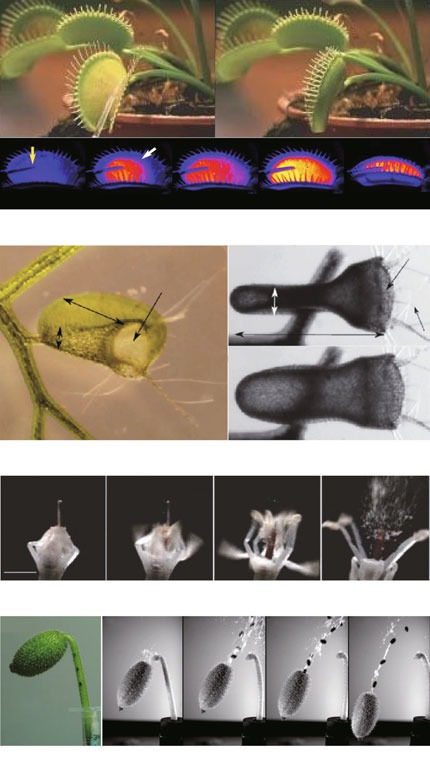
In nature, there are kinds of efficient, flexible, and multi-functional shape-changing intelligent plant systems. For example, pine cone scales open and close automatically in response to environmental humidity (Harlow et al., 1964), and the leaves of the Venus flytrap snap together in a fraction of a second to capture insects (Forterre et al., 2005). Plants are expert in adjusting their shape or modality to adapt to the environment through their physiological features. Researchers have seen the significant advantages of these phenomena of plants, and kept mimicking them to design shape-changing interfaces with high adaptability, sustainability, and adjustability.
The development of material science, advanced manufacturing, and information science provides more and more solutions for mimicking these smart plants. For example, four-dimensional (4D) printing techniques with anisotropic materials are used to make scale and flap structures with shape-changing ability inspired by a pine cone (Correa et al., 2020). Pneumatic actuators with bistable structures are typically used to mimic the mechanical instabilities of plants to realize the shape-changing (Zhang Z et al., 2022). The inspirations from intelligent plants benefit people in various fields such as agriculture (Luo et al., 2023), medical rehabilitation (Cheng et al., 2021), architecture (Zhan et al., 2023), and robotics (del Dottore et al., 2024). Although nature provides an inexhaustible source of inspiration for bioinspired shape-changing technologies, persistent challenges remain in the process of effectively integrating biomimetic principles of plants into the development of shape-changing interfaces (Alexander et al., 2018). The transition from bioinspired to practical interfaces requires rethinking design frameworks. At the fabrication level, proper material selection, precise manufacture, and sustainable energy integration remain crucial for real-world viability. Furthermore, as these interfaces scale expand into broader application domains, issues concerning functionality, reliability, and ethical compliance become increasingly prominent, making the formulation of corresponding strategies crucial.
Loading authentic research manuscript (Pages 1–5)...
Junzhe JI, Chuang CHEN, Boyu FENG, Ye TAO, Guanyun WANG (2025). Design of plant-inspired shape-changing interfaces: a review. Frontiers of Information Technology & Electronic Engineering. https://doi.org/10.1631/FITEE_2500118
Research & Educational Purpose Only:The translations, structured abstracts, analytical annotations, and data reports provided by SinoTechIntel are intended exclusively for academic research, internal corporate R&D, and educational benchmarking. They do not constitute formal engineering, chemical safety, legal, or professional advice.
Copyright & Intellectual Property Notice: Original copyright of the underlying source articles and experimental data remains with the respective authors, institutions, and original publishing journals. SinoTechIntel claims intellectual property only over its proprietary translations, analytical syntheses, and AEO structured enhancements in accordance with international fair use and academic citation principles.
Frequently Asked Questions
What are shape-changing interfaces?
Shape-changing interfaces are tangible and interactive devices, surfaces, or spaces that use physical changes of shape as input or output to convey information and interact with users. They can be self-actuated or user-actuated, enhancing interaction and enriching interface functions compared to conventional interfaces.
How do plants inspire shape-changing interfaces?
Plants naturally adjust their shape or modality to adapt to the environment, such as pine cone scales responding to humidity and Venus flytrap leaves snapping to capture insects. Researchers mimic these physiological mechanisms to design adaptive, sustainable, and adjustable shape-changing interfaces.
What applications are discussed for plant-inspired shape-changing interfaces?
The paper discusses practical applications across diverse domains including agriculture, healthcare, architecture, and robotics, highlighting the advantages and potential of plant-inspired shape-changing interfaces in these fields.
What are the key challenges in developing plant-inspired shape-changing interfaces?
Key challenges include design thinking in interdisciplinary tasks, dynamic behavior and control principles, novel materials and processes, application scenario and functionality matching, and large-scale application requirements.
What fabrication and actuation methods are highlighted?
The review highlights recent advancements such as material selections and syntheses, fabrication methods like 4D printing with anisotropic materials, and actuating mechanisms such as pneumatic actuators with bistable structures to mimic plant morphological changes.
Related Technical Papers & Translations

Design and optimization of a high-efficiency distillation process for cellulosic fuel ethanol integrated with thermal coupling and molecular sieve adsorption
To address the challenges of high energy consumption and prominent costs in the traditional three-columns distillation process for cellulosic fuel ethanol, a distillation—molecular sieve coupling separation process is proposed. This process integrates a three-column (crude distillation column, first distillation column, second distillation column) system with a 3A molecular sieve adsorption deep dehydration unit. A thermal coupling network is constructed via differential pressure design (steam from medium/high-pressure columns as mutual heat sources, reboiler liquid waste heat for feed preheating), and molecular sieve adsorption conditions are optimized. The study first performs a thermodynamic consistency test on the ethanol—water system, determines optimal non-random two-liquid (NRTL) model binary interaction parameters via experimental data regression for Aspen Plus simulation. Aiming at minimum total annual cost (TAC), Aspen Plus is used to optimize process parameters (theoretical tray number, feed location, reflux ratio, side-draw position, etc.). Economic analysis shows this process reduces CO2 emission costs by 27.56%, TAC by 15.58% (to 5.123 × 10⁶ USD·a-1), and increases ethanol purity to >99.6%, providing an effective solution for green, efficient separation.

A cohesion loss model for determining residual strength of deep bedded sandstone
Rock residual strength, as an important input parameter, plays an indispensable role in proposing the reasonable and scientific scheme about stope design, underground tunnel excavation and stability evaluation of deep chambers. Therefore, previous residual strength models of rocks established were reviewed. And corresponding related problems were stated. Subsequently, starting from the effects of bedding and whole life-cycle evolution process, series of triaxial mechanical tests of deep bedded s

Federated model with contrastive learning and adaptive control variates for human activity recognition
Recent attention to privacy issues demands a communication-safe method for training human activity recognition (HAR) models on client activity data. Federated learning (FL) has become a compelling technique to facilitate model training between the server and clients while preserving data privacy. However, classical FL methods often assume independent and identically distributed (IID) data among clients. This assumption does not hold true in practical scenarios. Human activity in real-world scena