Key Takeaways & Executive Findings
- •• A dual-switching strategy alternates between the base double-integral system and its dual system based on the quadrant of the system state, effectively reducing tracking and differential signal overshoot. • A novel linearized control law is introduced, leading to a new dual-switch tracking differentiator with improved convergence and time optimality. • Simulation results confirm notable overshoot reduction and enhanced noise filtering performance compared to classic tracking differentiators. • Experimental validation on a PMSM platform shows the proposed TD as a speed-loop filter reduces the standard deviation from 5.63 r/min to 4.93 r/min versus moving average filtering.
Abstract
Signal filtering and differential acquisition are classic yet challenging issues in control engineering. The discrete-time optimal control (DTOC) based on classic tracking differentiator (TD) can effectively extract differentiation signals and filter signals, while eliminating the chattering problem that arises during the discretization of the continuous solution. However, under external disturbance, the convergence mode may change, leading to overshoot and noise amplification. In this paper, a dual-switching strategy is proposed, which can alternate between the base double-integral system and its dual system according to the quadrant of the system’s state. And a novel linearized control law is also introduced, deriving a novel dual-switch tracking differentiator. Further analysis of system convergence and time optimality is provided. Simulation results show that the application of this dual-switching strategy notably reduces overshoot in both tracking and differential signals while enhancing noise filtering performance. Moreover, experiments conducted on a permanent magnet synchronous motor (PMSM) platform, where the proposed TD acts as a filter in the speed feedback loop, demonstrate that the standard deviation between the reference speed and the target speed (at a constant speed of 378 r/min) decreased from 5.63 r/min to 4.93 r/min, compared to the moving average algorithm.
1. Introduction
Signal filtering and differentiation have long been the key challenges in control engineering, particularly since signal differentiation is crucial in many control algorithms. Extensive research has been conducted on differentiator design, including linear time tracking differentiator [1], based on the continuous linear system, high-gain observer-based differentiators [2], which requires high gain values to ensure differentiation accuracy, and sliding-mode based differentiators, such as high-order super-twisting based differentiator [3] and a hybrid robust finite-time differentiator [4] among others [5−8].
Initially developed by HAN [9], the discrete tracking differentiator was proposed using the isochronic region (IR) method, denoted as Fhan-TD [10], which solved the high-frequency chattering problem that occurs in the direct digitization of continuous differentiator solution. This tracking differentiator has several advantages: it requires weaker constraints on input signals [11], avoiding setpoint jumps [12]. It also plays an important role in active disturbance rejection control (ADRC) [9] and has been applied in various scenarios, including speed and position detection for maglev trains [13, 14], speed filtering for electric motors [15], and speed estimation on optical encoders [16], etc. [17, 18]. Moreover, Ref. [10] and relevant research demonstrate that the discrete-time optimal control (DTOC) is not a bang-bang control [19], and the essence of the control law is a sliding-mode control with boundary levels [10].
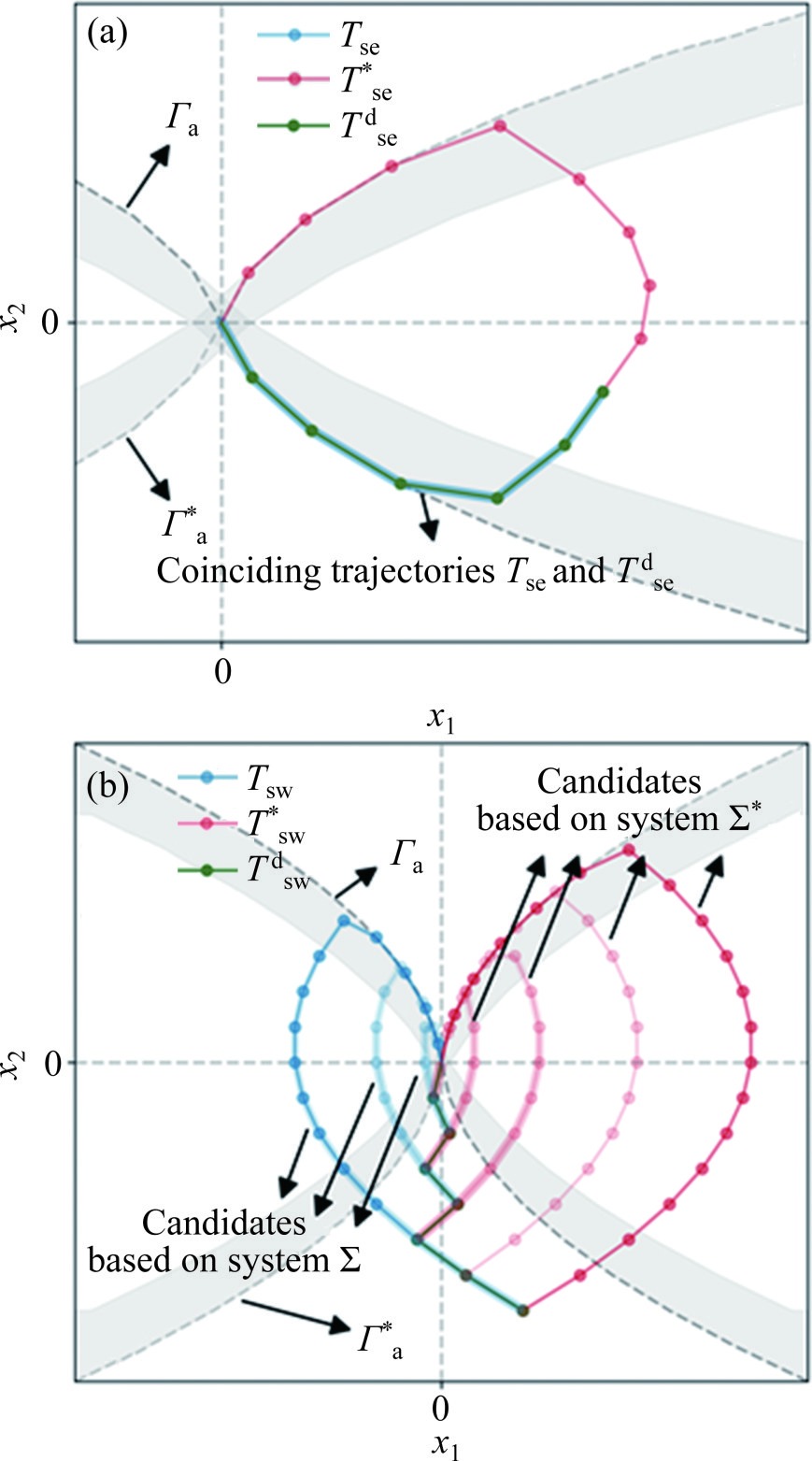
However, overshoots persist in signal tracking and differentiation when using the discrete tracking differentiator Fhan-TD [9], which reduces the anti-interference capability in the differential signal. This issue occurs in at least three scenarios: 1) when it approaches the steady state; 2) when the system step size is too large; and 3) when the input signal is heavily polluted by noise. Regarding the first case, SUN et al [20] found that the actual state trajectory does not always align with the discrete points on the minimum time state trajectory, causing the trajectory to cross the coordinate axes before reaching the steady state. XIE et al [21, 22] also pointed out that the trajectory is suboptimal, with larger step sizes leading to bigger overshoots and static tracking errors. Both SUN et al and XIE et al modified the control synthesis function based on two factors: the positional relationship between the state and the optimal trajectory points, and a time criterion comparing the sampling step to the time required for the state to return to the origin. Many researchers also focus on improving the control synthesis function, including ZHANG’s linearized control strategy proposed by ZHANG et al [23], a novel control algorithm based on the hyperbolic tangent function [24], and a control law based on the position relationship of the state and corresponding characteristic points on the boundary curves [25]. These methods are computationally simpler and generally easier to apply, with some already implemented in industrial applications [26, 27]. Notably,
Loading authentic research manuscript (Pages 1–5)...
HAN Kun, ZHANG Hao-bo (2025). Design of a novel discrete dual-switching tracking differentiator. Journal of Central South University. https://doi.org/10.1007/s11771-025-5992-5
Research & Educational Purpose Only:The translations, structured abstracts, analytical annotations, and data reports provided by SinoTechIntel are intended exclusively for academic research, internal corporate R&D, and educational benchmarking. They do not constitute formal engineering, chemical safety, legal, or professional advice.
Copyright & Intellectual Property Notice: Original copyright of the underlying source articles and experimental data remains with the respective authors, institutions, and original publishing journals. SinoTechIntel claims intellectual property only over its proprietary translations, analytical syntheses, and AEO structured enhancements in accordance with international fair use and academic citation principles.
Frequently Asked Questions
What is a tracking differentiator?
A tracking differentiator is a dynamic system that provides a smoothed signal and its derivative from a noisy input, widely used in control engineering for signal filtering and differential extraction.
What is the dual-switching strategy proposed in this paper?
The dual-switching strategy alternates between the base double-integral system and its dual system based on the quadrant of the system's state. This approach reduces overshoot and improves noise filtering performance compared to classic tracking differentiators.
How does the proposed dual-switching tracking differentiator reduce overshoot?
By switching between the base and dual systems according to the state's quadrant, the control law avoids trajectory crossing the coordinate axes, thereby reducing overshoot in both tracking and differential signals, even under external disturbances.
What were the experimental results on the PMSM platform?
In a permanent magnet synchronous motor (PMSM) speed feedback loop, the proposed tracking differentiator used as a filter reduced the standard deviation between reference and target speed from 5.63 r/min to 4.93 r/min at 378 r/min, compared to the moving average algorithm.
What are the advantages over the classic Fhan-TD?
The proposed dual-switching strategy notably reduces overshoot in tracking and differential signals while enhancing noise filtering performance, addressing limitations of the classic Fhan-TD under large step sizes, near steady-state, or noisy input conditions.
Related Technical Papers & Translations

Design and optimization of a high-efficiency distillation process for cellulosic fuel ethanol integrated with thermal coupling and molecular sieve adsorption
To address the challenges of high energy consumption and prominent costs in the traditional three-columns distillation process for cellulosic fuel ethanol, a distillation—molecular sieve coupling separation process is proposed. This process integrates a three-column (crude distillation column, first distillation column, second distillation column) system with a 3A molecular sieve adsorption deep dehydration unit. A thermal coupling network is constructed via differential pressure design (steam from medium/high-pressure columns as mutual heat sources, reboiler liquid waste heat for feed preheating), and molecular sieve adsorption conditions are optimized. The study first performs a thermodynamic consistency test on the ethanol—water system, determines optimal non-random two-liquid (NRTL) model binary interaction parameters via experimental data regression for Aspen Plus simulation. Aiming at minimum total annual cost (TAC), Aspen Plus is used to optimize process parameters (theoretical tray number, feed location, reflux ratio, side-draw position, etc.). Economic analysis shows this process reduces CO2 emission costs by 27.56%, TAC by 15.58% (to 5.123 × 10⁶ USD·a-1), and increases ethanol purity to >99.6%, providing an effective solution for green, efficient separation.

A cohesion loss model for determining residual strength of deep bedded sandstone
Rock residual strength, as an important input parameter, plays an indispensable role in proposing the reasonable and scientific scheme about stope design, underground tunnel excavation and stability evaluation of deep chambers. Therefore, previous residual strength models of rocks established were reviewed. And corresponding related problems were stated. Subsequently, starting from the effects of bedding and whole life-cycle evolution process, series of triaxial mechanical tests of deep bedded s

Federated model with contrastive learning and adaptive control variates for human activity recognition
Recent attention to privacy issues demands a communication-safe method for training human activity recognition (HAR) models on client activity data. Federated learning (FL) has become a compelling technique to facilitate model training between the server and clients while preserving data privacy. However, classical FL methods often assume independent and identically distributed (IID) data among clients. This assumption does not hold true in practical scenarios. Human activity in real-world scena