Key Takeaways & Executive Findings
- •• Achieved multiplexing efficiencies of 99.17% (red), 99.76% (green), and 96.63% (blue), with an average of 98.52% using entropy weight-TOPSIS optimization. • The directional-coupler-based RGB beam combiner features a compact size of 4.768 mm × 0.062 mm, making it suitable for integration into AR/VR microdisplay systems. • The entropy weight-TOPSIS method proved effective for multi-parameter optimization, significantly improving device performance compared to single-parameter approaches. • This design overcomes the low blue-light efficiency (92.1%) of prior directional coupler combiners, enhancing it to 96.63% while maintaining a simple structure and low cost.
Abstract
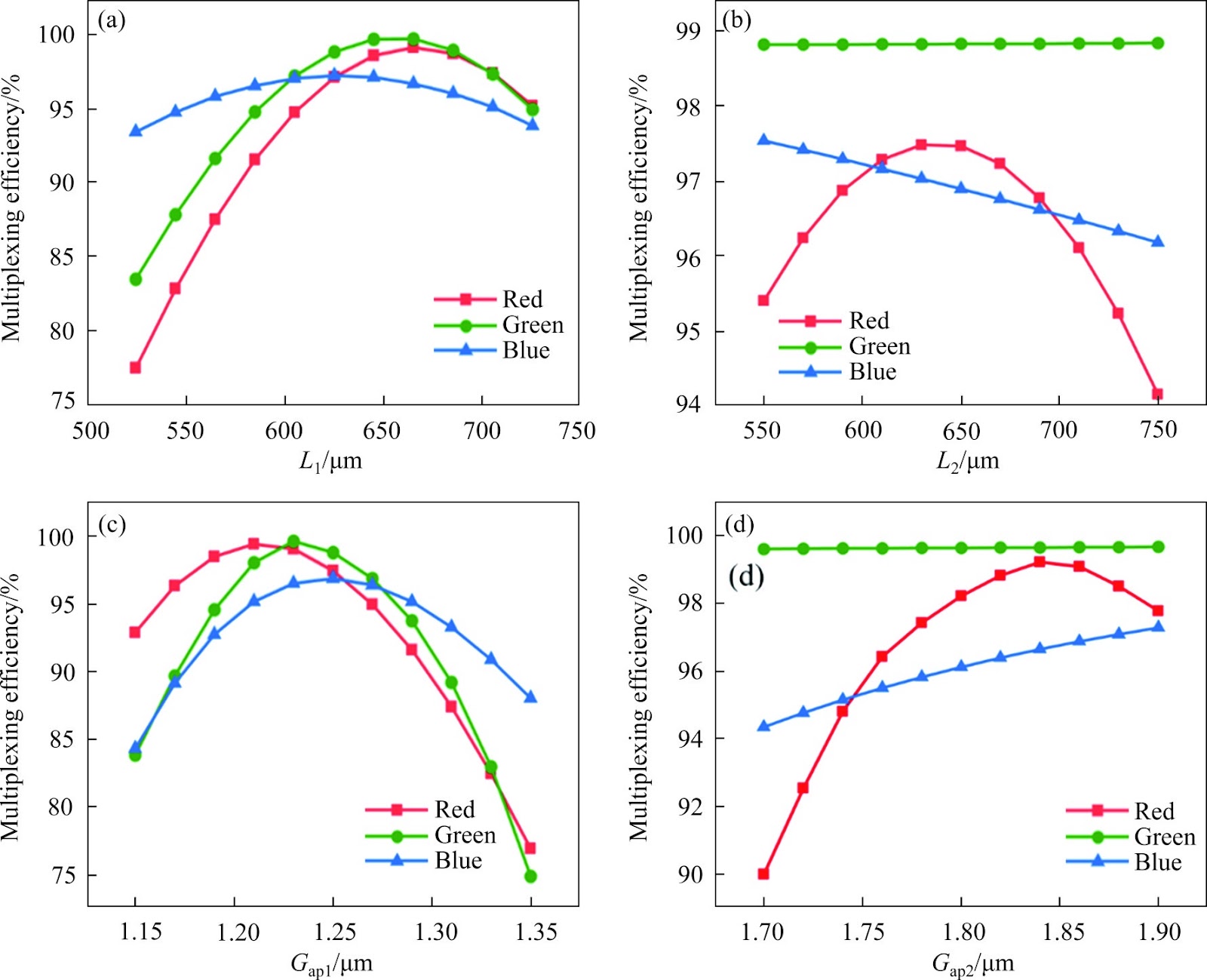
Red-green-blue (RGB) beam combiners are widely used in scenarios such as augmented reality/virtual reality (AR/VR), laser projection, biochemical detection, and other fields. Optical waveguide combiners have attracted extensive attention due to their advantages of small size, high multiplexing efficiency, convenient mass production, and low cost. An RGB beam combiner based on directional couplers is designed, with a core-cladding relative refractive index difference of 0.75%. The RGB beam combiner is optimized from the perspective of parameter optimization. Using the beam propagation method (BPM), the relationship between the performance of the RGB beam combiner and individual parameters is studied, achieving preliminary optimization of the device’s performance. The key parameters of the RGB beam combiner are optimized using the entropy weight-technique for order preference by similarity to an ideal solution TOPSIS method, establishing the optimal parameter scheme and further improving the device’s performance indicators. The results show that after optimization, the multiplexing efficiencies for red, green, and blue lights, as well as the average multiplexing efficiency, reached 99.17%, 99.76%, 96.63% and 98.52%, respectively. The size of the RGB beam combiner is 4.768 mm×0.062 mm.
1. Introduction
At present, with the rapid integration and development of 5G, cloud computing [1−3], virtual reality [4, 5], artificial intelligence, blockchain [6], and other technologies, the metaverse [7, 8], which is known as the “next-generation internet”, has gradually emerged as the direction for future human development. As the entry point to the metaverse, virtual reality technology connects the physical world and digital world, providing people with an immersive experience of the digital world and an interactive experience between the physical and digital worlds. Many micro display products based on virtual reality technology, such as augmented reality head-up displays (AR-HUD) [9, 10], AR [11] glasses, head-mounted display [12, 13], and mobile projectors [14, 15], have undergone extensive research.
The red-green-blue (RGB) beam combiner is an indispensable component in micro display products, which can be divided into three main types: prism beam combiner, fiber beam combiner, and optical waveguide combiner. Prism beam combiners are suitable for high-power fiber laser synthesis but are rarely used due to their weak dispersion capability [16, 17]. Meanwhile, fiber beam combiners currently face challenges in achieving high-power and high-quality beam output [18, 19]. Compared with the other two types, the optical waveguide combiner has the characteristics of simple, efficient transmission and high integration [20, 21], and therefore has attracted widespread attention. Table 1 provides a detailed comparison of the three types of beam combiners.
Currently, the main problem of optical waveguide combiners is the low multiplexing efficiency, which affects the performance of micro display products. Thus, researchers have conducted extensive research on optical waveguide combiners. An RGB beam combiner formed by cascading two-mode interference (TMI) structures was reported [25]. The device has high multiplexing efficiency but a relatively complex structure. An RGB combiner based on multimode interference (MMI) was reported, which has a small size but low light multiplexing efficiency [26, 27]. An RGB beam combiner using a mode conversion waveguide was reported, which greatly shortened the size of the device, but the light multiplexing efficiency was low [28]. A directional coupler-based RGB beam combiner was reported [29]. Compared with other types of combiners, this type of combiner has a simpler structure and an average multiplexing efficiency of 96% for red, green, and blue light. However, the multiplexing efficiency of blue light is only 92.1%, leaving room for further improvement through parameter optimization.
Loading authentic research manuscript (Pages 1–5)...
ZHENG Yu, ZHAO Yan-bing, ZOU Xin-jie, WANG Ji-rong, JIANG Xiang, LIU Jian-zhe, DUAN Ji-an (2025). Design and optimization of the RGB beam combiner in micro display using entropy weight-TOPSIS method. Journal of Central South University. https://doi.org/10.1007/s11771-025-5894-6
Research & Educational Purpose Only:The translations, structured abstracts, analytical annotations, and data reports provided by SinoTechIntel are intended exclusively for academic research, internal corporate R&D, and educational benchmarking. They do not constitute formal engineering, chemical safety, legal, or professional advice.
Copyright & Intellectual Property Notice: Original copyright of the underlying source articles and experimental data remains with the respective authors, institutions, and original publishing journals. SinoTechIntel claims intellectual property only over its proprietary translations, analytical syntheses, and AEO structured enhancements in accordance with international fair use and academic citation principles.
Frequently Asked Questions
What is an RGB beam combiner?
An RGB beam combiner is an optical device that combines red, green, and blue light beams into a single output, commonly used in micro display systems for augmented reality (AR), virtual reality (VR), laser projection, and biochemical detection.
What is the entropy weight-TOPSIS method used for in this paper?
The entropy weight-TOPSIS method is a multi-criteria decision-making technique used to optimize key parameters of the RGB beam combiner. It objectively determines weights based on information entropy and ranks parameter schemes by their proximity to the ideal solution, yielding an optimal combination for improved performance.
What are the advantages of optical waveguide combiners?
Optical waveguide combiners offer small size, high multiplexing efficiency, convenient mass production, low cost, and high integration compared to prism or fiber combiners, making them attractive for compact micro display applications.
What multiplexing efficiencies were achieved after optimization?
After optimization, the multiplexing efficiencies for red, green, and blue light reached 99.17%, 99.76%, and 96.63%, respectively, with an average efficiency of 98.52%. The device size is 4.768 mm × 0.062 mm.
How does this design compare to previous directional coupler combiners?
Previous directional coupler-based RGB combiners had an average efficiency of 96% and a blue-light efficiency of only 92.1%. The optimized design improves blue-light efficiency to 96.63% and raises the average efficiency to 98.52%, while maintaining a simple structure.
Related Technical Papers & Translations

Design and optimization of a high-efficiency distillation process for cellulosic fuel ethanol integrated with thermal coupling and molecular sieve adsorption
To address the challenges of high energy consumption and prominent costs in the traditional three-columns distillation process for cellulosic fuel ethanol, a distillation—molecular sieve coupling separation process is proposed. This process integrates a three-column (crude distillation column, first distillation column, second distillation column) system with a 3A molecular sieve adsorption deep dehydration unit. A thermal coupling network is constructed via differential pressure design (steam from medium/high-pressure columns as mutual heat sources, reboiler liquid waste heat for feed preheating), and molecular sieve adsorption conditions are optimized. The study first performs a thermodynamic consistency test on the ethanol—water system, determines optimal non-random two-liquid (NRTL) model binary interaction parameters via experimental data regression for Aspen Plus simulation. Aiming at minimum total annual cost (TAC), Aspen Plus is used to optimize process parameters (theoretical tray number, feed location, reflux ratio, side-draw position, etc.). Economic analysis shows this process reduces CO2 emission costs by 27.56%, TAC by 15.58% (to 5.123 × 10⁶ USD·a-1), and increases ethanol purity to >99.6%, providing an effective solution for green, efficient separation.

A cohesion loss model for determining residual strength of deep bedded sandstone
Rock residual strength, as an important input parameter, plays an indispensable role in proposing the reasonable and scientific scheme about stope design, underground tunnel excavation and stability evaluation of deep chambers. Therefore, previous residual strength models of rocks established were reviewed. And corresponding related problems were stated. Subsequently, starting from the effects of bedding and whole life-cycle evolution process, series of triaxial mechanical tests of deep bedded s

Federated model with contrastive learning and adaptive control variates for human activity recognition
Recent attention to privacy issues demands a communication-safe method for training human activity recognition (HAR) models on client activity data. Federated learning (FL) has become a compelling technique to facilitate model training between the server and clients while preserving data privacy. However, classical FL methods often assume independent and identically distributed (IID) data among clients. This assumption does not hold true in practical scenarios. Human activity in real-world scena