Key Takeaways & Executive Findings
- •• Dynamic segregation of cemented paste backfill (CPB) in pipelines was quantified using electrical resistance tomography (ERT), enabling real-time non-invasive monitoring. • CPB conductivity increases with transport time but decreases with higher solid mass content, with solid content exerting a greater influence on segregation. • At low solid content, solid particles migrate to the pipe bottom; this migratory behavior diminishes as solid content increases. • Higher solid mass content amplifies the effect of conveying time on segregation, highlighting the need to balance these factors in pipeline design to minimize wear and blockage risks.
Abstract
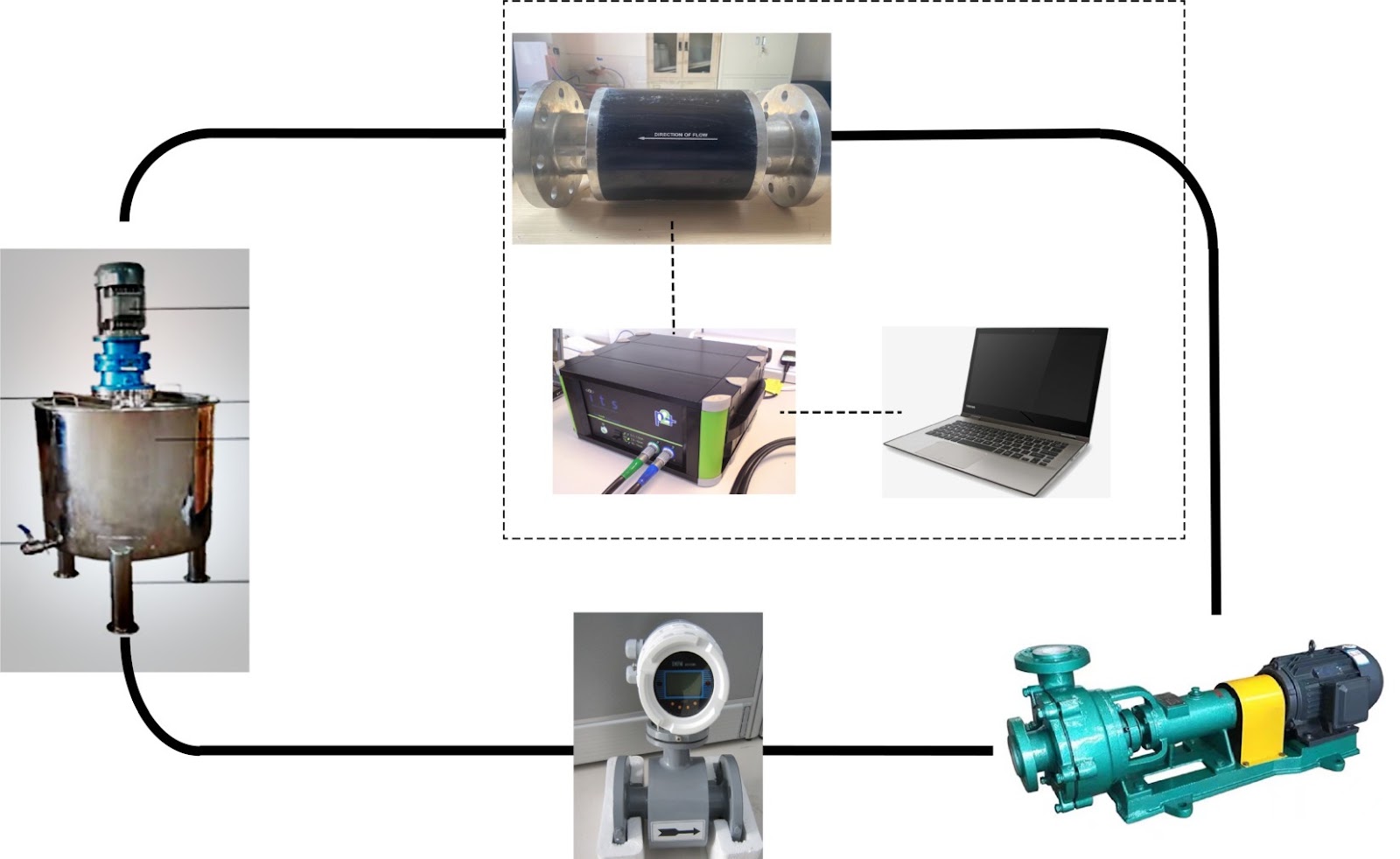
Cement paste backfill (CPB) technology is a key method for mine waste treatment, and pipeline transport is critical for safe and efficient waste transfer. Variations in raw material properties can cause slurry segregation, increase pipeline wear and resistance, raise the risk of blockages or bursts, and disrupt operations. To study CPB slurry segregation during transport, CPB was prepared using cement as the cementitious material and unclassified tailings as inert materials. A small annular-tube device using an electrical resistance tomography system was developed to analyze its flow characteristics, and quantitative segregation assessment methods were developed. The results indicated that CPB conductivity increases with transport time but decreases with higher solid mass content, with the latter having a greater impact. At a low solid content, solid particles migrated toward the bottom of the pipe as the flow time increased, and the migratory behavior of the particles diminished as the solid content increased. At a flow rate of 1.25 m/s, the heterogeneity index for CPB with 58wt% solid content increased by 1.24 in 20 min, whereas that for CPB with 62wt% solid content increased by 2.17. Higher solid mass content amplifies the effect of conveying time on segregation, emphasizing the need to balance these factors for minimizing segregation. These insights can guide the optimization of mine pipeline transport systems.
1. Introduction
The development of mineral resources has caused significant damage to the ecological environment through the destruction of vegetation, formation of waste-rock piles, accumulation of tailings, and relocation of river channels [1–4]. Meanwhile, geological disasters, such as subsidence, landslides, mudslides, and avalanches, induced by the numerous empty areas generated by ore mining pose a serious threat to human safety [5–9]. The cut and fill mining method protects the environment and fully utilizes mine waste materials. It mitigates the hazards caused by underground mining, such as surface subsidence. This achieves the purpose of controlling the ground pressure activities. Additionally, it reduces tailings discharge, avoids the dangers associated with tailings accumulation, and achieves a win-win outcome of safe underground mining and environmental governance [10–13]. Therefore, cut and fill mining is increasingly being used.
The backfilling mining method prepares cement paste backfill (CPB) through a backfilling system and transports the CPB to fill mine voids. The backfilling system consists of four key processes: full tailings concentration, aggregate mixing, pipeline transportation, and filling of underground mine voids [10–11,14]. The low-concentration tailings slurry from the mineral processing plant is thickened and mixed with binding materials (e.g., cement) to form CPB. After mixing and preparation, CPB is transported by gravity or pumping pipelines to underground mining areas for backfilling. CPB pipeline transportation plays a crucial role in mine backfilling [15–16]. CPB is a highly concentrated suspension of unclassified tailings, cement, and water that can be regarded as a non-Newtonian fluid with shear-thinning properties [17–19]. During pipeline transportation, CPB is subjected to shear, resulting in low viscosity; the floc structure composed of cement and fine particles cannot carry coarse particles, resulting in the precipitation of coarse particles (i.e., segregation), which reduces the homogeneity of the CPB [20]. There are two types of segregation in a pipeline: static and dynamic. Static segregation mainly occurs in the pump stopping stage, whereas dynamic segregation occurs in the transportation stage [21–22]. The dynamic segregation of CPB leads to pipe wear and increased transportation resistance, preventing the backfilling system from operating normally. This results in significant economic losses. Therefore, it is necessary to study the dynamic segregation of CPB in pipelines.
In previous studies, the segregation of cementitious materials was mainly assessed using the visual stability index (VSI) [23], electronic image analysis [24], the column method [25], the hydrostatic pressure tests [26], separation probes [27], the ultrasonic method [28], the visible slurry method [29], and the radioactive element labeling method [30]. However, each of these methods has limitations. VSI is not capable of quantitatively de
Loading authentic research manuscript (Pages 1–5)...
Yingjie Chang, Aixiang Wu, Zhu'en Ruan, Shaoyong Wang, Jiandong Wang, Shulong Liu, Shuangcheng Du (2025). Characterizing dynamic segregation behavior in cemented paste during pipeline transport through electrical resistance tomography. Journal of Mineral Metallurgy and Materials Science. https://doi.org/10.1007/s12613-025-3283-7
Research & Educational Purpose Only:The translations, structured abstracts, analytical annotations, and data reports provided by SinoTechIntel are intended exclusively for academic research, internal corporate R&D, and educational benchmarking. They do not constitute formal engineering, chemical safety, legal, or professional advice.
Copyright & Intellectual Property Notice: Original copyright of the underlying source articles and experimental data remains with the respective authors, institutions, and original publishing journals. SinoTechIntel claims intellectual property only over its proprietary translations, analytical syntheses, and AEO structured enhancements in accordance with international fair use and academic citation principles.
Frequently Asked Questions
What is dynamic segregation in cemented paste backfill?
Dynamic segregation occurs during pipeline transport of cemented paste backfill (CPB), where coarse particles precipitate due to shear and reduced viscosity, leading to heterogeneity. It causes pipe wear, increased resistance, and risks of blockages.
How does electrical resistance tomography (ERT) characterize CPB segregation?
ERT is a non-invasive technique that measures conductivity changes in the slurry. In this study, a small annular-tube device with an ERT system was developed to quantify dynamic segregation, showing that conductivity increases with transport time but decreases with higher solid mass content.
What effect does solid mass content have on segregation?
Higher solid mass content amplifies the effect of conveying time on segregation. At 58wt% solid content, the heterogeneity index increased by 1.24 in 20 minutes, while at 62wt% it increased by 2.17, indicating that more solids lead to greater segregation over time.
What are the practical implications for mine pipeline transport?
The findings help optimize pipeline transport by balancing solid content and conveying time to minimize segregation, thereby reducing pipe wear, energy consumption, and blockage risks in backfill systems.
What methods were previously used to assess segregation, and why is ERT better?
Traditional methods include visual stability index, electronic image analysis, ultrasonic, and radioactive labeling, but they have limitations such as lack of quantitative capability. ERT offers real-time, non-invasive, quantitative assessment of dynamic segregation during transport.
Related Technical Papers & Translations

Design and optimization of a high-efficiency distillation process for cellulosic fuel ethanol integrated with thermal coupling and molecular sieve adsorption
To address the challenges of high energy consumption and prominent costs in the traditional three-columns distillation process for cellulosic fuel ethanol, a distillation—molecular sieve coupling separation process is proposed. This process integrates a three-column (crude distillation column, first distillation column, second distillation column) system with a 3A molecular sieve adsorption deep dehydration unit. A thermal coupling network is constructed via differential pressure design (steam from medium/high-pressure columns as mutual heat sources, reboiler liquid waste heat for feed preheating), and molecular sieve adsorption conditions are optimized. The study first performs a thermodynamic consistency test on the ethanol—water system, determines optimal non-random two-liquid (NRTL) model binary interaction parameters via experimental data regression for Aspen Plus simulation. Aiming at minimum total annual cost (TAC), Aspen Plus is used to optimize process parameters (theoretical tray number, feed location, reflux ratio, side-draw position, etc.). Economic analysis shows this process reduces CO2 emission costs by 27.56%, TAC by 15.58% (to 5.123 × 10⁶ USD·a-1), and increases ethanol purity to >99.6%, providing an effective solution for green, efficient separation.

A cohesion loss model for determining residual strength of deep bedded sandstone
Rock residual strength, as an important input parameter, plays an indispensable role in proposing the reasonable and scientific scheme about stope design, underground tunnel excavation and stability evaluation of deep chambers. Therefore, previous residual strength models of rocks established were reviewed. And corresponding related problems were stated. Subsequently, starting from the effects of bedding and whole life-cycle evolution process, series of triaxial mechanical tests of deep bedded s

Federated model with contrastive learning and adaptive control variates for human activity recognition
Recent attention to privacy issues demands a communication-safe method for training human activity recognition (HAR) models on client activity data. Federated learning (FL) has become a compelling technique to facilitate model training between the server and clients while preserving data privacy. However, classical FL methods often assume independent and identically distributed (IID) data among clients. This assumption does not hold true in practical scenarios. Human activity in real-world scena