Key Takeaways & Executive Findings
- •• A full-sectional microstructure characterization method was developed to investigate coarse slag rim formation during hypo-peritectic steel continuous casting. • Slag rim formation is driven by liquid slag solidification during mold oscillation, with average heating rates of ~100 K·s−1 and cooling rates of ~400 K·s−1 producing lamellar microstructures. • Two distinct formation pathways for highly crystalline mold powders were identified: powder A (higher breaking temperature/viscosity, narrower solidification range) forms coarse, thick rims; powder B (lower values, wider range) forms thin rims. • The findings provide critical insights into controlling longitudinal surface cracks in hypo-peritectic steel by understanding and managing slag rim formation.
Abstract
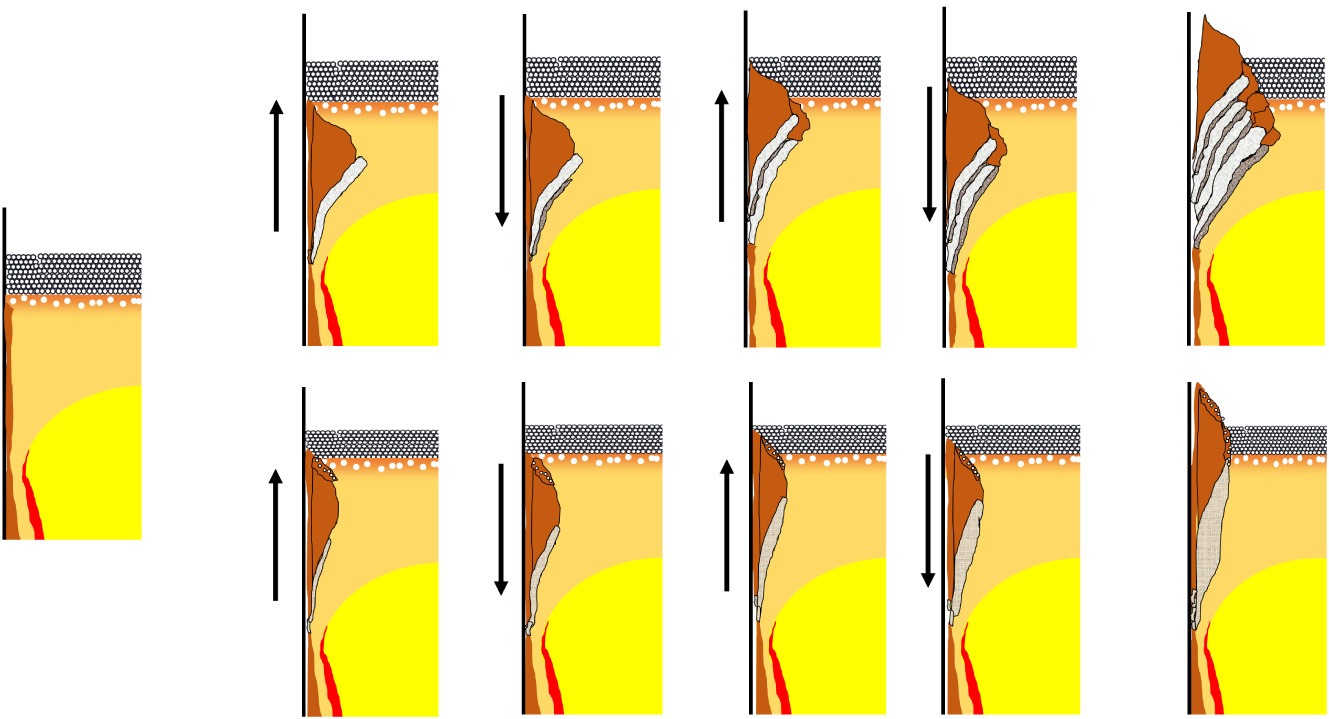
A full-sectional microstructure characterization method was developed to investigate the formation of coarse slag rims during the continuous casting of hypo-peritectic steel. The cross-sectional microstructural analysis of typical slag rims for two highly crystalline powders revealed that their formation was primarily driven by the solidification of the liquid slag. Distinct differences were observed in the microstructures of slag rims from the two powders. Powder A (characterized by a higher breaking temperature and viscosity) displayed alternating lamellar microstructures of coarse and fine phases, with the coarse phases composed of akermanite–gehlenite transition phases. In contrast, powder B (with a lower breaking temperature and viscosity) predominantly comprised regular akermanite–gehlenite crystals interspersed with a certain amount of glassy phases. Numerical simulations of a three-phase fluid flow coupled with heat transfer indicate that slag rim formation correlates with mold oscillation. Solidification of the liquid slag at the slag rim front predominantly occurs during the negative stroke of the mold oscillation. The average heating rate during the ascending stage of the mold reaches approximately 100 K·s−1, whereas the average cooling rate during the descending stage attains 400 K·s−1. This temperature variation leads to the formation of lamellar microstructures, whereas the ascending stage promotes the formation of coarse structures and thicker slag rims. Based on the powder properties, two distinct formation pathways exist for highly crystalline mold powders. For the powders with a higher breaking temperature, higher viscosity, and narrower solidification range (powder A), coarse microstructures and thicker slag rims were preferentially formed. For powders with lower breaking temperature and viscosity and wider solidification ranges (powder B), the liquid slag resisted rapid solidification, and the extended mushy zone allowed the partial liquid slag to persist at the slag rim front, promoting the formation of a thin slag rim. This study enhances the understanding of slag rim formation in highly crystalline mold powders and provides critical insights into the control of longitudinal surface cracks in hypo-peritectic steel.
1. Introduction
Longitudinal surface cracks, being a long-standing primary issue in the continuous casting process of hypo-peritectic steel [1–4], severely limits its production efficiency and energy saving capability. Even after extensive research of casting parameters for gaining deeper insights about the formation of these cracks and the subsequent measures to prevent them [5–9], these cracks remain inevitable. The occurrence of these cracks is closely linked to the irregularities in the continuous casting process [2,10], the uneven liquid slag infiltration between the shell and mold wall in particular [11]. This phenomenon is significantly responsible for the formation of coarse slag rims [12–14], especially when powders with high crystallinity are used in hypo-peritectic steel production. Investigating the formation process of slag rims is critical for gaining deeper insights on the coarse slag rim mechanisms and for suppressing longitudinal surface cracks.
The formation of coarse slag rims is frequently associated with the physical properties of the mold powder, such as viscosity [15] and breaking temperature [16]. Typically, higher viscosity corresponds to coarser slag rims, and powders with higher breaking temperatures tend to precipitate high-melting-point phases, which may eventually lead to formation of coarse slag rims. In addition to examining the physical properties that influence the slag rim size, the formation process of slag rims at different scales has been explored. Perrot et al. [17] proposed the widely accepted “painting” mechanism, where the slag rim grows vertically during mold oscillation via continuous bonding of liquid slag to slag rims formed earlier. However, this mechanism does not comprehensively explain the formation of slag rims along the thickness direction, which is critically responsible for the surface defects in the strand. In this regard, researchers have attributed slag rim growth to the sintered phase. Kromhout et al. [15] demonstrated that sintering reactions between Na2O and raw materials may promote slag rim formation, using scanning electron microscopy (SEM) analysis at the micrometer scale. Di et al. [18] found that the sintered phases constituted ~70% of the slag rims during the continuous casting of 430 stainless steel. Ren et al. [19] further identified the precipitation of the high-melting-point phase as the core of the coarse rims. In addition, variations in the properties of the mold powder significantly affect the growth of the rim. Marshall et al. [20] established the relationship between the coarse slag rims and the variations in the powder properties owing to the steel–slag reactions during the continuous casting of high-aluminum steel. Yan et al. [21] reached similar conclusions.
Loading authentic research manuscript (Pages 1–5)...
Zhiqiang Peng, Zibing Hou, Shuxian Xu, Ping Tang, Guanghua Wen (2025). Characterization of the formation of slag rims of mold powder during hypo-peritectic steel continuous casting based on full-sectional microstructures. Journal of Mineral Metallurgy and Materials Science. https://doi.org/10.1007/s12613-025-3196-5
Research & Educational Purpose Only:The translations, structured abstracts, analytical annotations, and data reports provided by SinoTechIntel are intended exclusively for academic research, internal corporate R&D, and educational benchmarking. They do not constitute formal engineering, chemical safety, legal, or professional advice.
Copyright & Intellectual Property Notice: Original copyright of the underlying source articles and experimental data remains with the respective authors, institutions, and original publishing journals. SinoTechIntel claims intellectual property only over its proprietary translations, analytical syntheses, and AEO structured enhancements in accordance with international fair use and academic citation principles.
Frequently Asked Questions
What is the main objective of this study?
To characterize the formation of slag rims of mold powder during hypo-peritectic steel continuous casting using full-sectional microstructure analysis, providing insights into control of longitudinal surface cracks.
What methods were used in the research?
The study employed full-sectional microstructure characterization, numerical simulations of three-phase fluid flow coupled with heat transfer, and analysis of two highly crystalline mold powders with different physical properties.
What are the key findings regarding slag rim formation?
Slag rim formation is primarily driven by liquid slag solidification during mold oscillation. The average heating rate during the ascending stage is approximately 100 K·s−1, while the cooling rate during the descending stage reaches 400 K·s−1, leading to lamellar microstructures. Two distinct formation pathways exist depending on powder properties.
How do powder properties influence slag rim formation?
Powder with higher breaking temperature, higher viscosity, and narrower solidification range (Powder A) forms coarse microstructures and thicker slag rims. In contrast, powder with lower breaking temperature and viscosity and wider solidification range (Powder B) promotes the formation of thin slag rims.
What is the engineering significance of this study?
The findings enhance the understanding of slag rim formation in highly crystalline mold powders and provide critical insights for controlling longitudinal surface cracks in hypo-peritectic steel continuous casting.
Related Technical Papers & Translations

Design and optimization of a high-efficiency distillation process for cellulosic fuel ethanol integrated with thermal coupling and molecular sieve adsorption
To address the challenges of high energy consumption and prominent costs in the traditional three-columns distillation process for cellulosic fuel ethanol, a distillation—molecular sieve coupling separation process is proposed. This process integrates a three-column (crude distillation column, first distillation column, second distillation column) system with a 3A molecular sieve adsorption deep dehydration unit. A thermal coupling network is constructed via differential pressure design (steam from medium/high-pressure columns as mutual heat sources, reboiler liquid waste heat for feed preheating), and molecular sieve adsorption conditions are optimized. The study first performs a thermodynamic consistency test on the ethanol—water system, determines optimal non-random two-liquid (NRTL) model binary interaction parameters via experimental data regression for Aspen Plus simulation. Aiming at minimum total annual cost (TAC), Aspen Plus is used to optimize process parameters (theoretical tray number, feed location, reflux ratio, side-draw position, etc.). Economic analysis shows this process reduces CO2 emission costs by 27.56%, TAC by 15.58% (to 5.123 × 10⁶ USD·a-1), and increases ethanol purity to >99.6%, providing an effective solution for green, efficient separation.

A cohesion loss model for determining residual strength of deep bedded sandstone
Rock residual strength, as an important input parameter, plays an indispensable role in proposing the reasonable and scientific scheme about stope design, underground tunnel excavation and stability evaluation of deep chambers. Therefore, previous residual strength models of rocks established were reviewed. And corresponding related problems were stated. Subsequently, starting from the effects of bedding and whole life-cycle evolution process, series of triaxial mechanical tests of deep bedded s

Federated model with contrastive learning and adaptive control variates for human activity recognition
Recent attention to privacy issues demands a communication-safe method for training human activity recognition (HAR) models on client activity data. Federated learning (FL) has become a compelling technique to facilitate model training between the server and clients while preserving data privacy. However, classical FL methods often assume independent and identically distributed (IID) data among clients. This assumption does not hold true in practical scenarios. Human activity in real-world scena