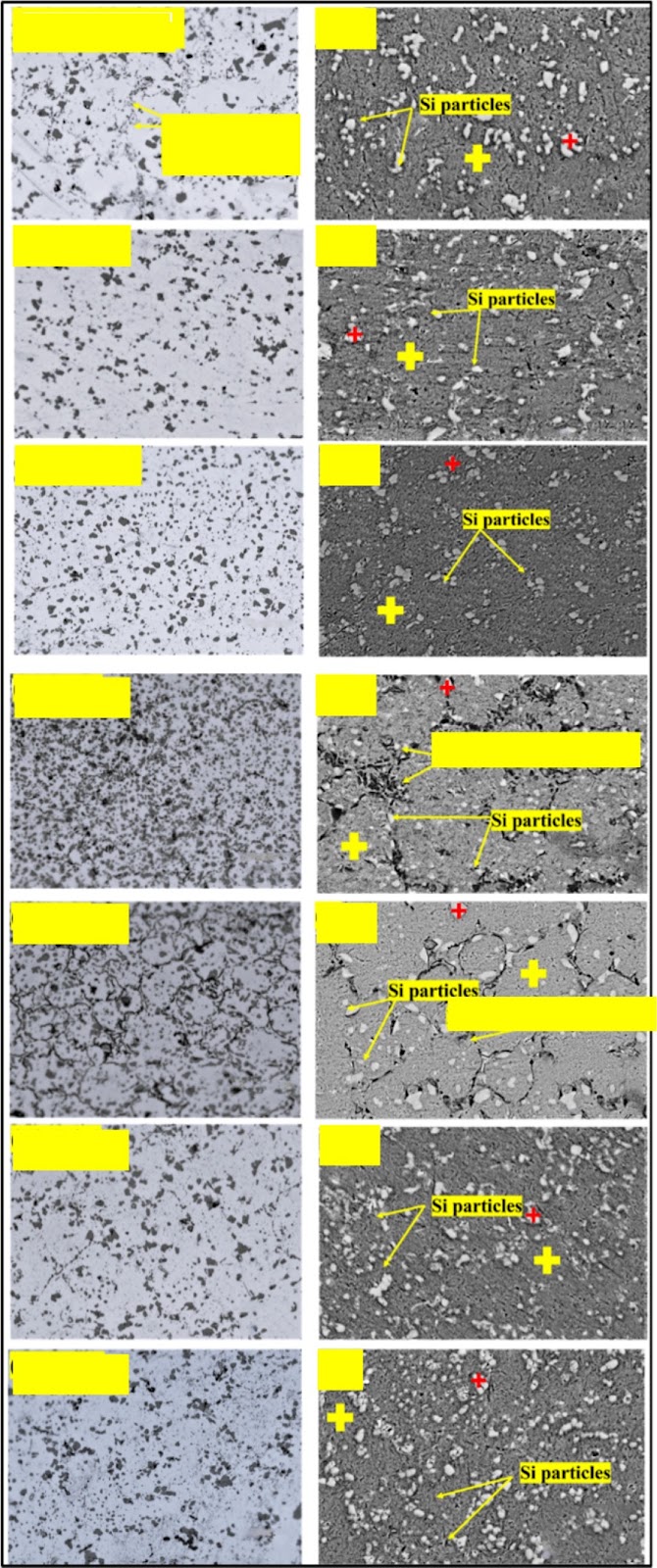
Key Takeaways & Executive Findings
- •• Direct aging at 200°C for 360 min (DA-2) offers the best overall balance of mechanical strength (~203 MPa), ductility (~4.4%), and corrosion resistance for direct powder forged Al–10Si–0.3Mg. • T6 treatment (solutionizing at 500°C for 180 min + aging at 200°C for 360 min) achieves the highest tensile strength (207.15 MPa) and elongation (5.02%), but with slightly inferior electrochemical performance compared to DA-2. • Solution treatment alone leads to partial Si dissolution, increased porosity, and the lowest corrosion resistance, demonstrating the necessity of subsequent aging. • DPF combined with optimized heat treatment enhances Si particle distribution uniformity and reduces interparticle boundaries, critical for aerospace and automotive applications.
Abstract
This study investigated the effects of direct aging (DA), solution treatment (ST), and ST followed by DA (T6) on the microstructural, mechanical, and corrosion properties of direct powder forged Al–10Si–0.3Mg alloy specimens. Microstructural analyses conducted using optical microscopy, scanning electron microscopy, and electron backscatter diffraction revealed that among DA specimens, direct aging at 200°C (DA-2) exhibited significantly enhanced silicon (Si) particle distribution uniformity and minimal interparticle boundaries owing to increased diffusion bonding; ST specimens exhibited partial Si dissolution, higher porosity, and retained the interparticle boundaries; and T6 specimens exhibited improved microstructural uniformity and enhanced Si precipitation. Furthermore, mechanical property evaluations indicated that T6 treatment comprising ST at 500°C for 180 min followed by DA at 200°C for 360 min resulted in the highest tensile strength (207.15 MPa) and elongation (5.02%), followed closely by DA at 200°C for 360 min (203.13 MPa and 4.39%). These improvements were attributed to the lower residual stress, higher diffusion distances, and well-dispersed Si particles induced by DA-2 treatment. Corrosion analyses conducted using cyclic polarization and impedance spectroscopy indicated varied electrochemical responses, with DA-2 resulting in the lowest corrosion current and highest impedance, and ST resulting in the lowest corrosion resistance. Overall, DA at 200°C for 360 min was the most effective heat treatment, offering the optimal balance between mechanical and corrosion-resistance properties.
1. Introduction
Aluminum alloys are essential in the aerospace, automotive, and marine industries owing to their light weight, excellent strength-to-weight ratio, corrosion resistance, and thermal stability. Among these, Al–Si–Mg alloys—especially AlSi10Mg—have gained prominence owing to their ability to be easily age-hardened and cast as well as their excellent performance [1–2].
The AlSi10Mg alloy is widely used in traditional manufacturing processes, such as casting and high-pressure diecasting, as well as more advanced processes, such as selective laser melting (SLM) and direct powder forging (DPF) [3–8]. Casting is cost-effective and facilitates large-scale production, but its use of slower cooling rates (~102°C·s−1) can produce coarse Si particles and common defects, such as porosity and inclusions, that reduce mechanical performance [9–11]. These drawbacks have been addressed by newer manufacturing technologies, such as SLM, that provide rapid cooling rates (up to 106–108°C·s−1), enabling the formation of fine cellular dendritic Si networks on the Al matrix. However, parts fabricated using SLM often exhibit issues such as high residual stress, microstructural anisotropy, porosity, and size limitations [12–13].
Researchers such as Dwivedi et al. [7] have attempted to address these issues through the application of DPF to produce Al–10Si–0.3Mg components. The DPF technique combines the benefits of powder metallurgy and forging to enable near-full densification as well as improved distribution of Si particles and stronger bonds between grains than either method in isolation. As a result, DPF is especially valuable for producing parts at scale for critical sectors such as transportation and aerospace. However, forging can introduce residual stresses and microstructural inconsistencies that affect the strength and long-term durability of a material, highlighting the value of subsequent heat treatment. Kuang et al. [14] demonstrated that thermal exposure significantly influences the microstructure and mechanical properties of Al alloys. Previous studies have shown that thermal treatment significantly influences solute redistribution and phase transformation kinetics in metallic systems [15–16], thereby emphasizing the importance of optimized thermal processing.
Loading authentic research manuscript (Pages 1–5)...
Akanksha Dwivedi, K.E.R.V. Prasad, Debdipta Banik, Saikat Mandal, A. Durga Prasad, and Srinu Gangolu (2025). Characterization of heat treatment-driven microstructural evolution, mechanical properties and electrochemical behavior of direct powder forged Al–10Si–0.3Mg alloy. Journal of Mineral Metallurgy and Materials Science. https://doi.org/10.1007/s12613-025-3221-8
Research & Educational Purpose Only:The translations, structured abstracts, analytical annotations, and data reports provided by SinoTechIntel are intended exclusively for academic research, internal corporate R&D, and educational benchmarking. They do not constitute formal engineering, chemical safety, legal, or professional advice.
Copyright & Intellectual Property Notice: Original copyright of the underlying source articles and experimental data remains with the respective authors, institutions, and original publishing journals. SinoTechIntel claims intellectual property only over its proprietary translations, analytical syntheses, and AEO structured enhancements in accordance with international fair use and academic citation principles.
Frequently Asked Questions
What heat treatment gives the best overall properties for direct powder forged Al–10Si–0.3Mg alloy?
Direct aging at 200°C for 360 minutes (DA-2) provides the optimal balance of mechanical strength (~203 MPa tensile strength) and corrosion resistance, as it yields uniform Si particle distribution and low residual stress.
How does T6 treatment compare with direct aging?
T6 treatment (solutionizing at 500°C for 180 min + aging at 200°C for 360 min) achieves the highest tensile strength (207.15 MPa) and elongation (5.02%), but DA-2 shows superior corrosion resistance with lower corrosion current and higher impedance.
Why does solution treatment alone reduce corrosion resistance?
Solution treatment (ST) causes partial Si dissolution, increased porosity, and retained interparticle boundaries, which weaken the passive film and lead to the lowest corrosion resistance among the studied conditions.
What role does direct powder forging (DPF) play in this study?
DPF provides near-full densification and improved Si particle distribution compared to conventional casting or SLM, but it introduces residual stresses; subsequent heat treatments are needed to optimize microstructure and performance.
What are the key microstructural features after DA-2 treatment?
DA-2 leads to significantly enhanced silicon particle distribution uniformity, minimal interparticle boundaries due to increased diffusion bonding, and well-dispersed Si particles, which collectively improve mechanical and corrosion properties.
Related Technical Papers & Translations

Design and optimization of a high-efficiency distillation process for cellulosic fuel ethanol integrated with thermal coupling and molecular sieve adsorption
To address the challenges of high energy consumption and prominent costs in the traditional three-columns distillation process for cellulosic fuel ethanol, a distillation—molecular sieve coupling separation process is proposed. This process integrates a three-column (crude distillation column, first distillation column, second distillation column) system with a 3A molecular sieve adsorption deep dehydration unit. A thermal coupling network is constructed via differential pressure design (steam from medium/high-pressure columns as mutual heat sources, reboiler liquid waste heat for feed preheating), and molecular sieve adsorption conditions are optimized. The study first performs a thermodynamic consistency test on the ethanol—water system, determines optimal non-random two-liquid (NRTL) model binary interaction parameters via experimental data regression for Aspen Plus simulation. Aiming at minimum total annual cost (TAC), Aspen Plus is used to optimize process parameters (theoretical tray number, feed location, reflux ratio, side-draw position, etc.). Economic analysis shows this process reduces CO2 emission costs by 27.56%, TAC by 15.58% (to 5.123 × 10⁶ USD·a-1), and increases ethanol purity to >99.6%, providing an effective solution for green, efficient separation.

A cohesion loss model for determining residual strength of deep bedded sandstone
Rock residual strength, as an important input parameter, plays an indispensable role in proposing the reasonable and scientific scheme about stope design, underground tunnel excavation and stability evaluation of deep chambers. Therefore, previous residual strength models of rocks established were reviewed. And corresponding related problems were stated. Subsequently, starting from the effects of bedding and whole life-cycle evolution process, series of triaxial mechanical tests of deep bedded s

Federated model with contrastive learning and adaptive control variates for human activity recognition
Recent attention to privacy issues demands a communication-safe method for training human activity recognition (HAR) models on client activity data. Federated learning (FL) has become a compelling technique to facilitate model training between the server and clients while preserving data privacy. However, classical FL methods often assume independent and identically distributed (IID) data among clients. This assumption does not hold true in practical scenarios. Human activity in real-world scena